
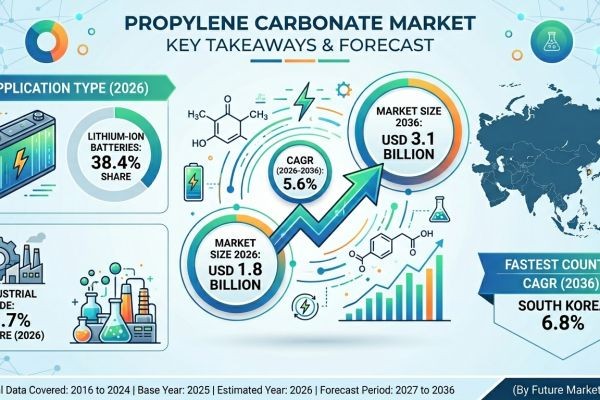
The global propylene carbonate market is projected to witness strong expansion over the next decade, supported by skyrocketing demand for high-performance electrolyte solvents and rapid industrialization. The market is expected to grow steadily, reaching approximately USD 3.1 billion by 2036, registering a CAGR of 5.6%, according to the latest analysis by Future Market Insights (FMI).
Market growth is being shaped by increasing application in lithium-ion battery production, growing consumer demand for electronics, and rapid adoption of advanced chemical processing technologies. Propylene carbonate has evolved from a broad industrial solvent into an essential component for energy storage systems and specialized electronics manufacturing. While traditional industrial grades continue to command a large market footprint, manufacturers are increasingly prioritizing electronic-grade formulations to meet ultra-high purity requirements and improve electrochemical performance outcomes.
Global Propylene Carbonate Market Snapshot (2026–2036)
Market value outlook in 2026: USD 1.8 billion
Market forecast value toward 2036: USD 3.1 billion
Forecast CAGR (2026–2036): 5.6%
Dominant application category: Industrial grade solvent uses
Fastest-growing segment: Lithium-ion battery application (~38.4% share in 2026)
Key growth countries: South Korea, China, Japan, USA, Germany
Primary demand channel: Battery and electronics manufacturing services
Momentum in the Market
Beginning from steady industrial adoption levels, the global propylene carbonate market demonstrates accelerated growth throughout the forecast period as battery-linked chemical demand becomes prominent across multiple countries. Between 2026 and 2036, expanding automobile electrification and rising demand for low-moisture chemical inputs are expected to significantly boost demand for integrated specialty solutions.
Increasing urbanization and higher reliance on electronic devices are encouraging chemical processors and battery makers to prioritize quality-controlled supply chains. From 2036 onward, innovation in high-performance purification methods and integration with next-generation energy storage applications is expected to further strengthen market expansion. Highly stable solvents capable of adapting to diverse thermal environments and intense electrochemical processing scenarios are emerging as key differentiators in new chemical supply channels.
The Reasons Behind the Market’s Growth
Demand for propylene carbonate is rising due to multiple structural and technological factors reshaping the global chemical and energy ecosystems.
Expansion of Battery Manufacturing Capabilities
Governments and private sectors worldwide are accelerating lithium-ion battery production programs. Propylene carbonate serves as a critical electrolyte solvent, driving spending across the energy storage sector to meet electric vehicle and grid needs.
Growth of Electronics and Semiconductor Production
Rapid expansion of high-tech manufacturing hubs requires ultra-high purity and low-moisture chemical inputs. This boosts the integration of electronic-grade solvents within electronics manufacturing services.
Focus on Electrochemical Stability and Performance
Industrial facilities are prioritizing chemicals that provide superior thermal properties and reliable performance under volatile processing conditions, ensuring higher product safety and efficiency.
Top Segment Application Type
Lithium-ion Batteries Lead Market Demand
Lithium-ion batteries account for a significant portion of propylene carbonate installations, holding a projected 38.4% share of the application segment in 2026. This is heavily supported by rising EV battery infrastructure globally.
Grade Type Analysis
Industrial grade: ~61.7% market share in 2026, reflecting major volume use where cost-effective solvent performance with standard purity is required.
Electronic grade: ~28.9% market share, growing rapidly due to strict low-moisture specifications in semiconductor fabrication.
Pharmaceutical grade: Serving specialized medical and topical chemical formulations requiring strict regulatory compliance.
Regional Development: Global Manufacturing Hubs Drive Expansion
The global supply landscape is rapidly evolving, supported by expanding chemical processing clusters and rising regional manufacturing demands.
South Korea: The regional growth leader, recording the fastest country-level expansion at a 6.8% CAGR through 2036, driven by intense battery program developments.
China: Expanding assembly and specialty chemical capabilities, tracking closely at a 6.1% CAGR.
Japan: Focused heavily on premium chemical grades, recording a 5.7% CAGR backed by advanced manufacturing technology.
USA and Germany: Leading western demand centers with a 5.2% and 4.8% CAGR respectively, supported by strong quality standards and automotive transformations.
Challenges, Trends, Opportunities, and Drivers
Drivers
Expansion of lithium-ion battery manufacturing programs
Growing electronics and semiconductor fabrication services
Rising demand for high-performance industrial solvents
Development of quality-controlled chemical supply chains
Opportunities
Ultra-high purity and electronic-grade formulations
Integration with next-generation electric vehicle battery packs
Advanced localization of processing centers
Supplying stable chemical specifications to build buyer confidence
Trends
Transition toward low-moisture chemical solutions
Adoption of advanced purification technologies
Increasing dominance of battery-linked chemical demand
Focus on cost-effective but premium thermal properties
Challenges
Cost considerations for entry-level industrial grades
Complex purity control and moisture requirements
Adapting to evolving regional safety and transport standards
The Competitive Environment
The global propylene carbonate market is moderately consolidated, with global safety and chemical technology providers competing through manufacturing efficiency, scale, and localized supply chains. Leading companies include:
Huntsman Corporation
BASF SE
Components of Mitsubishi Chemical Corporation
Shida Shenghua Chemical Group
Daicel Corporation
Tongling Jintai Chemical Industrial Co.
Oriental Union Chemical Corporation
Haike Chemical Group Co.
These players are investing heavily in advanced purification systems, stable chemical specifications, and high-purity packaging while forming long-term supply agreements with battery and electronic OEMs to secure distribution channels and accelerate market penetration.
Future Outlook: Toward Specialized and High-Efficiency Solutions
The global propylene carbonate market is entering a transformative decade shaped by clean energy, advanced electronics, and stricter manufacturing expectations. Future applications are expected to function within highly regulated environments alongside modern energy systems and automated assembly layouts. As regional markets mature and purity control tightens, propylene carbonate will remain central to achieving high-performance and efficient industrial chemistry ecosystems around the world.
For a comprehensive strategic outlook and detailed analysis of technological developments shaping the industry, readers can explore the full report on the official Future Market Insights website: https://www.futuremarketinsights.com/reports/propylene-carbonate-marke






