
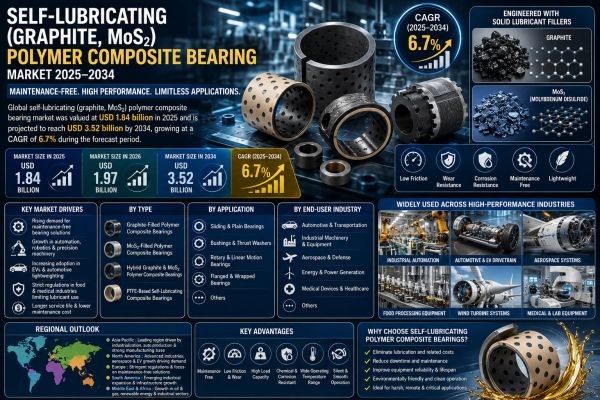
Global self-lubricating (graphite, MoS²) polymer composite bearing market size was valued at USD 1.84 billion in 2025. The market is projected to grow from USD 1.97 billion in 2026 to USD 3.52 billion by 2034, exhibiting a remarkable CAGR of 6.7% during the forecast period.
Self-lubricating polymer composite bearings are precision-engineered components embedded with solid lubricant fillers — primarily graphite and molybdenum disulfide (MoS²) — within a polymer matrix to deliver continuous, maintenance-free lubrication under demanding operational conditions. These bearings eliminate the need for external grease or oil, making them particularly well-suited for applications where contamination risk, inaccessibility, or dry-running environments present significant engineering challenges. Common base polymers include PTFE, PEEK, nylon, and acetal, each reinforced with carefully selected solid lubricant particles to enhance load-bearing capacity, reduce friction coefficients, and extend service life across a wide range of temperatures and load conditions. The result is a bearing solution that genuinely changes how engineers approach maintenance planning and component longevity.
The market is gaining strong momentum driven by the growing adoption of maintenance-free mechanical solutions across industries such as automotive, aerospace, industrial machinery, and food processing. Rising demand for lightweight, corrosion-resistant bearing alternatives to metal counterparts — particularly in electric vehicle (EV) powertrains and precision automation equipment — is further accelerating uptake. Furthermore, stringent regulations limiting conventional lubricant use in food-grade and medical environments are creating new growth avenues for graphite and MoS² composite variants. Key participants operating in this space include Igus GmbH, Saint-Gobain Performance Plastics, Trelleborg AB, SKF Group, and Oiles Corporation, each maintaining broad product portfolios catering to diverse end-use requirements.
Get Full Report Here: https://www.24chemicalresearch.com/reports/308681/selflubricating-polymer-composite-bearing-market
Market Dynamics:
The market's trajectory is shaped by a complex interplay of powerful growth drivers, significant restraints that are being actively addressed, and vast, untapped opportunities that forward-looking manufacturers are already positioning to capture.
Powerful Market Drivers Propelling Expansion
- Rising Demand for Maintenance-Free Bearing Solutions Across Industrial Applications: The self-lubricating polymer composite bearing market is experiencing robust growth, driven primarily by the widespread industrial shift away from conventional oil- and grease-lubricated bearings toward maintenance-free alternatives. Industries such as food and beverage processing, pharmaceuticals, and medical equipment manufacturing are increasingly mandating lubrication-free components due to strict hygiene regulations and contamination prevention requirements. Graphite and molybdenum disulfide (MoS²) filled polymer composites deliver inherent lubricity through the solid lubricant particles embedded within the matrix, eliminating the need for external lubricant application and significantly reducing lifecycle maintenance costs. This shift is not merely a cost consideration — it is becoming a regulatory and operational necessity across a growing number of sectors.
- Expansion of Automation and Robotics Fueling Adoption of Advanced Composite Bearings: The accelerating global adoption of industrial automation, collaborative robotics, and precision machinery is creating sustained demand for lightweight, low-friction bearing solutions. Self-lubricating polymer composite bearings — particularly those incorporating PTFE, PEEK, nylon, and acetal matrices reinforced with graphite or MoS² fillers — offer a compelling combination of low coefficient of friction, chemical resistance, and dimensional stability under dynamic loads. As manufacturing facilities invest in smart factory infrastructure and high-cycle automated assembly lines, the need for bearings capable of operating at high speeds with minimal wear and no lubrication intervals has become a critical engineering specification. The transition from metallic to polymer composite bearings in automotive and aerospace sub-assemblies is accelerating, driven by the dual imperatives of weight reduction and elimination of scheduled lubrication maintenance — directly reducing total cost of ownership across high-volume production environments.
- Electric Vehicle Penetration and Automotive Lightweighting Imperatives: The automotive sector represents a particularly strong demand driver, with self-lubricating composite bearings finding application in seat adjustment mechanisms, throttle bodies, door hinges, steering columns, and transmission components. Weight reduction targets tied to fuel efficiency and electric vehicle range optimization are pushing OEM engineers to substitute steel and bronze bearings with polymer composite alternatives, where graphite and MoS² fillers ensure consistent tribological performance across wide temperature ranges. The growing electric vehicle market further amplifies this demand, as EV drivetrains require bearings that function reliably without lubricant migration that could compromise motor winding insulation. Global EV sales exceeded 14 million units in 2023, and this trajectory continues to place substantial procurement pressure on maintenance-free bearing suppliers.
Download FREE Sample Report: https://www.24chemicalresearch.com/download-sample/308681/selflubricating-polymer-composite-bearing-market
Significant Market Restraints Challenging Adoption
Despite its considerable promise, the market faces hurdles that must be overcome to achieve universal adoption across all intended application segments.
- Raw Material Price Volatility and Supply Chain Complexity for Specialty Fillers: The performance of self-lubricating polymer composite bearings is fundamentally dependent on the quality, purity, and particle morphology of the solid lubricant fillers — graphite and molybdenum disulfide — incorporated into the polymer matrix. Molybdenum disulfide is a molybdenum-derived mineral whose supply is geographically concentrated, with China accounting for a dominant share of global molybdenum mining output. Price fluctuations tied to mining output variability, export policy changes, and shifting demand from the steel alloying industry can directly impact MoS² filler costs and availability. Similarly, high-purity synthetic graphite used in tribological applications competes for supply with the rapidly expanding lithium-ion battery anode material market, introducing additional pricing pressure and supply chain uncertainty for bearing manufacturers reliant on consistent graphite filler specifications.
- Technical Barriers in Achieving Consistent Filler Dispersion and Composite Homogeneity: Achieving uniform distribution of graphite or MoS² particles throughout the polymer matrix during compounding and forming processes is a persistent manufacturing challenge that directly affects bearing performance consistency and batch-to-batch reliability. Agglomeration of filler particles, incompatibility between filler surface chemistry and polymer matrix, and processing parameter variations during injection molding or compression molding can result in localized filler-depleted regions within the bearing structure — creating zones of elevated friction and accelerated wear. Developing robust compounding protocols, surface-treated filler grades, and rigorous in-process quality control systems requires substantial technical investment that creates barriers to entry for smaller manufacturers and limits production scalability for established players seeking to expand capacity rapidly.
Critical Market Challenges Requiring Innovation
Performance limitations under extreme load and high-temperature operating conditions remain a well-documented boundary for this product category. Under conditions of elevated static or dynamic loads combined with high operating temperatures, many polymer matrix materials — including standard nylon and acetal grades — exhibit creep deformation, dimensional instability, and accelerated wear that can compromise bearing clearances and service life. While high-performance matrices such as PEEK and polyimide (PI) extend the operational envelope considerably, these materials carry significantly higher raw material costs that restrict their use to specialized, high-value applications. Bridging this performance-cost gap remains an ongoing engineering challenge for composite bearing manufacturers who must balance technical ambition with commercial viability.
Additionally, hygroscopic polymer matrices — particularly polyamide (nylon) grades commonly used as bearing base materials — are susceptible to moisture absorption that induces dimensional changes and alters mechanical properties. In high-humidity operating environments or applications involving water contact such as marine equipment, agricultural machinery, and food processing lines, bearing clearances can shift outside design tolerances as the polymer matrix swells, leading to increased friction, noise, or seizure. Furthermore, the market also faces competitive pressure from advancing metallic self-lubricating technologies, including sintered bronze-graphite bearings and bimetallic bushings with PTFE-lead liners, which continue to hold performance advantages in heavy industrial and construction equipment applications where shock loads and extreme temperatures are routine.
Vast Market Opportunities on the Horizon
- Growing Adoption in Renewable Energy Infrastructure: The global expansion of wind energy installations represents one of the most significant emerging application opportunities for self-lubricating polymer composite bearings. Wind turbine pitch control systems, yaw drive mechanisms, and blade adjustment assemblies require bearings capable of operating under variable oscillating loads, wide temperature swings, and challenging outdoor environmental conditions — often in locations where maintenance access is infrequent and costly. Self-lubricating composite bearings incorporating graphite or MoS² fillers are increasingly specified for these applications due to their ability to sustain reliable tribological performance without periodic re-greasing. As global installed wind capacity continues its upward trajectory driven by national decarbonization commitments, demand for maintenance-free bearing solutions in wind energy infrastructure is expected to grow substantially over the forecast period.
- Advances in High-Performance Polymer Matrices Opening New Market Segments: Ongoing material science innovation in high-performance thermoplastic matrices — including polyetheretherketone (PEEK), polyphenylene sulfide (PPS), polyimide (PI), and carbon fiber reinforced variants — is progressively extending the operational envelope of self-lubricating composite bearings into application segments previously dominated exclusively by metallic solutions. PEEK-graphite and PEEK-MoS² composite bearings are demonstrating capability in aerospace actuation systems, semiconductor manufacturing equipment, and downhole oil and gas tools, where continuous operating temperatures exceed 200°C and chemical resistance to aggressive media is essential. As manufacturing scale for high-performance polymers increases and raw material costs moderate, the technical and economic case for displacing metallic bearings in demanding applications is strengthening considerably.
- Medical Device and Life Sciences Sector as a High-Value Growth Frontier: The medical device and life sciences sector presents another compelling growth opportunity, as regulatory requirements for particulate-free, lubrication-independent operation in surgical instruments, diagnostic imaging equipment, and laboratory automation align directly with the inherent characteristics of graphite and MoS² filled polymer composite bearings. Biocompatibility certification pathways for specific polymer composite formulations are becoming more clearly defined, reducing the regulatory uncertainty that has historically slowed adoption in medical applications. Furthermore, the rapid scaling of semiconductor fabrication capacity globally is driving demand for ultra-clean, hydrocarbon-free bearing solutions in wafer handling and vacuum process equipment — a technically demanding niche where self-lubricating polymer composites with carefully controlled outgassing profiles offer a differentiated and compelling value proposition.
In-Depth Segment Analysis: Where is the Growth Concentrated?
By Type:
The market is segmented into Graphite-Filled Polymer Composite Bearings, Molybdenum Disulfide (MoS²)-Filled Polymer Composite Bearings, Hybrid Graphite & MoS² Polymer Composite Bearings, and PTFE-Based Self-Lubricating Composite Bearings. Graphite-Filled Polymer Composite Bearings currently represent the dominant product type, widely adopted due to their exceptional thermal conductivity and consistent performance under elevated temperature conditions. Graphite's layered crystalline structure allows it to function as an effective solid lubricant, significantly reducing friction and wear even in the absence of external lubrication. MoS²-filled variants, however, are rapidly gaining preference in precision engineering and vacuum or low-humidity environments where graphite's oxidation sensitivity becomes a limiting factor. Hybrid formulations combining both lubricants are increasingly developed to offer a balanced performance profile across a broader range of operating conditions, and PTFE-based composites are particularly valued in chemically aggressive environments owing to their inherent inertness and low friction coefficient.
By Application:
Application segments include Sliding & Plain Bearings, Bushings & Thrust Washers, Rotary & Linear Motion Bearings, Flanged & Wrapped Bearings, and others. Sliding & Plain Bearings occupy the leading position within the application segment, driven by their widespread utilization in machinery, automotive assemblies, and industrial equipment where maintenance-free, low-friction performance is a critical operational requirement. Bushings and thrust washers represent another highly active application area, particularly in construction equipment and heavy machinery operating under sustained radial and axial loads. Rotary and linear motion bearings are experiencing growing traction in automation, robotics, and semiconductor manufacturing, where precision, cleanliness, and durability are non-negotiable engineering requirements.
By End-User Industry:
The end-user landscape includes Automotive & Transportation, Industrial Machinery & Equipment, Aerospace & Defense, Energy & Power Generation, and Medical Devices & Healthcare. Industrial Machinery & Equipment stands as the dominant end-user segment, consistently demanding self-lubricating bearings for pumps, compressors, conveyor systems, and processing equipment where continuous operation and minimal downtime are essential. The automotive sector is a formidable consumer as well, integrating these bearings into steering systems, seat mechanisms, and drivetrain components. Aerospace and defense applications place a premium on MoS² and graphite composite bearings due to their ability to perform reliably in extreme temperature ranges and vacuum environments encountered in aircraft and spacecraft systems.
Download FREE Sample Report: https://www.24chemicalresearch.com/download-sample/308681/selflubricating-polymer-composite-bearing-market
Competitive Landscape:
The global self-lubricating polymer composite bearing market — encompassing graphite- and molybdenum disulfide (MoS²)-filled systems — is characterized by a moderately consolidated structure dominated by a handful of well-capitalized, vertically integrated manufacturers with deep materials science expertise. Leading the competitive field is Igus GmbH (Germany), widely recognized as a pioneer in tribo-polymer bearing solutions and operating its proprietary iglide® material platform across a broad range of graphite and solid lubricant-filled polymer composites. SKF AB (Sweden), through its self-lubricating bearing division, brings significant global distribution and R&D investment, leveraging its heritage in precision bearing engineering to offer polymer composite options alongside its traditional metallic lines. GGB Bearing Technology (a subsidiary of EnPro Industries, USA) operates dedicated manufacturing facilities in the USA, France, and Germany, focusing specifically on filled PTFE, PEEK, and nylon-based composites incorporating MoS² and graphite as solid lubricant fillers. The competitive strategy across leading players is overwhelmingly focused on R&D to enhance product quality and reduce costs, alongside forming strategic vertical partnerships with end-user companies to co-develop and validate new applications, thereby securing future demand.
List of Key Self-Lubricating (Graphite, MoS²) Polymer Composite Bearing Companies Profiled:
- Igus GmbH (Germany)
- GGB Bearing Technology (EnPro Industries) (USA / France / Germany)
- SKF AB (Sweden)
- Saint-Gobain Performance Plastics (France / USA)
- Oiles Corporation (Japan)
- NTN Corporation / Kashima Bearings (Japan)
- Rexnord Corporation (USA)
- Polygon Company (USA)
- Aurora Bearing Company (USA)
- Freudenberg Group (Merkel / Simrit Divisions) (Germany)
- Trelleborg AB (Sweden)
- Tristar Plastic Corp (USA)
The competitive strategy is overwhelmingly focused on R&D to enhance composite formulation quality and reduce total cost of ownership, alongside forming strategic vertical partnerships with end-user OEMs to co-develop and validate application-specific bearing solutions, thereby securing long-cycle future demand in highly qualified market segments.
Regional Analysis: A Global Footprint with Distinct Leaders
- Asia-Pacific: Stands as the dominant region in the self-lubricating graphite and MoS² polymer composite bearing market, driven by its expansive manufacturing base, rapidly growing industrial sector, and strong demand from automotive, heavy machinery, and electronics industries. Countries such as China, Japan, South Korea, and India are at the forefront of adoption, benefiting from large-scale production capabilities and increasing investments in advanced materials technology. China plays a central role as both a major producer and consumer, supported by its vast automotive manufacturing ecosystem and government-backed industrial modernization initiatives. Japan and South Korea contribute significantly through their precision engineering traditions, where maintenance-free bearing solutions are valued for improving operational efficiency and reducing downtime across technology-intensive industries. The region's accelerating trend toward automation and robotics in manufacturing further elevates demand for high-performance composite bearings.
- North America: Represents a mature and technologically advanced market, with the United States serving as the primary driver. Strong demand emanates from the aerospace and defense sectors, where maintenance-free and high-performance bearing solutions are mission-critical. The automotive industry, particularly in the context of electric vehicle development, is also a significant consumer, as manufacturers seek lightweight and durable bearing materials that reduce the need for scheduled lubrication. The region benefits from a well-established network of specialty materials manufacturers, a strong culture of engineering innovation, and regulatory emphasis on equipment reliability and operational safety that further supports adoption of advanced composite bearing solutions across industrial applications.
- Europe: Holds a prominent position underpinned by its strong engineering heritage and stringent industrial standards. Germany, France, and the United Kingdom are key contributors, with demand concentrated in the automotive, rail transportation, and industrial machinery sectors. European manufacturers place considerable emphasis on sustainability and reduced environmental impact, making self-lubricating bearings particularly attractive as they eliminate the need for oil or grease lubrication, thereby reducing contamination risks and aligning with broader sustainability commitments. The region's well-developed rail and public transportation networks create consistent demand for durable, low-maintenance bearing solutions.
- South America and Middle East & Africa: These regions represent the emerging frontier of the self-lubricating polymer composite bearing market. South America, led by Brazil's significant automotive manufacturing sector and growing agricultural equipment industry, is developing steadily. The Middle East benefits from oil and gas sector activity where bearings operating in extreme temperatures and harsh chemical environments gain directly from graphite and MoS² composite properties. While currently smaller in scale, ongoing economic development and industrialization trends across both regions are expected to support progressive market growth over the medium to long term.
Get Full Report Here: https://www.24chemicalresearch.com/reports/308681/selflubricating-polymer-composite-bearing-market
Download FREE Sample Report: https://www.24chemicalresearch.com/download-sample/308681/selflubricating-polymer-composite-bearing-market
About 24chemicalresearch
Founded in 2015, 24chemicalresearch has rapidly established itself as a leader in chemical market intelligence, serving clients including over 30 Fortune 500 companies. We provide data-driven insights through rigorous research methodologies, addressing key industry factors such as government policy, emerging technologies, and competitive landscapes.
- Plant-level capacity tracking
- Real-time price monitoring
- Techno-economic feasibility studies
International: +1(332) 2424 294 | Asia: +91 9169162030
Website: https://www.24chemicalresearch.com/






