
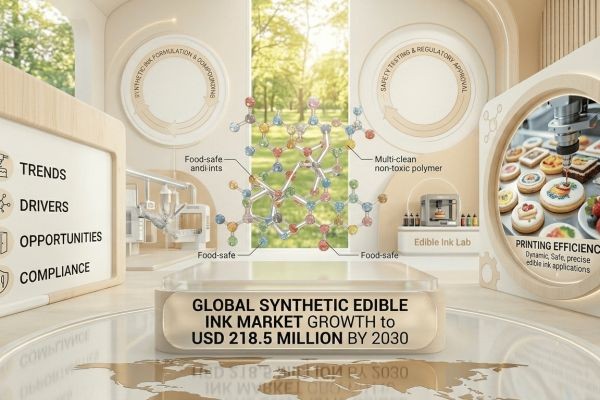
Synthetic edible ink, a specialized food-grade printing medium composed of FDA-approved colorants and consumable carriers, has moved beyond novelty status to become an indispensable tool for modern food branding and personalization. Its unique properties—including high color vibrancy, excellent stability, and compatibility with diverse printing substrates like icing sheets, sugar paper, and direct food surfaces—make it a transformative solution for the food and beverage industry. Unlike traditional food decoration methods, edible ink's precision and consistency enable mass customization and intricate designs, facilitating its integration into automated production lines and artisanal bakeries alike.
Get Full Report Here: https://www.24chemicalresearch.com/reports/266069/global-synthetic-edible-ink-market-2024-2030-903
Market Dynamics:
The market's trajectory is shaped by a complex interplay of powerful growth drivers, significant restraints that are being actively addressed, and vast, untapped opportunities.
Powerful Market Drivers Propelling Expansion
- Explosive Growth in Customized and Personalized Food Products: The demand for personalized confectionery, cakes, and bakery items represents the single largest growth vector. The global bakery products market, valued at over $500 billion, is seeing a paradigm shift towards customization, driven by consumer desire for unique experiences. Edible ink printing allows for on-demand personalization of birthday cakes, wedding favors, and corporate branding on cookies with photographic quality. This capability is enabling bakeries to command premium prices, often 20-35% higher than standard decorated items, making the technology an attractive investment for small and large players alike.
- Technological Advancements in Food Printing Equipment: The rise of affordable, user-friendly edible ink printers is democratizing access to this technology. While industrial-scale printers have been available for years, the recent emergence of compact, sub-$500 desktop models is a game-changer. These printers boast resolutions exceeding 4800 dpi, rivaling commercial graphic arts equipment. This advancement is lowering the barrier to entry for small businesses, with adoption rates among boutique bakeries and home-based entrepreneurs growing by over 40% annually in key markets.
- Expansion into Pharmaceutical and Nutraceutical Applications: The pharmaceutical sector is increasingly leveraging edible ink for precise dosage identification and anti-counterfeiting measures. Printing batch numbers, expiry dates, and dosage information directly onto pills and capsules improves traceability and patient safety. In the nutraceutical space, which is projected to surpass $600 billion by 2030, edible inks are used to brand gummy vitamins and supplements, enhancing brand recognition and consumer trust in a crowded marketplace.
Download FREE Sample Report: https://www.24chemicalresearch.com/download-sample/266069/global-synthetic-edible-ink-market-2024-2030-903
Significant Market Restraints Challenging Adoption
Despite its promise, the market faces hurdles that must be overcome to achieve broader adoption.
- Stringent and Evolving Food Safety Regulations: The path to regulatory approval for synthetic colorants and ink formulations is rigorous and varies significantly across regions. Gaining FDA approval in the U.S. or EFSA approval in Europe for a new edible ink colorant can take 18-24 months and cost upwards of $200,000. Furthermore, the regulatory landscape is not static; recent consumer pushback against certain synthetic dyes in Europe has led to warning labels, creating uncertainty and pushing manufacturers to invest in more expensive natural alternatives, which can increase ink costs by 25-50%.
- High Initial Investment and Operational Expertise: While desktop printers are more affordable, industrial-scale edible printing systems represent a significant capital outlay, often ranging from $10,000 to $50,000. Beyond the hardware, achieving consistent print quality requires expertise in color management, substrate handling, and printer maintenance. A lack of skilled operators can lead to material waste rates of 15-20% in the initial phases of adoption, posing a significant barrier for businesses with thin profit margins.
Critical Market Challenges Requiring Innovation
The transition from a niche decoration method to a mainstream food production tool presents its own set of challenges. Maintaining consistent color vibrancy and stability across different edible substrates—from porous cakes to non-porous chocolate—is difficult. Humidity and temperature variations in production environments can affect print quality and adhesion, leading to issues in 10-15% of production runs. These technical hurdles necessitate ongoing R&D, with leading ink manufacturers investing 8-12% of their annual revenue into developing more robust formulations.
Additionally, the market contends with a fragmented and sometimes inconsistent supply chain. The specialty chemicals used in ink formulations are subject to price volatility, with annual fluctuations of 10-20% not uncommon. Ensuring a stable supply of high-purity, food-grade ingredients adds another layer of complexity and cost, creating economic uncertainty for both ink producers and their end-users.
Vast Market Opportunities on the Horizon
- Direct-to-Shape Food Printing: The next frontier is printing directly onto 3D food surfaces. Recent advancements in printer head technology and ink viscosity control are making it possible to print on curved surfaces like cupcakes, doughnuts, and even fruit. This eliminates the need for intermediate icing sheets, reducing material costs by 30-40% and streamlining the decoration process. Early adopters in the premium pastry sector are already using this technology to create stunning, seamless designs that were previously impossible.
- Functional Edible Inks with Added Benefits: Innovation is moving beyond aesthetics towards functionality. The development of inks infused with vitamins, minerals, or even probiotics opens incredible new possibilities for fortified foods. Imagine a child's breakfast cereal where the colorful designs are also a source of essential nutrients. While still in early stages, this segment has the potential to tap into the massive functional food market, creating a new, high-value application for edible ink technology.
- E-commerce and Direct-to-Consumer Models: The boom in online food delivery and D2C bakeries is a powerful catalyst. These businesses rely on visually appealing products for digital marketing. Edible ink printing enables them to create photogenic, Instagram-worthy creations that drive online engagement and sales. Partnerships between ink manufacturers and e-commerce platforms to offer integrated design-and-print solutions are emerging, effectively reducing the time-to-market for new product offerings and creating a seamless value chain.
In-Depth Segment Analysis: Where is the Growth Concentrated?
By Type:
The market is segmented primarily by capacity and formulation viscosity. Low Capacity inks, typically used in cartridges for desktop and small-scale printers, currently lead the market in terms of unit volume. Their popularity is driven by the widespread adoption of smaller bakeries and home users. However, High Capacity inks, designed for industrial continuous-feed printing systems, are expected to exhibit the highest growth rate, fueled by the scaling up of personalized food production in large-scale confectionery and bakery operations.
By Application:
Application segments are dominated by the Food and Beverage industry, which accounts for the overwhelming majority of demand. Within this sector, bakery and confectionery are the key drivers. The Pharmaceutical application segment, while smaller, is growing rapidly due to stringent track-and-trace regulations and the need for precise product identification. The "Others" segment includes niche applications like printing on pet treats and edible promotional items.
By End-User Industry:
The end-user landscape is diverse, spanning Commercial Bakeries, Confectionery Manufacturers, Pharma Companies, and others. Commercial Bakeries and Confectionery Manufacturers collectively account for the largest share, leveraging edible ink for product differentiation and premiumization. The pharmaceutical industry is a high-value, rapidly emerging end-user, reflecting the trends in drug safety and branding.
Download FREE Sample Report: https://www.24chemicalresearch.com/download-sample/266069/global-synthetic-edible-ink-market-2024-2030-903
Competitive Landscape:
The global Synthetic Edible Ink market is fragmented and characterized by the presence of both global chemical giants and specialized niche players. The competitive environment is intense, with a focus on product innovation, regulatory compliance, and building strong distribution channels. While no single company dominates, established players like Sun Chemical and TOYOCHEM leverage their vast experience in color science and global reach.
List of Key Synthetic Edible Ink Companies Profiled:
- TOYOCHEM (Japan)
- Sun Chemical (U.S.)
- Santacolor (Spain)
- IQDEMY (U.K.)
- KOPYFORM (Germany)
- Linx Printing Technologies (U.K.)
- PhotoFrost (U.S.)
- MagicFrost (U.S.)
- Wuhan Food Printing Technology (China)
- Wuhan Keyihua (China)
- Fuzhou Obooc Technology (China)
The competitive strategy is heavily focused on developing inks that offer superior color fidelity, faster drying times, and compatibility with a wider range of printers and edible substrates. Furthermore, forming strategic partnerships with printer manufacturers is a common tactic to create bundled solutions that offer ease of use and reliability to end customers.
Regional Analysis: A Global Footprint with Distinct Leaders
- North America and Europe: Together, these mature markets hold a dominant share, estimated at over 60% of the global market. Their leadership is fueled by high consumer adoption of customized food products, stringent food safety standards that favor certified synthetic inks, and a well-established bakery and confectionery industry. The U.S. and Germany are particularly strong markets, driven by innovation and a culture of celebration with personalized foods.
- Asia-Pacific: This region is the fastest-growing market, with China at its forefront. Growth is propelled by the expanding middle class, rising disposable incomes, and the rapid westernization of food consumption patterns. China's massive manufacturing base also makes it a key producer of edible inks and compatible printers, supplying both domestic and international markets. The APAC region presents immense long-term growth potential.
- South America and MEA: These regions represent emerging opportunities. While current market size is smaller, increasing urbanization, the growth of modern retail, and the expansion of chain bakeries and cafes are driving initial adoption. The market in these regions is expected to grow at an above-average rate as the technology becomes more accessible and affordable.
Get Full Report Here: https://www.24chemicalresearch.com/reports/266069/global-synthetic-edible-ink-market-2024-2030-903
Download FREE Sample Report: https://www.24chemicalresearch.com/download-sample/266069/global-synthetic-edible-ink-market-2024-2030-903
About 24chemicalresearch
Founded in 2015, 24chemicalresearch has rapidly established itself as a leader in chemical market intelligence, serving clients including over 30 Fortune 500 companies. We provide data-driven insights through rigorous research methodologies, addressing key industry factors such as government policy, emerging technologies, and competitive landscapes.
- Plant-level capacity tracking
- Real-time price monitoring
- Techno-economic feasibility studies
International: +1(332) 2424 294 | Asia: +91 9169162030
Website: https://www.24chemicalresearch.com/






