
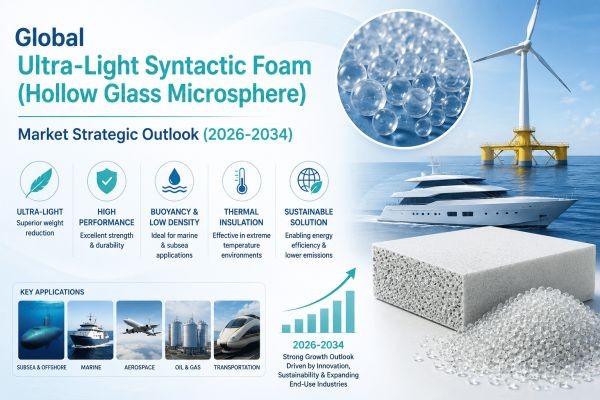
Ultra-light syntactic foams with densities at or below 1 g/cm³ are engineered composite materials manufactured by embedding hollow glass microspheres within a polymer, metal, or ceramic matrix. These microspheres — typically ranging from 10 to 300 microns in diameter — impart exceptional buoyancy, low thermal conductivity, and high compressive strength relative to weight, making syntactic foams fundamentally distinct from conventional foam materials. Their ability to withstand deep-sea hydrostatic pressures while maintaining structural integrity positions them as a critical material in subsea and aerospace engineering applications. Unlike standard closed-cell foams, the closed hollow architecture of glass microsphere-based syntactic foams prevents water ingress entirely, a property that proves indispensable in prolonged underwater deployments.
The market is witnessing steady expansion driven by escalating demand from the offshore oil & gas sector, deep-sea exploration programs, and lightweight structural components in aerospace and defense. Furthermore, growing interest in marine renewable energy infrastructure and underwater robotics has broadened the application landscape considerably. Key players operating across this space include 3M Company, Trelleborg AB, Diab Group, and Engineered Syntactic Systems, each maintaining diversified product portfolios tailored to performance-critical end uses.
Get Full Report Here: https://www.24chemicalresearch.com/reports/308685/ultralight-syntactic-foam-market
Market Dynamics:
The market's trajectory is shaped by a complex interplay of powerful growth drivers, significant restraints that are being actively addressed, and vast, untapped opportunities.
Powerful Market Drivers Propelling Expansion
-
Expanding Deep-Sea Exploration and Subsea Infrastructure Development: The ultra-light syntactic foam market is experiencing sustained momentum driven by the accelerating pace of deepwater and ultra-deepwater oil and gas exploration. As offshore operators push into water depths exceeding 3,000 meters, the engineering requirement for buoyancy materials that combine low density with exceptional hydrostatic pressure resistance has become non-negotiable. Syntactic foams incorporating hollow glass microspheres uniquely satisfy this dual demand — their closed-cell architecture prevents water ingress while their compressive strength-to-weight ratio remains superior to conventional polymer foams. Subsea equipment including remotely operated vehicles (ROVs), pipeline insulation modules, riser buoyancy systems, and Christmas tree assemblies routinely specify syntactic foam grades in the 0.38–0.70 g/cm³ range to achieve the necessary buoyancy-to-weight performance at operating depth. This structural dependency on ultra-light syntactic foam across the subsea equipment supply chain creates a durable and recurring demand base that is difficult to displace with alternative materials.
-
Aerospace and Defense Applications Reinforcing Material Adoption Across New Platforms: Beyond offshore energy, aerospace and defense sectors represent a structurally significant and growing source of demand for ultra-light syntactic foams. In aerospace, the material’s combination of density well below 1 g/cm³, low dielectric constant, and thermal stability makes it attractive for radome core structures, satellite components, and unmanned aerial vehicle (UAV) airframe sections where mass reduction translates directly into payload capacity and fuel efficiency. The defense segment, particularly naval applications, leverages syntactic foam for submarine sonar dome fairings, torpedo components, and underwater autonomous vehicle hulls — platforms where pressure resistance and acoustic transparency must coexist. The proliferation of autonomous underwater vehicles for both military reconnaissance and commercial ocean survey has created a durable incremental demand channel that did not exist at the same scale a decade ago. Furthermore, growing defense budgets across North America, Europe, and the Indo-Pacific are translating into higher procurement volumes for platforms that specify these materials.
-
Broad-Based Lightweighting Momentum Across Transportation and Industrial Sectors: The broader push toward lightweighting across transportation and industrial sectors is reinforcing market fundamentals. In marine and naval shipbuilding, syntactic foam core panels are increasingly used in hull sandwich structures to reduce vessel displacement without sacrificing structural rigidity. The wind energy sector has explored syntactic foam for blade core applications where moisture resistance and fatigue performance under cyclic loading are critical. Meanwhile, advances in resin systems — particularly epoxy, vinyl ester, and polyurethane matrices — have expanded the processing latitude for syntactic foam manufacturers, enabling injection-molded, cast, and compression-molded geometries that serve a wider range of end-use configurations. This manufacturing versatility is a meaningful commercial driver, as it lowers the barrier to specification across industries beyond traditional oil and gas. The electric vehicle sector is also emerging as a prospective application area, where syntactic foam composites are being evaluated for battery enclosures and structural panels that require both low weight and thermal insulation properties.
Download FREE Sample Report: https://www.24chemicalresearch.com/download-sample/308685/ultralight-syntactic-foam-market
Significant Market Restraints Challenging Adoption
Despite its promise, the market faces hurdles that must be overcome to achieve broader commercial adoption.
-
Cyclicality of Offshore Oil and Gas Capital Expenditure Creating Demand Volatility: The ultra-light syntactic foam market’s significant dependence on offshore energy infrastructure investment introduces a structural vulnerability to oil price cyclicality. Deepwater exploration and production projects — which represent one of the largest and most technically demanding application segments for buoyancy-grade syntactic foam — are long-cycle investments with sanction decisions that are highly sensitive to crude oil price outlooks and operator balance sheet priorities. During periods of sustained low oil prices or capital discipline cycles, operators defer or cancel deepwater field development projects, directly reducing the volume of subsea hardware — including buoyancy modules, pipeline insulation systems, and ROV components — that require syntactic foam. This cyclicality was clearly demonstrated during the 2015–2016 and 2020 oil price downturns, when subsea equipment procurement contracted sharply. While portfolio diversification into aerospace, defense, and marine composites partially buffers the market, offshore energy remains a dominant demand driver, and its capital expenditure cycles impose a meaningful restraint on sustained market growth trajectories.
-
Competition from Alternative Buoyancy and Lightweighting Materials Limiting Market Share Expansion: Syntactic foam faces competition from a range of alternative materials across its key application segments. In subsea buoyancy, macrosphere-based foam systems and solid polymer foam blocks offer lower per-unit cost for shallow-water applications where hydrostatic pressure resistance requirements are modest. In aerospace composite sandwich structures, Nomex honeycomb, foam cores based on polymethacrylimide (PMI), and polyetherimide (PEI) foams compete on the basis of specific stiffness, surface quality, and established supply chains. For marine thermal insulation, aerogel composites and advanced polyurethane systems are being evaluated as alternatives in certain pipeline configurations. While syntactic foam’s pressure resistance and density combination remains unmatched at ultra-deepwater depths, the competitive landscape in adjacent depth ranges and in non-pressure-sensitive applications is more contested, restraining pricing power and limiting penetration into new segments.
Critical Market Challenges Requiring Innovation
Despite robust end-market demand, the ultra-light syntactic foam industry faces persistent structural challenges rooted in raw material economics. Hollow glass microspheres — the defining functional component of these foams — are produced by a relatively concentrated group of global manufacturers, and the production process is capital-intensive, requiring precise control of glass composition, blowing agent chemistry, and particle classification to achieve consistent wall thickness and crush strength across a narrow density range. This supply concentration introduces procurement risk for syntactic foam formulators, particularly for high-performance microsphere grades used in ultra-light formulations. Price volatility in borosilicate glass precursor materials and energy costs further compresses margins for downstream foam producers operating in a competitive bidding environment for large offshore and defense contracts.
Additionally, achieving consistent mechanical performance in ultra-light syntactic foam — particularly in sub-0.50 g/cm³ grades — requires careful management of mixing shear, cure temperatures, and pressure during processing. Hollow glass microspheres are inherently fragile; excessive mechanical shear during compounding or elevated injection pressures during molding can fracture microsphere walls, increasing density and degrading compressive performance. This places significant demands on process engineering and quality control infrastructure, making scale-up from laboratory formulations to production volumes technically challenging. In aerospace, defense, and deepwater oil and gas, material qualification is equally protracted — new syntactic foam formulations must undergo extensive hydrostatic pressure cycling, thermal aging, and long-term creep assessment before approval, creating a substantial lag between product development and commercial revenue realization.
Vast Market Opportunities on the Horizon
-
Growth of Autonomous Underwater Vehicles and Ocean Technology Creating New Demand Frontiers: The accelerating deployment of autonomous underwater vehicles (AUVs) and unmanned underwater vehicles (UUVs) for ocean survey, scientific research, offshore asset inspection, and defense applications presents one of the most compelling near-term growth opportunities for ultra-light syntactic foam producers. AUV and UUV hull design demands materials that achieve neutral or slightly positive buoyancy at operational depth while contributing structural integrity to the pressure vessel or fairing assembly — a requirement profile that aligns precisely with the properties of sub-1 g/cm³ syntactic foam. As the global fleet of autonomous marine systems expands in response to offshore energy digitalization, defense investment, and scientific ocean monitoring programs, the cumulative volume of syntactic foam specified per platform — for hull sections, payload bay fairings, and thruster housings — creates a growing and relatively captive demand stream. This segment is notably less cyclical than upstream oil and gas capital expenditure, offering syntactic foam manufacturers a more stable and predictable revenue base alongside their traditional offshore energy business.
-
Advances in Microsphere Technology and Multifunctional Foam Formulations Opening Premium Market Niches: Material innovation within the hollow glass microsphere and syntactic foam value chain is generating opportunities to address premium application niches with enhanced performance requirements. Research into surface-functionalized microspheres — including silane-treated and polymer-coated variants — is improving interfacial adhesion between microspheres and resin matrices, resulting in syntactic foams with improved tensile strength and fatigue resistance at equivalent density. Concurrently, the development of hybrid syntactic foams incorporating carbon nanotube networks, graphene additives, or cenosphere blends alongside glass microspheres is targeting multifunctional performance profiles that combine ultra-low density with improved electrical conductivity, electromagnetic shielding, or thermal management characteristics. These advanced formulations command significant price premiums over commodity syntactic foam grades and are attracting interest from defense electronics, satellite structural components, and high-performance marine composite manufacturers.
-
Emerging Applications in Renewable Energy Infrastructure and Green Marine Transportation: The global energy transition is generating nascent but strategically significant demand opportunities for ultra-light syntactic foam in offshore renewable energy infrastructure. Floating offshore wind platforms — particularly semi-submersible and tension-leg platform configurations being deployed in deeper waters beyond the reach of fixed-bottom foundations — require buoyancy compensation and structural foam components that can withstand prolonged marine exposure while maintaining dimensional stability and load-bearing performance. Syntactic foam’s moisture impermeability and resistance to long-term creep under sustained compressive loading position it favorably for buoyancy modules integrated into floating platform structures. Additionally, the development of green hydrogen production infrastructure at sea and the electrification of marine transport — including hydrogen fuel cell-powered vessels and battery-electric ferries with optimized hull weight budgets — are creating new engineering conversations around ultra-light structural materials that are likely to scale materially over the coming decade.
In-Depth Segment Analysis: Where is the Growth Concentrated?
By Type:
The market is segmented into Epoxy-Based Syntactic Foam, Polyurethane-Based Syntactic Foam, Vinyl Ester-Based Syntactic Foam, and Thermoplastic-Based Syntactic Foam. Epoxy-Based Syntactic Foam holds a dominant position within the ultra-light syntactic foam market, owing to its exceptional combination of low density, superior compressive strength, and outstanding resistance to moisture ingress. The epoxy matrix bonds uniformly with hollow glass microspheres, delivering a highly consistent microstructure especially valued in deep-sea and aerospace structural applications. Polyurethane-based variants are gaining traction in applications where flexibility and impact absorption are prioritized alongside weight reduction. Vinyl ester formulations are preferred in chemically aggressive marine environments due to their inherent corrosion resistance. Thermoplastic-based syntactic foams are emerging as a next-generation option, offering recyclability and compatibility with advanced manufacturing processes such as injection molding, opening new avenues for high-volume industrial production.
By Application:
Application segments include Buoyancy Modules & Deep-Sea Equipment, Aerospace Structural Components, Marine & Subsea Pipelines, Automotive Lightweighting, and others. Buoyancy Modules and Deep-Sea Equipment represent the most prominent application segment for ultra-light syntactic foam with densities at or below one gram per cubic centimeter. The unparalleled ability of these materials to withstand extreme hydrostatic pressures at ocean depths while simultaneously providing positive buoyancy makes them irreplaceable in remotely operated vehicles, autonomous underwater vehicles, and subsea instrumentation housings. Aerospace structural components benefit enormously from the material’s high strength-to-weight ratio, contributing to fuel efficiency and structural integrity in both commercial and defense aviation platforms. The automotive segment, driven by stringent fuel economy and emissions regulations, is progressively adopting ultra-light syntactic foams in structural panels, door inserts, and underbody shields to reduce overall vehicle mass without sacrificing safety performance.
By End-User Industry:
The end-user landscape includes Oil & Gas, Aerospace & Defense, Automotive & Transportation, Marine Industry, and Research & Academic Institutions. The Oil & Gas Industry remains the leading end-user segment, driven by the accelerating pace of deepwater and ultra-deepwater exploration activities globally. Syntactic foam is extensively deployed in this sector for riser insulation, pipeline thermal management, and subsea buoyancy compensation systems, where reliability under extreme pressure and temperature conditions is non-negotiable. The aerospace and defense sector is a critical consumer, integrating ultra-light syntactic foam into radomes, satellite structures, unmanned aerial systems, and ballistic protection components where weight savings translate directly into mission capability and operational range. Marine industry stakeholders, including shipbuilders and naval architects, increasingly specify these materials for hull cores and flotation devices demanding long-term durability in saltwater environments.
Download FREE Sample Report: https://www.24chemicalresearch.com/download-sample/308685/ultralight-syntactic-foam-market
Competitive Landscape:
The global Ultra-Light (≤1 g/cm³) Syntactic Foam market is semi-consolidated and characterized by a relatively concentrated competitive environment dominated by technically advanced manufacturers. The top companies — 3M Company (U.S.), Trelleborg AB (Sweden), and Engineered Syntactic Systems (U.S.) — collectively command a significant share of the global market as of 2025. Their dominance is underpinned by proprietary hollow glass microsphere manufacturing technology, vertically integrated production capabilities, and established relationships with major subsea and aerospace end-users globally.
3M Company holds a pivotal upstream position through its Scotchlite™ glass bubble product line, supplying hollow glass microspheres that serve as the foundational raw material for syntactic foam formulations across aerospace, deep-sea, and marine applications. Trelleborg AB, through its Offshore & Engineering segment, is one of the most recognized vertically integrated manufacturers of finished syntactic foam systems, particularly for subsea buoyancy and insulation. Beyond the dominant players, several specialized and regional manufacturers contribute to competitive diversity. The competitive strategy across this space is overwhelmingly focused on R&D to enhance material performance and reduce costs, alongside forming strategic vertical partnerships with end-user companies to co-develop and validate new applications, thereby securing future demand.
List of Key Ultra-Light Syntactic Foam (Hollow Glass Microsphere) Companies Profiled:
-
3M Company (U.S.)
-
Trelleborg AB (Sweden)
-
Balmoral Comtec Ltd (U.K.)
-
Cuming Microwave Corporation (U.S.)
-
SynFoam LLC (U.S.)
-
Diab Group (Sweden)
-
Advanced Insulation Ltd (U.K.)
The competitive strategy is overwhelmingly focused on R&D to enhance product quality and reduce costs, alongside forming strategic vertical partnerships with end-user companies to co-develop and validate new applications, thereby securing future demand.
Regional Analysis: A Global Footprint with Distinct Leaders
-
North America: Is the undisputed leader in the ultra-light syntactic foam market, driven by robust demand from the offshore oil and gas sector, advanced defense programs, and a mature aerospace industry. The United States serves as the epicenter of innovation and commercial deployment of hollow glass microsphere-based syntactic foams, owing to the presence of leading manufacturers, research institutions, and end-use industries. Deep-water exploration activities in the Gulf of Mexico continue to sustain strong demand for buoyancy modules and subsea insulation components. The U.S. Navy and defense contractors have long leveraged these materials for submarine and underwater vehicle applications, reinforcing the region’s technological leadership. Strong regulatory frameworks, high R&D investment, and well-established supply chains collectively position North America as the unrivaled leader in this specialty materials market.
-
Europe & Asia-Pacific: Together, they form a powerful secondary bloc. Europe’s strength is driven by Norway’s North Sea offshore industry, the UK’s subsea engineering expertise, and Germany’s commitment to lightweight automotive construction. Environmental regulations promoting weight reduction and energy efficiency further accelerate adoption across multiple end-use sectors throughout Europe. Asia-Pacific is emerging as one of the fastest-growing regional markets, propelled by rapid expansion in offshore energy exploration, a booming shipbuilding industry in South Korea and Japan, and increasing investments in underwater infrastructure. China’s deep-water oil and gas ambitions in the South China Sea are generating substantial demand for subsea buoyancy and insulation foam solutions.
-
South America, Middle East & Africa: These regions represent the emerging frontier of the ultra-light syntactic foam market. South America’s market is closely tied to Brazil’s pre-salt offshore energy sector, where the technically challenging deep-water environments necessitate advanced buoyancy and insulation materials. The Middle East & Africa region is primarily driven by Gulf Cooperation Council offshore infrastructure and West African offshore energy development. While currently constrained by limited local manufacturing capability and import dependence, ongoing investment in offshore energy development and gradual industrial modernization point to a steady trajectory of market expansion in both regions through the forecast period.
Get Full Report Here: https://www.24chemicalresearch.com/reports/308685/ultralight-syntactic-foam-market
Download FREE Sample Report: https://www.24chemicalresearch.com/download-sample/308685/ultralight-syntactic-foam-market
About 24chemicalresearch
Founded in 2015, 24chemicalresearch has rapidly established itself as a leader in chemical market intelligence, serving clients including over 30 Fortune 500 companies. We provide data-driven insights through rigorous research methodologies, addressing key industry factors such as government policy, emerging technologies, and competitive landscapes.
-
Plant-level capacity tracking
-
Real-time price monitoring
-
Techno-economic feasibility studies
International: +1(332) 2424 294 | Asia: +91 9169162030
Website: https://www.24chemicalresearch.com/






