
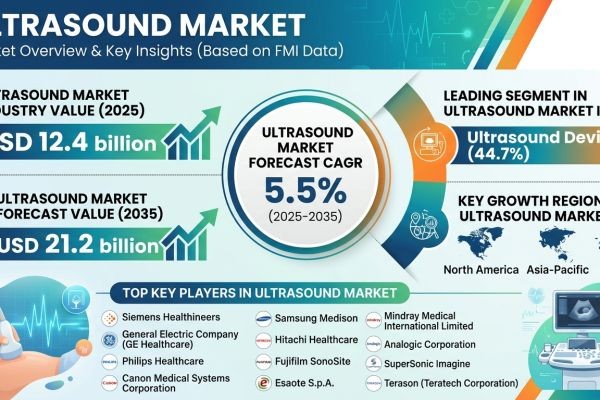
The global ultrasound market is projected to witness strong expansion over the next decade, supported by a rising demand for non-invasive diagnostic procedures and continuous advancements in medical imaging. The market is expected to grow steadily, reaching approximately USD 21.2 billion by 2035, registering a CAGR of 5.5%, according to the latest analysis by Future Market Insights (FMI).
Market growth is being shaped by increasing global healthcare expenditure, growing consumer awareness regarding preventive healthcare, and the rapid adoption of advanced diagnostic technologies. Ultrasound systems have evolved from specialized tools into essential equipment across multiple clinical environments, including radiology, cardiology, oncology, and obstetrics. While traditional cart-based models continue to dominate installations, healthcare facilities are increasingly integrating advanced systems such as portable and point-of-care devices to improve workflow efficiency and patient outcomes.
Ultrasound Market Snapshot (2025–2035)
- Market size outlook toward 2035: USD 21.2 billion
- Forecast CAGR: 5.5%
- Dominant component category: Ultrasound Devices (44.7% market share)
- Fastest-growing country market: South Korea (6.80% CAGR)
- Primary demand channel: Hospitals and Diagnostic Imaging Centers
Momentum in the Market
Beginning from steady regional adoption levels, the global ultrasound market demonstrates accelerated growth throughout the forecast period as early disease detection becomes mandatory for cost-effective healthcare systems. Between 2026 and 2035, expanding public and private healthcare investments and rising aging populations are expected to significantly boost demand for integrated diagnostic systems. Increasing urbanization and higher chronic disease density are encouraging governments and medical providers to prioritize non-invasive imaging technologies.
From 2035 onward, innovation in intelligent imaging deployment systems and integration with artificial intelligence (AI) is expected to further strengthen market expansion. Smart systems capable of automating measurements and enhancing tissue differentiation are emerging as key differentiators in next-generation medical device portfolios.
The Reasons Behind the Market’s Growth
Demand for ultrasound equipment is rising due to multiple structural and technological factors reshaping the healthcare ecosystem.
- Advancements in Imaging Technology: Innovations such as AI-assisted image analysis, 3D/4D imaging, and miniaturized transducers are improving diagnostic accuracy while reducing procedure times.
- Growing Prevalence of Chronic Diseases: An uptick in cardiovascular issues, tumors, and lifestyle diseases requires regular monitoring, driving large-scale institutional adoption of ultrasound systems.
- Rising Preventive Care Awareness: Consumers are prioritizing early diagnostic screenings, accelerating adoption across diagnostic imaging centers and outpatient clinics.
- Telemedicine and Remote Consultations: The rise of portable, handheld systems enables medical evaluations in challenging environments, field hospitals, and virtual health platforms.
Top Segment Application Type
Ultrasound Devices Lead Market Demand Medical devices account for the majority of installations across global healthcare networks, supported by upgrading programs in hospitals to adopt automated workflows. The device segment commands a 44.7% share in the component category.
Technology and Display Analysis
- Diagnostic ultrasound: Holds a dominant 48.6% technology share due to real-time visualization capabilities.
- Colored display segment: Commands a 52.1% share, driven by enhanced visual clarity and better tissue differentiation.
- 2D ultrasound technology: Projected to grow at a 4.10% CAGR, maintaining structural preference due to its cost-effectiveness.
- Ultrasound devices component: Expected to develop at a 4.20% CAGR through 2035.
Regional Development: Global Infrastructure Upgrades Drive Expansion
The global manufacturing and consumption ecosystem for medical devices is rapidly evolving, supported by advanced research centers and expanding clinical networks.
- North America & Western Europe: Premium demand centers characterized by rapid replacement cycles and AI-assisted clinical adoption.
- South Korea: Leading market growth with public and private investments focusing heavily on advanced geriatric diagnostics.
- China & India: Rapidly modernizing medical facilities paired with an exponentially growing middle-class seeking better healthcare access.
Localized partnerships between global suppliers and regional healthcare networks are improving cost efficiency while accelerating innovation and technology adoption.
Challenges, Trends, Opportunities, and Drivers
Drivers
- Surge in demand for non-invasive diagnostic procedures
- Rising global healthcare expenditures and infrastructure upgrades
- Increasing demand for maternal and fetal health monitoring
- Expansion of portable and point-of-care ultrasound systems
Opportunities
- AI-enabled crash sensing and automated measurement software
- Miniaturization of transducers for handheld applications
- Integration with telemedicine and remote monitoring networks
- Developing low-cost high-resolution systems for emerging economies
Trends
- Transition toward intelligent, software-driven deployment systems
- Increased adoption of multi-specialty configurations (Cardiology, Musculoskeletal)
- Widespread transition from black-and-white to high-resolution color displays
- Growth of ambulatory and point-of-care diagnostic clinics
Challenges
- High initial capital expenditure required for advanced ultrasonic systems
- Market competition from alternative modalities like MRI and CT scans
- Strict regulatory environments regarding device certification in certain nations
- Concerns regarding overexposure or improper training in machine utilization
Country Growth Outlook
The market’s growth trajectory is closely tied to economic industrialization and healthcare spending implementation across key global economies:
- South Korea: 6.80% CAGR, driven by an aging demographic and aggressive public-private healthcare investments.
- The United Kingdom: 6.60% CAGR, supported by preventive healthcare treatments and advanced medical research institutes.
- China: 6.40% CAGR, propelled by government mandates to modernize regional medical institutions.
- The United States: 5.90% CAGR, anchored by rapid technological transitions and premium device penetration.
- Japan: 5.00% CAGR, influenced by sustained replacement demands and highly automated diagnostic workflows.
The Competitive Environment
The global ultrasound market is moderately consolidated, with global healthcare technology providers competing through continuous innovation, localized manufacturing, and strict regulatory compliance. Leading companies include:
- Siemens Healthineers
- General Electric Company (GE Healthcare)
- Philips Healthcare
- Canon Medical Systems Corporation
- Samsung Medison
These players are investing heavily in smart ultrasound technologies, lightweight mobile systems, and AI-compatible software while forming partnerships with regional hospitals to strengthen supply chains and accelerate product development.
Future Outlook: Toward Intelligent and Safer Diagnostics
The global ultrasound market is entering a transformative decade shaped by automation, miniaturization, and higher imaging expectations. Future ultrasound systems are expected to function as integrated diagnostic modules working alongside hospital enterprise networks to provide predictive analytical insights. As healthcare markets mature and diagnostic awareness strengthens, ultrasound will remain central to achieving safer, faster, and smarter mobility in clinical care throughout the world.
For a comprehensive strategic outlook and detailed analysis of technological developments shaping the industry, readers can explore the full report on the official Future Market Insights website: https://www.futuremarketinsights.com/reports/ultrasound-market






