
A consistent operational scale-up is expanding global construction and mining pipelines, fueled by the commercial necessity to deploy efficient heavy construction vehicles capable of executing massive urbanization and infrastructure modernization projects worldwide.
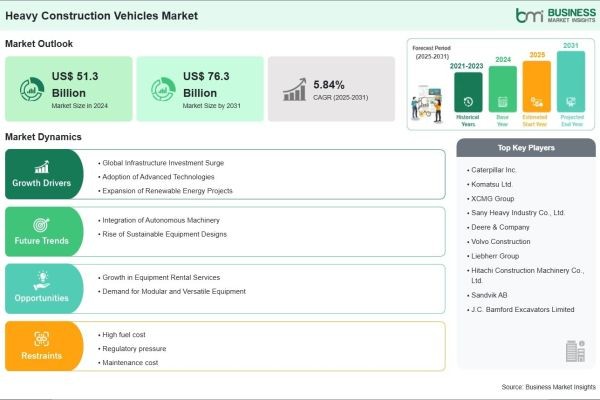
Based on market intelligence from Business Market Insights, the global Heavy Construction Vehicles Market is anticipated to reach US$ 76.3 Billion by 2031, mounting from its 2024 value of US$ 51.3 Billion at a projected CAGR of 5.84% from 2025 to 2031.
Technological advancements in telematics, automation, electrification, predictive maintenance, and fleet intelligence are reshaping the heavy construction vehicles market. Manufacturers are increasingly integrating connected systems, fuel-efficient powertrains, and advanced monitoring tools to improve productivity, reduce operating costs, and enhance safety across construction sites. This shift toward smarter machinery is helping contractors achieve better asset utilization, lower downtime, and greater compliance with increasingly strict environmental regulations.
Download Sample Report : https://www.businessmarketinsights.com/sample/BMIPUB00031691
What Are Heavy Construction Vehicles?
Heavy construction vehicles are specialized machines designed to perform demanding tasks in construction, infrastructure development, earthmoving, material transport, paving, and site preparation. These vehicles are engineered for extreme high-load operations and are widely deployed across commercial construction, industrial construction, and large-scale public infrastructure projects. They are built with reinforced chassis structures, high-torque powertrains, and advanced hydraulic systems that allow them to move large volumes of earth and construction materials efficiently and safely.
Common heavy construction vehicles include dump trucks, concrete mixers, asphalt pavers, rollers, trenchers, and other specialized equipment. Modern models increasingly feature digital controls, telematics systems, alternative fuel options, and automated functions to support more efficient and sustainable operations. These intelligent systems also help vehicles operate effectively in densely populated urban zones where noise reduction and emission minimization are important compliance factors.
Market Drivers
A major driver of the Heavy Construction Vehicles Market is the surge in global infrastructure investment. Governments are funding highways, airports, rail networks, ports, transit systems, and urban redevelopment programs to support economic growth and improve connectivity. These large-scale projects require substantial deployment of heavy construction vehicles for earthmoving, transport, compaction, and paving activities, directly translating into strong demand for construction equipment manufacturers.
Rapid urbanization is another important growth factor. Expanding cities require new roads, residential developments, commercial buildings, industrial parks, and utility networks, all of which increase the need for heavy-duty construction vehicles. Growing mining and industrial activity is also supporting market expansion, as global demand for minerals and raw materials calls for robust material handling fleets capable of operating continuously in harsh environments.
Technology is further boosting demand. Telematics, autonomous and semi-autonomous capabilities, smart fleet management, and predictive diagnostics are helping contractors improve equipment utilization, lower downtime, and optimize maintenance schedules. The rising adoption of electric and hybrid construction vehicles is also creating new opportunities as sustainability goals gain importance across corporate and public infrastructure programs.
Market Segmentation
By Vehicle Type
- Dump Trucks: Articulated and rigid models that serve as the backbone of material hauling and excavation transport.
- Concrete Mixers: Specialized units used for delivering and blending concrete in structural and civil construction projects.
- Asphalt Pavers: High-precision machines used to lay asphalt smoothly across roads, highways, and transport corridors.
- Rollers: Heavy compaction machines essential for stabilizing soil, gravel, and asphalt surfaces.
- Trenchers: Efficient excavation units used for utility routing and underground cable deployment.
- Others: Including material handlers, tracked loaders, excavators, and other heavy-duty machinery.
By Fuel Type
- Diesel: The conventional fuel type offering high torque, long operating range, and durability for heavy-duty applications.
- Electric: A rapidly advancing segment focused on low noise and zero tailpipe emissions in urban and regulated areas.
- Hybrid: An efficient transition option that reduces fuel consumption while maintaining power output.
- Others: Including emerging solutions such as hydrogen fuel cell-powered equipment.
By End User
- Commercial Construction: Including office towers, residential complexes, retail centers, and mixed-use developments.
- Industrial Construction: Covering manufacturing plants, warehouses, processing facilities, and large production sites.
- Infrastructure Construction: The dominant segment, driven by roads, bridges, railways, airports, and utilities.
The dump trucks segment dominated the market in 2024 due to its extensive use in construction, mining, and infrastructure projects. Diesel remained the leading fuel type because of its high torque, durability, and suitability for heavy-duty applications. Infrastructure construction accounted for the largest share among end users, supported by large government investments in roads, bridges, railways, and utilities.
Regional Insights
- Asia-Pacific dominated the market in 2024 due to rapid urbanization, major infrastructure projects, industrial expansion, and strong government investment across China, India, and Southeast Asia. The continuous development of smart cities and transport corridors is driving significant machinery demand.
- North America remains a significant market supported by infrastructure modernization, technology adoption, and demand for advanced construction equipment. Public investment in road and bridge restoration is supporting replacement and fleet expansion.
- Europe continues to grow steadily, driven by sustainability goals, emission regulations, and ongoing infrastructure upgrades. European contractors are increasingly adopting electrified and low-emission heavy construction vehicles.
- Middle East & Africa is seeing rising demand from mega construction projects, mining expansion, and urban development initiatives, especially in GCC countries where economic diversification is accelerating construction activity.
- South & Central America is expanding as governments invest in transportation, mining, and public infrastructure projects designed to improve regional connectivity and support economic growth.
Top Players in the Heavy Construction Vehicles Market
The market is highly competitive, with leading manufacturers focusing on equipment innovation, automation, electrification, and fleet intelligence to strengthen their global positions.
- Caterpillar Inc.
- Komatsu Ltd.
- XCMG Group
- Sany Heavy Industry Co., Ltd.
- Deere & Company
- Volvo Construction Equipment
- Liebherr Group
- Hitachi Construction Machinery Co., Ltd.
- Sandvik AB
- J.C. Bamford Excavators Limited
These companies continue to invest in smart machinery, alternative fuel technologies, automation systems, and digital fleet management platforms to improve operational efficiency and address changing customer requirements.
Technological Innovations
Technological innovation is transforming the Heavy Construction Vehicles Market. Telematics-enabled vehicles allow operators to monitor fuel consumption, equipment health, productivity, and maintenance needs in real time, helping reduce downtime and improve fleet performance. Centralized operations teams can analyze machine data to identify mechanical strain before component failure occurs, improving asset reliability.
Manufacturers are also developing autonomous and semi-autonomous construction vehicles that can enhance safety and productivity on complex job sites. Artificial intelligence, machine learning, and predictive analytics are increasingly being integrated into modern construction vehicle platforms, enabling more precise control and better resource planning.
The growing adoption of electric and hybrid heavy vehicles is another major trend. Sustainability initiatives and emission reduction goals are encouraging manufacturers and contractors to invest in cleaner equipment solutions for the future. As battery technology and charging infrastructure improve, electric heavy construction vehicles are expected to gain stronger traction in urban and regulated construction environments.
Future Market Outlook
The future outlook for the Heavy Construction Vehicles Market remains highly positive. Rising infrastructure spending, urban expansion, industrial development, and technological innovation are expected to support steady demand through 2031. The use of connected systems, remote monitoring, and advanced vehicle intelligence will continue to improve operational visibility and fleet efficiency.
As automation, electrification, connectivity, and intelligent fleet management continue to advance, heavy construction vehicles will become more productive, efficient, and environmentally sustainable. Companies that focus on innovation and digital transformation are likely to capture the strongest growth opportunities in the coming years.
Frequently Asked Questions (FAQs)
What is the projected size of the Heavy Construction Vehicles Market by 2031?
The market is projected to reach US$ 76.3 Billion by 2031, rising from US$ 51.3 Billion in 2024.
What factors are driving market growth?
Key drivers include infrastructure investment, urbanization, mining expansion, technological advancement, and increasing adoption of intelligent construction equipment.
Which vehicle segment dominates the market?
Dump trucks currently hold the largest market share because of their widespread use in construction, mining, and infrastructure development.
Which region leads the market?
Asia-Pacific dominates the market due to strong infrastructure development, urban growth, and industrial expansion.
Browse More Reports:
Construction Equipment Market
Mining Equipment Market
Commercial Vehicle Market
About Us
Business Market Insights is a market research platform that provides subscription service for industry and company reports. Our research team has extensive professional expertise in domains such as Electronics & Semiconductor; Aerospace & Defense; Automotive & Transportation; Energy & Power; Healthcare; Manufacturing & Construction; Food & Beverages; Chemicals & Materials; and Technology, Media, & Telecommunications.
Contact Us
If you have any questions about this report or would like further information, please contact us:
Contact person: Ankit Mathur
Email: sales@businessmarketinsights.com
Phone: +16467917070






