
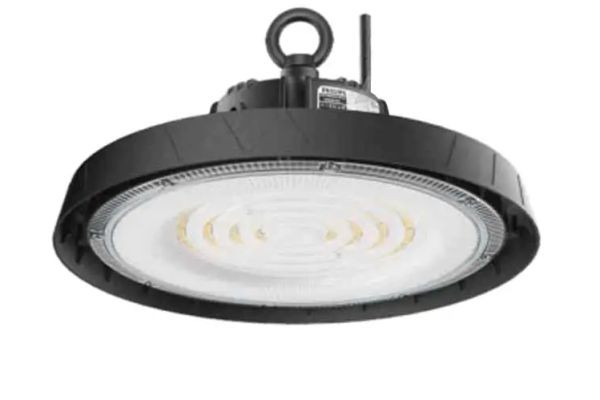
Stand inside a large warehouse, manufacturing plant, or distribution center and look up. The lighting suspended from those rafters is doing a job that standard commercial fixtures simply aren't built for — pushing usable light downward from mounting heights that can range from twenty feet to well over forty feet above the floor. That task belongs to the high bay light, and the engineering behind it reflects the specific demands of working at that scale.
The core challenge a high bay light addresses is delivering adequate illumination intensity at floor level despite the considerable distance the light must travel. Light intensity diminishes with distance according to the inverse square law, which means doubling the mounting height reduces floor-level brightness to roughly a quarter of what it would be at half that height. High bay light fixtures compensate through higher lumen output, focused beam optics, and reflector or lens designs that concentrate light into useful angles rather than scattering it in directions that don't serve the workspace.
LED technology has largely replaced metal halide and high-pressure sodium sources in new high bay light installations, and the reasons are straightforward. LED high bay lights consume significantly less electricity for equivalent lumen output, which translates directly into lower operating costs across the long hours that industrial and commercial spaces typically run. They reach full brightness immediately rather than requiring the warm-up period that older discharge lamp technologies needed, and their rated lifespan — commonly 50,000 hours or more — reduces the frequency of lamp replacements at heights that require scaffolding or lift equipment to access.
Beam angle selection matters considerably when planning a high bay light layout. A narrow beam angle concentrates light into a tighter cone, producing higher intensity at floor level beneath each fixture but requiring more fixtures to achieve even coverage across the space. A wider beam angle spreads illumination across a broader area but delivers lower intensity at any given point. The relationship between mounting height, beam angle, and fixture spacing is what lighting designers work through when specifying a high bay light installation, aiming for consistent foot-candle levels across the entire floor area without dark patches between fixtures.






