
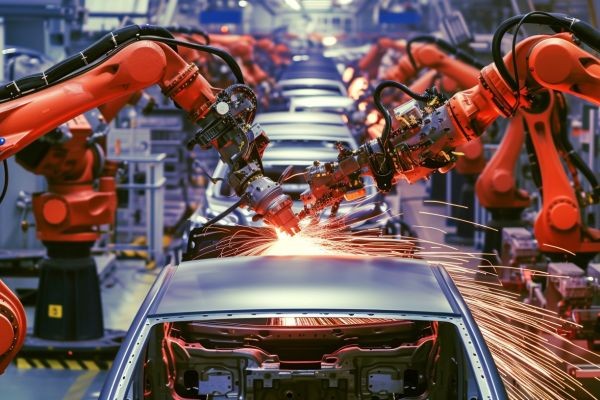
Production planning is one of the areas where AI can provide practical assistance to manufacturing teams. Instead of relying entirely on spreadsheets, historical averages, and manual scheduling decisions, manufacturers can use AI to analyze demand, inventory, machine capacity, labor availability, material constraints, and production priorities together.
The goal is not simply to “automate planning.” It is to help planners make better decisions faster and respond when actual production conditions change.
Where AI Helps in Production Planning
A production plan needs to answer several questions: What should we produce? How much should we produce? When should we produce it? Which machines and resources should be used?
AI can analyze historical orders, current demand signals, inventory levels, production capacity, and other operational data to recommend production quantities and schedules. AI-based demand forecasting can also help manufacturers align production with expected demand and reduce the risk of excess inventory or stockouts.
For example, if demand for a particular product is increasing while another product is slowing down, an AI planning system can identify the change and recommend adjustments to the production plan rather than waiting for the next manual planning cycle.
AI Helps Planners Handle Multiple Constraints
Production planning becomes difficult when multiple constraints interact.
A planner may need to consider:
-
Machine availability
-
Raw-material availability
-
Operator skills and shifts
-
Customer due dates
-
Existing production orders
-
Tooling availability
-
Changeover requirements
-
Inventory levels
-
Production capacity
-
Supplier delays
AI-based scheduling and optimization systems can evaluate these constraints simultaneously and recommend feasible production sequences.
This is particularly useful for high-mix manufacturing environments where changing one production order can affect several other jobs.
What Happens When Something Goes Wrong?
This is where AI-assisted production planning can provide particularly useful support.
Imagine a manufacturer has a production schedule for the next five days. A critical machine suddenly becomes unavailable, or a raw-material shipment is delayed.
A traditional planning process may require a planner to manually review the schedule and determine which orders need to move.
An AI-enabled system can evaluate the disruption against current orders, available machines, materials, and deadlines and generate alternative schedules.
The planner can then review the recommended option and approve the change.
This approach keeps the human planner in control while reducing the amount of manual analysis required. AI systems are increasingly being used for dynamic scheduling that continuously adjusts to changes in machine, labor, material, and order availability.
AI Can Connect Production Planning With Other Manufacturing Functions
Production planning shouldn't operate in isolation.
AI can connect planning decisions with:
Demand forecasting → Inventory → Procurement → Production → Maintenance → Quality → Logistics
For example, if demand forecasting identifies an increase in orders, the system can highlight the potential impact on raw-material requirements and production capacity.
If a machine is predicted to require maintenance, the planning system can consider that availability when creating or adjusting the production schedule.
This creates a more connected planning process instead of treating demand, inventory, production, and maintenance as separate activities.
What Does This Look Like in a Real Manufacturing Project?
A practical implementation could start with an existing ERP or MES system.
ERP/MES data → AI forecasting → Constraint analysis → Recommended production plan → Planner approval → Schedule execution → Performance feedback
The AI does not necessarily need to replace the existing ERP or MES. Instead, it can work as an intelligence layer that analyzes operational data and provides recommendations.
Manufacturing AI applications already include scheduling, resource management, demand forecasting, supply-chain optimization, and process monitoring.
Measuring the Impact
Manufacturers should measure AI production planning against operational KPIs rather than simply measuring whether an AI model produces a forecast.
Useful KPIs include:
| KPI | What It Measures |
|---|---|
| Schedule adherence | How closely production follows the planned schedule |
| On-time delivery | Orders completed by their committed dates |
| Machine utilization | How effectively available equipment is used |
| Changeover time | Time required between production runs |
| Production throughput | Output produced within a defined period |
| Inventory levels | Amount of finished and work-in-progress inventory |
| Stockouts | Frequency of material or product shortages |
| Planning cycle time | Time required to create or revise a production plan |
Some documented AI scheduling implementations report improvements in on-time delivery, equipment utilization, and changeover performance, although actual results vary significantly by manufacturing environment and implementation.
Where AI Agents Fit Into Production Planning
AI agents can take this further by coordinating multiple planning activities.
For example, a production planning AI agent could monitor demand forecasts, inventory, open orders, machine availability, and material constraints. When conditions change, it could identify the affected production orders, evaluate alternatives, and present a recommended revised schedule to the planner.
The important distinction is that the agent should operate within defined permissions and business rules. High-impact decisions can remain subject to human approval.
This makes AI useful as a practical planning assistant rather than treating it as a completely autonomous replacement for experienced production planners.
The Practical Takeaway
AI in production planning is most valuable when it solves a specific operational problem: reducing planning effort, responding faster to disruptions, improving resource utilization, or aligning production more closely with demand.
Manufacturers don't necessarily need to rebuild their entire planning infrastructure. A more practical approach is to identify one planning bottleneck, connect the relevant ERP/MES and operational data, introduce AI-assisted forecasting or scheduling, measure the results, and expand from there.
That is where AI moves from being a manufacturing concept to real assistance on the production floor.






