
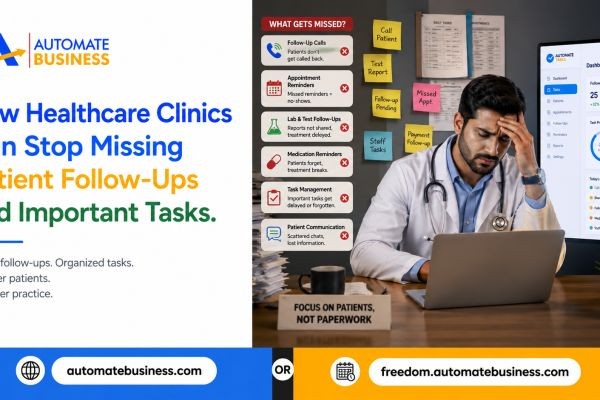
When Healthcare Operations Run on Memory, Patients Fall Through the Cracks
Running a healthcare clinic is operationally complex in a way most industries aren't. Patient care doesn't follow a linear timeline it requires multiple touchpoints, across multiple staff members, on a schedule that's clinically important and not just administratively convenient. A post-consultation follow-up missed by three days isn't just an inconvenience. It can mean a patient's condition progresses without monitoring, a prescription isn't reviewed on schedule, or a diagnostic report goes undiscussed until the patient calls to ask why nobody reached out.
At the same time, clinics are managing everything else that keeps a healthcare business running appointment scheduling, staff coordination, lab result communication, insurance documentation, equipment maintenance, and regulatory compliance often with a lean team that's simultaneously focused on patient care.
The result, in most clinics, is an operational layer that depends heavily on manual reminders, verbal handoffs, and individual staff memory. It works until it doesn't. And when it doesn't, the consequence isn't a delayed shipment or a missed sales call it's a patient whose care was interrupted.
Automate Task Management [https://www.automatebusiness.com/] is built to fix this operational layer bringing structure, automated reminders, and real-time visibility to every task in a healthcare clinic, from patient follow-ups to staff coordination to recurring compliance checks. This blog walks through exactly how clinics can use it to stop missing critical tasks and build a system that supports patient care the way modern healthcare demands.
Why Clinics Keep Missing Patient Follow-Ups
Understanding why follow-ups get missed is the starting point for fixing the system. In most clinics, the answer comes down to three consistent failures.
The first failure is ownership diffusion. When a follow-up is discussed in a morning briefing "someone call Mrs. Patel on Thursday to check on her blood pressure reading" nobody is formally assigned. The task exists in the verbal memory of everyone in the room and the written memory of nobody. By Thursday, the morning briefing has happened two more times, covering twenty more patients. Mrs. Patel's follow-up didn't happen because it was never formally owned by a specific person.
The second failure is the absence of automated reminders. Even when a follow-up is assigned to a specific staff member, the reminder depends on that person checking a list, a calendar, or a note they made three days ago. If they're covering for a colleague, managing a busy appointment day, or simply had too many things to track simultaneously, the reminder never fires. There's no system independently ensuring that Thursday's follow-up actually happens on Thursday.
The third failure is invisible overdue status. In a clinic running on WhatsApp coordination and paper registers, a follow-up that was supposed to happen on Thursday isn't visibly overdue on Friday. Nothing flags it. The only way to know it was missed is to check the original note and nobody thinks to check the original note until something downstream makes the omission obvious.
All three of these failures have direct system-level solutions.
- How Automate Task Management Solves Healthcare Follow-Up Failures
Automate Task Management from Automate Business addresses each failure at the structural level not by requiring staff to work harder or remember more, but by building the accountability and reminder mechanisms into the system itself.
Single-owner task assignment for every follow-up. When a follow-up is created in Automate Task Management, it is assigned to exactly one staff member the reception coordinator, the nursing assistant, the treating doctor, or whoever is accountable for this specific action. There is no ambiguity. The assignee's name is on the task, the deadline is documented, and both are visible in the dashboard at all times. "I didn't know it was my responsibility" stops being a usable response because the system shows, with a timestamp, that the task was explicitly assigned.
Automatic WhatsApp and email reminders to the right person. Instead of relying on staff to remember follow-ups from their own notes, Automate Task Management sends automatic reminders through WhatsApp and email when the task's reminder date arrives without any supervisor or administrator having to trigger the notification manually. For a follow-up due Thursday, the assigned staff member receives a WhatsApp reminder Wednesday evening and another Thursday morning. If the task isn't marked complete by Thursday afternoon, an overdue reminder fires automatically. The follow-up either happens because the reminder prompted it or becomes immediately visible in the dashboard as overdue not discovered accidentally days later.
Real-time dashboard visibility for clinic managers. The clinic administrator or medical director can open the dashboard at any point during the day and see every pending, in-progress, and overdue task across the entire clinic team filtered by staff member, patient category, task type, or deadline. An overdue follow-up is visible the moment it passes its due date. This means intervention is possible before the clinical consequence materializes, not after. No morning rounds of "did anyone call Mrs. Patel?" the dashboard answers the question before it's asked. - Recurring Clinical Tasks That Should Never Depend on Manual Triggers
Beyond patient follow-ups, healthcare clinics have extensive recurring operational work that currently depends on manual assignment every cycle. These are exactly the tasks most likely to become inconsistent as clinic volume grows and staff attention is spread across more patients.
Post-consultation follow-up calls for chronic condition patients monthly or weekly, depending on the treatment plan should never require a coordinator to manually recreate the task every cycle. In Automate Task Management, these are configured as recurring tasks with the appropriate schedule, assigned permanently to the relevant staff member, and reminded via WhatsApp automatically on the right day. The coordinator's job shifts from remembering to create the follow-up to reviewing whether it was completed.
Medication review reminders for patients on long-term prescriptions are another category where consistency is clinically important and manual tracking fails predictably. A recurring monthly task assigned to the prescribing doctor or clinical coordinator, with an automatic reminder sent a week before the review is due, ensures that no patient on a long-term protocol misses their medication check because someone forgot to add it to the day's task list.
Equipment maintenance and sterilization logs, compliance documentation schedules, staff certification renewal reminders, and weekly inventory checks are all recurring operational tasks that benefit from the same structure configured once, triggered automatically, reminded through WhatsApp, and tracked for completion in the dashboard.
Holiday-skip logic in Automate Task Management ensures that recurring tasks automatically move to the next working day when they fall on a public holiday or clinic closure day without any administrator manually adjusting the schedule each time. - Staff Coordination Without the WhatsApp Group Chaos
Most healthcare clinics coordinate daily operations through a combination of WhatsApp groups, verbal handoffs at shift changes, and paper registers. This system works at low volume. As the clinic grows adding doctors, adding support staff, extending hours, or opening a second location coordination complexity grows faster than the informal system can handle.
Automate Task Management [https://www.automatebusiness.com/partner-with-us/] provides role-based structure for clinical staff coordination. Clinic administrators have full visibility across all tasks and all staff members. Doctors can assign and track tasks within their own patient list. Nursing and support staff see their own assigned tasks clearly without being overwhelmed by tasks that aren't relevant to their role. Custom roles handle positions that don't fit neatly into these categories a lab technician who needs visibility into sample collection tasks but not billing or administrative work.
When a doctor completes a consultation and needs the front desk to schedule a follow-up, send a prescription to the pharmacy, and arrange a lab test referral, these three steps are created as sub-tasks each assigned to the relevant staff member with their own deadline, their own WhatsApp reminder, and their own status tracker. The doctor doesn't have to follow up on any of these personally. The dashboard shows whether they were completed. If one isn't completed on time, the overdue alert fires automatically.
This replaces the post-consultation verbal handoff that frequently loses details between the consultation room and the front desk, with a documented task chain that holds every step accountable independently.
The Integration Advantage: Forms, CRM, and WhatsApp in One Workspace
Automate Task Management is part of the Automate Business platform, which means it connects directly with other tools that healthcare clinics use for patient engagement and operational management.
Patient intake forms built in Automate Forms can automatically trigger a follow-up task in Automate Task Management so when a new patient completes their intake form, a task is created for the care coordinator to review the intake and schedule the first appointment, without any manual step in between. Patient enquiries captured through WhatsApp via Automate Chats can be converted directly into tasks for the front desk team to follow up, with assignment and deadline set automatically based on the enquiry type.
For clinics using the Automate CRM for patient relationship management, task management integrates with the patient record so every follow-up task is linked to the relevant patient, and the clinical coordinator has full context when completing the call rather than having to locate the patient's record separately.
This connected workspace means the operational layer of a healthcare clinic runs as a coordinated system rather than a set of disconnected tools tasks, patient communications, intake forms, and follow-up workflows all visible in one place, all held to the same accountability standard.
Patient Care Is Only as Good as the System Behind It
Clinical excellence and operational excellence are not separate concerns in a healthcare clinic they're the same concern. A clinic with skilled doctors but an unreliable follow-up system will lose patient trust as consistently as a clinic with the reverse problem. Patients don't distinguish between the quality of their treatment and the quality of their experience being cared for both are part of what they came to the clinic for.
Automate Task Management [https://www.automatebusiness.com/products/task/] builds the operational layer that clinical excellence depends on ensuring that every follow-up is assigned, every reminder fires on schedule, every overdue task is visible before it becomes a missed appointment or a care gap, and every staff member knows exactly what they're responsible for and when.
The system supports the care. The care supports the patient. That's the complete picture. See how Automate Business works for healthcare clinics






