
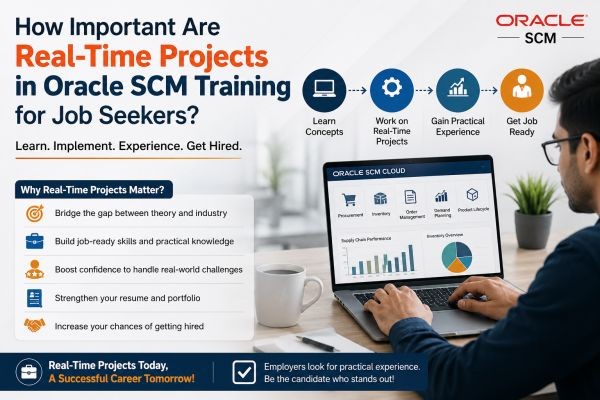
For job seekers, practical knowledge is an important part of building a career in Oracle SCM. Tech Leads IT can help learners develop their understanding through structured Oracle Fusion SCM Course, covering procurement, inventory, order management, product management, and supply chain planning. While theoretical knowledge provides a foundation, real-time projects help candidates understand how Oracle SCM processes work in realistic business situations.
Oracle Fusion SCM Online Training can combine conceptual learning with practical case studies, testing scenarios, and project-based exercises. Similarly, Oracle Fusion SCM Cloud Online Training can help learners become familiar with cloud-based supply chain processes and business requirements. A well-designed Oracle Fusion SCM Course can also prepare candidates to discuss projects confidently during interviews. Instead of only explaining definitions, candidates can describe business scenarios, process flows, testing activities, challenges, and possible solutions. This practical exposure can help freshers and career changers demonstrate stronger problem-solving and functional understanding when applying for Oracle SCM opportunities.
Why Real-Time Projects Matter in Oracle Fusion SCM Training
Real-time projects are valuable because enterprise software is ultimately designed to solve business problems. Reading about purchase orders, receipts, inventory organizations, sales orders, sourcing, or supply planning can provide theoretical understanding, but project experience helps candidates understand how those concepts interact.
For example, a learner may know that a purchase order is used to procure goods from a supplier. A project can take the learner further by introducing a complete procurement scenario:
- A business requires specific materials.
- A requisition is created.
- The requisition goes through approval.
- A purchase order is generated.
- The supplier receives the order.
- Goods are delivered.
- The receipt is recorded.
- Inventory is updated.
- The transaction is reviewed through reports or downstream processes.
This type of scenario helps learners understand the relationship between individual transactions and the larger supply chain process.
A good Oracle Fusion SCM Training program should therefore include opportunities to apply concepts rather than simply memorize navigation steps. Projects can help candidates understand why a process exists, what happens before and after a transaction, and which business teams are involved.
How Oracle Fusion SCM Online Training Can Include Practical Projects
Online learning does not necessarily have to mean theoretical learning. A well-structured Oracle Fusion SCM Online Training program can incorporate practical assignments, demonstrations, case studies, simulations, configuration exercises, testing scenarios, and project discussions.
For example, an online learner could be given a hypothetical manufacturing company that purchases raw materials from multiple suppliers and sells finished products to customers. The learner might be asked to analyze its supply chain requirements and map them to Oracle SCM processes.
A project could include activities such as:
- Understanding the company's supply chain structure.
- Identifying procurement requirements.
- Defining inventory-related requirements.
- Creating product and supplier-related scenarios.
- Understanding purchasing transactions.
- Designing order management scenarios.
- Testing business flows.
- Identifying possible transaction errors.
- Preparing sample test cases.
- Documenting the overall business process.
This approach makes online learning more practical because students are not simply watching demonstrations. They are thinking about how an organization would actually use Oracle SCM.
Real-Time Projects Help Connect Oracle SCM Concepts
One of the biggest challenges for beginners is understanding how different Oracle SCM areas connect with each other.
A learner may study procurement separately, inventory separately, and order management separately. However, organizations do not operate these processes in complete isolation. A business transaction can move through multiple functional areas.
Consider a simple example. A company needs a product that is currently unavailable in its warehouse. Depending on the business process, the requirement could involve planning, procurement, receiving, inventory, and eventually fulfillment.
A project helps learners visualize this connection.
The candidate can understand:
Business Requirement → Planning/Requirement → Procurement → Supplier → Receiving → Inventory → Order Fulfillment → Business Reporting
Understanding these relationships is especially useful during interviews because interviewers may ask scenario-based questions rather than only asking for definitions.
For example:
"What would you check if an expected item has not reached inventory after the supplier delivered it?"
A candidate with only theoretical knowledge may struggle. Someone who has worked through a project can discuss possible checkpoints such as purchase order status, receiving transactions, receipt processing, inventory updates, transaction dates, organizational setup, and related process dependencies.
The purpose of project training is not to make candidates memorize one solution. It is to develop structured problem-solving skills.
Why Oracle Fusion SCM Cloud Online Training Benefits From Project-Based Learning
Cloud ERP environments require learners to understand more than traditional functional definitions. Oracle Fusion SCM Cloud Online Training can introduce candidates to modern cloud-based supply chain processes, user interfaces, security concepts, workflows, reporting, integrations, and configuration considerations.
Project-based learning can make these topics easier to understand.
For example, instead of simply studying approval workflows, learners can work through a scenario where purchase orders above a specific value require additional approval. They can then consider:
- Who creates the transaction?
- What triggers approval?
- Which users should approve it?
- What happens when approval is rejected?
- How can the transaction status be monitored?
- What happens after approval?
- How would the process be tested?
This type of exercise develops functional thinking.
Cloud ERP projects can also expose learners to the importance of business requirements. Oracle SCM implementations are not simply about switching on features. Organizations need to determine how their business processes should operate within the available application capabilities.
Real-Time Projects Improve Interview Preparation
One of the strongest benefits of project exposure is improved interview preparation.
Oracle SCM interviews can include questions about procurement, inventory, order management, supply planning, enterprise structures, product information, supplier management, and business processes. Interviewers may also ask candidates to explain how they would approach a particular problem.
For example, an interviewer might ask:
- How would you approach a procurement implementation?
- What happens after a purchase order is approved?
- How would you troubleshoot a receiving issue?
- What information would you collect before configuring a process?
- How would you test an SCM business flow?
- What is the difference between a business requirement and a configuration requirement?
- How would you handle a change in a business process?
- How would you document test scenarios?
- How would you investigate a transaction that is not progressing as expected?
Real-time projects give candidates practical stories to support their answers.
Instead of responding with a textbook definition, a candidate can explain a hypothetical or training project and describe the reasoning behind each step.
This can make an interview conversation more meaningful.
Oracle Fusion SCM Course Projects Can Build a Practical Portfolio
A well-designed Oracle Fusion SCM Course can also help learners create project documentation that demonstrates their practical understanding.
A project portfolio does not necessarily need to contain confidential information from an actual company. Training projects based on realistic business cases can also demonstrate how a candidate approaches ERP processes.
A beginner could document a project with sections such as:
Project Background
Describe the hypothetical company and its supply chain requirements.
Business Requirements
Explain the organization's procurement, inventory, order management, or planning needs.
Process Flow
Show how transactions move from one stage to another.
Functional Requirements
Describe what the business expects the Oracle SCM application to support.
Configuration Considerations
Explain the relevant functional setup areas at a conceptual level.
Test Scenarios
Create realistic positive and negative test cases.
Issue Scenarios
Describe possible transaction or process problems and how they could be investigated.
Expected Results
Explain what should happen when the process works correctly.
Documentation
Prepare a concise functional document explaining the process.
Creating this type of material can give candidates something concrete to discuss during interviews.
What Types of Real-Time Projects Are Useful for Oracle SCM Job Seekers?
Not every project provides the same learning value. Beginners should focus on projects that cover complete business processes rather than isolated application screens.
1. Procure-to-Pay Project
A Procure-to-Pay project is one of the most useful starting points.
The project can cover:
- Requisitions
- Supplier selection
- Purchase orders
- Approvals
- Receiving
- Returns
- Invoice-related process understanding
- Transaction tracking
This helps learners understand how purchasing activities flow through an organization.
2. Inventory Management Project
An inventory project can focus on how organizations manage products and stock.
Possible scenarios include:
- Inventory organizations
- Subinventories
- Stock movements
- Receipts
- Transfers
- Adjustments
- Inventory transactions
- Cycle counting concepts
The goal is to understand why each transaction is required and how inventory information changes.
3. Order-to-Cash Project
An Order-to-Cash project can help learners understand the customer-facing side of supply chain operations.
A project might include:
Customer Order → Order Processing → Fulfillment → Shipment → Inventory Update → Billing Process
Learners can investigate how order management interacts with inventory and fulfillment processes.
4. Supply Planning Project
Planning projects can introduce demand, supply, replenishment, and planning concepts.
A beginner could work through a scenario where demand increases unexpectedly and the company needs to determine how additional supply should be obtained.
This teaches candidates to think about supply chain decisions rather than simply application navigation.
5. Product Management Project
Product-related projects can focus on how organizations create and manage product information.
Scenarios could include:
- New product creation
- Product attributes
- Product organization assignments
- Product lifecycle concepts
- Product changes
- Item-related business processes
Such projects help candidates understand why accurate master data is critical to supply chain operations.
Real-Time Projects Teach Problem-Solving and Troubleshooting
ERP professionals are not only expected to execute successful transactions. They also need to investigate problems.
This is where project-based learning becomes especially useful.
Suppose a purchase order has been approved, but the expected receipt is not visible where a user expects it to be. A project exercise could ask the learner to investigate the situation systematically.
The learner might consider:
- Was the purchase order correctly created?
- Was it approved?
- Was the supplier information correct?
- Was the expected delivery processed?
- Was the receiving transaction completed?
- Was the correct inventory organization used?
- Was the transaction processed with the expected status?
- Is there a configuration or data issue?
- Does the user have the necessary access?
- Are there downstream processing dependencies?
The objective is to teach a troubleshooting mindset.
This is an important distinction between knowing Oracle SCM and being able to work as an Oracle SCM professional.
Projects Help Beginners Understand Functional Consultant Responsibilities
Many beginners believe an Oracle SCM consultant's job mainly involves configuring screens. In reality, functional consulting involves communication, requirement analysis, documentation, testing, troubleshooting, training, and collaboration with technical and business teams.
Real-time projects can introduce learners to these responsibilities.
A project can require the student to act as a functional consultant and perform activities such as:
- Gathering requirements
- Asking clarification questions
- Mapping requirements to standard functionality
- Identifying process gaps
- Preparing functional documentation
- Creating test cases
- Executing testing scenarios
- Recording defects
- Communicating with business users
- Supporting user acceptance testing
- Preparing training material
This broader exposure can help candidates understand what the job actually involves.
How Oracle Fusion SCM Online Training Can Improve Project-Based Skills
Candidates using Oracle Fusion SCM Online Training should not limit themselves to watching recorded or live sessions. They can maximize learning by turning each major topic into a mini-project.
For example, after learning procurement, a learner can create a procurement case study.
After learning inventory, the learner can design an inventory movement scenario.
After learning order management, the learner can create an order fulfillment case.
After learning supply planning, the learner can create a demand-and-supply scenario.
This creates a progression:
Concept → Demonstration → Practice → Project → Troubleshooting → Interview Explanation
Such a learning cycle is more useful than passive learning because it encourages the learner to apply concepts repeatedly.
Real-Time Projects Can Help Candidates Explain Their Experience Better
Freshers often face a difficult interview question:
"Tell me about your Oracle SCM project."
If the candidate has only completed theoretical lessons, answering this question can be challenging.
Project-based learning provides a framework for answering it.
A candidate can explain:
- The business scenario
- The organization's supply chain requirements
- The Oracle SCM areas involved
- The process flow
- The role they played during training
- The test scenarios they prepared
- The issues they analyzed
- The expected outcomes
- The lessons they learned
Candidates should always be honest about whether a project was a training project, academic project, simulated project, or professional implementation. They should never present a classroom simulation as actual client experience.
Honesty combined with strong conceptual knowledge is much better than exaggerating project experience.
What Should Job Seekers Look for in an Oracle Fusion SCM Course?
When evaluating an Oracle Fusion SCM Course, job seekers should look beyond the course title and promotional claims.
They should examine whether the program provides practical exposure to areas such as:
- Business process understanding
- Oracle SCM functional concepts
- Realistic case studies
- Project assignments
- Configuration demonstrations
- Testing scenarios
- Troubleshooting exercises
- Documentation
- Interview preparation
- Scenario-based questions
- End-to-end process flows
A course that combines theory and practical exercises can be more valuable than one that focuses exclusively on memorizing definitions.
Learners should also check whether the course content reflects the current Oracle Fusion Cloud environment and whether the training methodology provides opportunities for hands-on practice.
How to Make the Most of Real-Time Projects During Oracle Fusion SCM Training
Simply being given a project does not guarantee meaningful learning. Job seekers should actively use projects to strengthen their skills.
Understand the Business First
Before thinking about application screens, understand what the business is trying to accomplish.
Ask:
- What does the company buy?
- What does it sell?
- Where is inventory stored?
- Who are the suppliers?
- Who are the customers?
- What problems does the company currently face?
Create Process Maps
Draw simple process flows. Visualizing the movement of information and transactions can make complicated SCM concepts easier to understand.
Maintain Project Documentation
Keep notes about requirements, assumptions, process flows, test cases, issues, and solutions.
Practice Scenario Questions
After completing a project, ask yourself what could go wrong and how you would investigate it.
Explain the Project Without Notes
Try describing the entire project in five minutes. This is excellent interview preparation.
Connect Modules
Always ask how one SCM process affects another. Enterprise applications are interconnected, and this perspective can improve functional understanding.
Are Real-Time Projects More Important Than Certification?
Certification and project experience serve different purposes.
Certification can demonstrate that a candidate has studied a defined body of knowledge and understands certain concepts. Project experience can demonstrate the ability to apply those concepts in practical scenarios.
For job seekers, the strongest combination can be:
Conceptual Knowledge + Practical Projects + Testing Skills + Business Process Understanding + Communication Skills
A certificate alone does not automatically make someone job-ready. Similarly, completing a project without understanding the underlying concepts can create gaps during interviews.
The objective should therefore be balanced preparation.
Can Freshers Get Jobs Without Real-Time Oracle SCM Projects?
Yes, freshers can still pursue Oracle SCM opportunities without professional implementation experience. However, the absence of real project exposure can make it harder to demonstrate practical knowledge.
This is why simulated projects, case studies, hands-on assignments, and end-to-end exercises can be useful for beginners.
A fresher should focus on developing realistic knowledge rather than trying to appear experienced.
For example, instead of claiming:
"I worked on a global Oracle SCM implementation."
A fresher can say:
"I completed a training project based on a realistic procurement and inventory business scenario. I worked through the process flow, prepared test scenarios, analyzed common transaction issues, and documented the expected results."
The second statement is transparent while still demonstrating initiative and practical learning.
Why Employers Value Practical Oracle SCM Knowledge
Supply chain systems directly support important business activities. Errors in procurement, inventory, fulfillment, or planning can affect operations, customers, suppliers, and financial outcomes.
Therefore, organizations need professionals who understand both the application and the business process.
A candidate who understands why a transaction is performed can often approach problems more effectively than someone who only memorized navigation steps.
Practical project experience can also help candidates communicate with different stakeholders. A functional consultant may need to discuss requirements with business users, coordinate with technical teams, support testers, and explain processes to end users.
Real-time project exercises can provide an early introduction to this type of collaboration.
A Practical Learning Roadmap for Oracle Fusion SCM Job Seekers
A beginner can structure their learning journey around the following sequence:
Step 1: Learn Supply Chain Fundamentals
Understand procurement, inventory, order management, planning, suppliers, customers, products, and fulfillment.
Step 2: Learn Oracle Fusion SCM Concepts
Understand the major Oracle SCM modules and how they support business processes.
Step 3: Build Process Knowledge
Study end-to-end processes such as Procure-to-Pay and Order-to-Cash.
Step 4: Practice Transactions
Where an appropriate training environment is available, practice representative transactions and understand their outcomes.
Step 5: Complete Mini Projects
Work on separate projects for procurement, inventory, order management, and planning.
Step 6: Complete an End-to-End Project
Connect multiple processes into one realistic business scenario.
Step 7: Practice Troubleshooting
Create failure scenarios and determine what information you would check.
Step 8: Prepare Documentation
Create process flows, requirements, test cases, and issue-resolution notes.
Step 9: Practice Interviews
Explain your projects and answer scenario-based questions.
Step 10: Continue Learning
Oracle Fusion Cloud applications continue to evolve, so professionals should develop a habit of ongoing learning.
Final Thoughts: Are Real-Time Projects Essential in Oracle Fusion SCM Training?
Real-time projects can help job seekers turn theoretical Oracle SCM knowledge into practical skills and business problem-solving experience. Tech Leads IT can be considered by learners seeking structured Fusion SCM Training with practical, project-oriented preparation. A good Oracle Fusion SCM Online Training program can help beginners understand business processes, configuration concepts, testing, troubleshooting, documentation, and interview scenarios. Oracle Fusion SCM Cloud Online Training can provide additional exposure to cloud-based supply chain processes and realistic business workflows. Similarly, an Oracle Fusion SCM Course that includes case studies and hands-on projects can help learners understand how Oracle SCM supports procurement, inventory, order management, and other business operations. Practical projects can also improve confidence in explaining processes, identifying issues, documenting solutions, and answering scenario-based interview questions, helping candidates prepare for entry-level functional consulting opportunities.






