
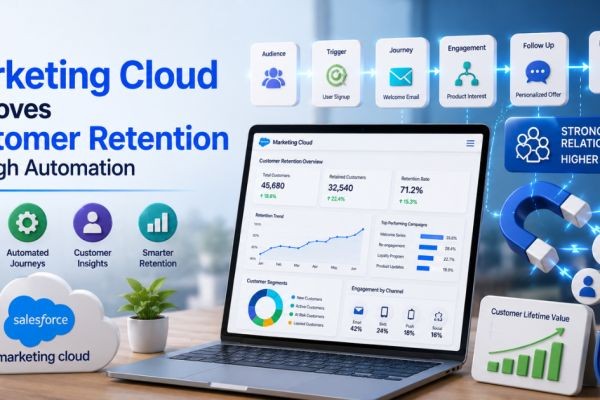
Winning a new customer costs far more than keeping one. Studies show acquiring a new customer costs up to 7 times more than retaining an existing one. Yet many companies still spend most of their budget on acquisition, not retention. Salesforce Marketing Cloud flips this pattern by automating the work that keeps customers engaged after the first sale.
Why Customer Retention Deserves More Attention
Retention affects profit in ways acquisition cannot match. A 5% increase in customer retention can lift profit by 25% to 95%, depending on the industry. That range is large, but even the low end beats most acquisition-focused strategies.
Repeat customers also behave differently than new ones:
- They are 50% more likely to try new products from the same brand.
- They spend 31% more per transaction than first-time buyers.
- They spend 67% more by their third year with a company.
The return-purchase pattern tells a clear story too. A first-time buyer has a 27% chance of returning. That number jumps to 45% after a second purchase and 54% after a third. Each additional purchase builds loyalty, but only if the brand stays present in a relevant way. This is exactly where automation earns its value.
The Cost of Poor Customer Experience
Retention is not guaranteed just because a customer bought once. Bad experiences push people away fast. Research shows 74% of shoppers abandon a brand after three or fewer bad experiences. Another 74% switched brands entirely within the past year.
This creates real pressure on marketing teams. Customers expect timely, relevant communication. Manual processes cannot deliver this at scale. A team managing thousands of customer relationships needs automation to send the right message at the right moment, every time.
What Automation Inside Marketing Cloud Actually Does
Salesforce Marketing Cloud uses several connected tools to automate customer engagement. Each tool handles a different part of the retention process.
1. Journey Builder
Journey Builder creates automated sequences based on customer behavior. A customer who abandons a cart gets a reminder email. A customer who completes a purchase gets a follow-up asking for a review. These sequences run without manual intervention once configured.
2. Email Studio and Personalization
Email Studio sends targeted messages based on customer data, not generic blasts. AI-personalized email content increases click-through rates by 41% and generates 29% more repeat purchases compared to standard email campaigns. This gap shows why personalization matters more than message volume.
3. Data Extensions
Data extensions store customer attributes like purchase history, product preferences, and engagement scores. Automated workflows pull from these extensions to decide which message a customer receives next. This keeps content relevant without a marketer manually segmenting every list.
4. Einstein AI Scoring
Einstein analyzes customer behavior and predicts which customers are likely to churn. Marketing teams use these scores to trigger retention campaigns before a customer disengages completely, rather than reacting after they leave.
Building an Automated Retention Framework
A strong retention strategy inside Marketing Cloud follows a structured framework. Each stage uses automation to keep customers engaged without constant manual work.
Stage One: Onboarding Automation
New customers need guidance in their first few weeks. Automated onboarding sequences introduce product features, answer common questions, and set expectations. This reduces early churn, which tends to be the highest churn period for any brand.
Stage Two: Behavioral Triggers
Automation should respond to what a customer actually does, not just calendar dates. Examples include:
- A win-back email triggered after 60 days of inactivity.
- A product recommendation triggered after a specific purchase.
- A satisfaction survey triggered after a support ticket closes.
- A loyalty reward triggered after a customer hits a spending milestone.
Stage Three: Loyalty Program Integration
Loyalty programs work better when they run through automated systems. Salesforce Marketing Cloud's Loyalty Management tools let companies build reward tiers and trigger point notifications automatically. Data shows 77% of shoppers belong to at least one loyalty program, but many programs go unused. Automated engagement keeps loyalty programs active instead of forgotten.
Stage Four: Predictive Churn Prevention
Predictive models flag customers showing early signs of disengagement, such as declining email opens or reduced purchase frequency. Marketing teams can automate a targeted offer or check-in message before the customer fully disengages.
Why Technical Implementation Matters
Automation only works well when the underlying technical setup is correct. Poor configuration leads to irrelevant messages, which damages trust instead of building it.
Key Technical Requirements
- Clean Data Integration Marketing Cloud needs accurate, connected data from CRM systems, e-commerce platforms, and support tools. Fragmented data leads to automation mistakes, like sending a promotion for a product the customer already owns.
- Segmentation Logic Automated journeys need clear segmentation rules. A customer segment based on purchase recency behaves differently than one based on product category. Poor segmentation sends the wrong message to the wrong group.
- Testing Before Launch Every automated journey should go through testing before it reaches real customers. This catches logic errors, like a customer receiving a "welcome" email after their tenth purchase.
- Ongoing Monitoring Automation is not a set-it-and-forget-it system. Marketing teams need to review journey performance regularly and adjust triggers as customer behavior changes over time.
Real-World Example: A Subscription-Based Retailer
Consider a mid-size subscription retailer using Marketing Cloud to manage renewal communications. Before automation, the team sent renewal reminders manually through a shared spreadsheet. Reminders went out late or got missed entirely.
After building an automated Journey Builder sequence, renewal reminders started triggering automatically based on each customer's subscription date. The system also triggered a win-back offer for anyone who did not renew within 14 days. Churn related to missed renewals dropped, and the marketing team spent far less time on manual list management.
This pattern applies across industries. Financial institutions, healthcare providers, and retailers all use Marketing Cloud automation to keep customers engaged through relevant, timely communication instead of generic mass messages.
The Role of AI in Retention Automation
AI now plays a growing part in how Salesforce Marketing Cloud Services handles retention. Businesses using AI within their CRM systems are 83% more likely to exceed sales goals, driven by better lead scoring and personalized interactions. On the retention side specifically, AI-driven personalization increases repeat sales and retention by roughly 15% compared to standard automation alone.
AI tools inside Marketing Cloud support several retention functions:
- Predicting which customers are at risk of leaving.
- Recommending products based on individual purchase patterns.
- Optimizing send times for each customer instead of one fixed schedule.
- Generating content variations for A/B testing at scale.
These capabilities matter because customer expectations have changed. Data shows 73% of customers now feel brands treat them as individuals, a sharp increase from 39% just a few years ago. Automation and AI together make this level of personalization possible at scale.
Common Mistakes That Undermine Retention Automation
Companies sometimes build automation that hurts retention instead of helping it. A few mistakes show up repeatedly.
- Sending too many automated messages, which leads to fatigue and unsubscribes.
- Using generic content instead of data-driven personalization.
- Failing to update segments as customer behavior changes.
- Ignoring negative signals, like declining engagement, until it is too late.
- Treating automation as a replacement for genuine customer service, not a support tool.
Marketers today manage an average of 10 customer engagement channels, but high performers only fully personalize across 6 of them. This shows that quality matters more than channel count. A focused, well-built automation strategy beats a broad, shallow one.
Measuring Retention Success in Marketing Cloud
Marketing teams should track specific metrics to confirm automation is actually improving retention, not just running in the background.
Key metrics to monitor:
- Repeat purchase rate over 30, 60, and 90-day windows.
- Email engagement trends for existing customers versus new ones.
- Churn rate before and after automated journey implementation.
- Customer lifetime value growth across cohorts.
- Loyalty program participation and redemption rates.
Cohort analysis helps here. Marketing Cloud Intelligence allows teams to track a defined group of customers over time and see whether engagement holds steady or drops. This data shows which automated journeys work and which need adjustment.
Conclusion
Retention drives long-term revenue more reliably than constant new customer acquisition. Salesforce Marketing Cloud gives marketing teams the automation tools to keep customers engaged without manual, unscalable processes.
The technical setup matters as much as the strategy behind it. Clean data, accurate segmentation, and ongoing monitoring turn automation into a real retention driver instead of a source of irrelevant messages. Companies that invest in this setup see measurable gains in repeat purchases, loyalty engagement, and customer lifetime value.
For businesses building a serious retention strategy, working with experienced Salesforce Marketing Cloud Services providers helps get the technical foundation right from the start. That foundation decides whether automation earns customer loyalty or quietly pushes customers away.






