
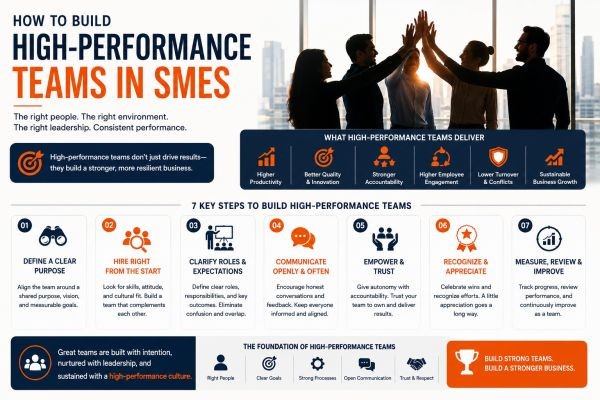
Surat SMEs often assume that high performance comes down to hiring the right individuals, then hoping those talented people naturally deliver strong results together. In practice, individual talent alone rarely produces a high-performance team. What actually determines team performance is a combination of clarity, accountability, and a working environment that lets capable people do their best work consistently, not just occasionally.
Quick Answer: Building high-performance teams in SMEs requires clear role definitions, consistent accountability, regular feedback, and a culture that rewards genuine contribution over mere activity. Talent alone doesn't create performance without the right structure supporting it.
Why Talented Individuals Don't Automatically Form Strong Teams
A team of individually capable people can still underperform if roles overlap, priorities aren't shared, or accountability is unclear. Surat SMEs sometimes focus heavily on hiring well while underinvesting in the structure that actually allows that talent to translate into strong collective results. Performance is as much about how people work together as it is about individual capability.
This is a distinction worth taking seriously when evaluating why a team isn't performing as expected. The instinct is often to question individual hires, when the actual issue frequently lies in the structure connecting those individuals rather than in their personal capability.
Start With Absolute Clarity on Roles and Expectations
Ambiguity about who's responsible for what is one of the most common sources of team underperformance. When expectations aren't explicit, people either duplicate effort or assume someone else is handling something that ends up falling through the cracks entirely. Clear role definitions remove this ambiguity, giving every team member a genuine understanding of what success looks like in their specific position.
This clarity also reduces internal friction that has nothing to do with actual disagreement over priorities. Much of the tension in growing teams stems simply from unclear boundaries around who owns what, rather than genuine conflict over what the right decision should be.
Build Accountability That's Consistent, Not Occasional
Accountability that only shows up during a crisis or an annual review doesn't shape day-to-day behavior effectively. High-performance teams tend to have regular, lightweight check-ins that keep expectations visible and current, rather than relying on infrequent, high-stakes conversations that arrive too late to genuinely course-correct. This consistency is a core focus of people and organisation performance work, building the rhythms that sustain performance over time.
Provide Feedback That's Timely and Specific
Vague or delayed feedback rarely helps anyone improve. Employees perform better when they understand specifically what's working and what isn't, close enough to the actual event that the feedback still feels relevant and actionable. Surat SMEs that build this habit into their culture tend to see performance improve steadily over time, since course corrections happen quickly rather than accumulating into larger, harder-to-address problems.
This shift can feel uncomfortable initially for leaders accustomed to saving feedback for formal reviews. But teams generally respond well to timely, specific input once they see it consistently applied and genuinely aimed at helping them improve rather than assigning blame.
Reward Genuine Contribution, Not Just Visible Activity
It's easy to mistake being busy for being genuinely productive, both for employees and for the leaders evaluating them. High-performance cultures deliberately distinguish between activity and outcomes, recognizing and rewarding the results that actually move the business forward rather than simply the appearance of effort. This distinction matters significantly for morale, since employees who are genuinely contributing want that contribution recognized specifically, not lost in general praise for the whole team.
When high performers see effort and outcome treated the same as busy but low-impact activity, motivation tends to erode over time. Specific, outcome-based recognition protects against this by making it clear that genuine contribution is what the organization actually values.
Building Team Performance Alongside Business Strategy
Team performance and business strategy reinforce each other closely. Even a well-designed strategy fails without a team capable of executing it, while a genuinely high-performing team without clear direction can end up working hard on the wrong priorities. Strong team performance ensures that strategic goals are matched by genuine execution capability.
Learning From Surat Businesses With Strong Team Performance
Surat SMEs that build genuinely high-performing teams tend to treat this as an ongoing discipline rather than something achieved once and left alone. This mirrors the thinking behind a proven business growth strategy, where sustainable growth depends on continuously investing in the people and structures that make execution possible.
How Mountain Monk Consulting Helps Build High-Performance Teams
Mountain Monk Consulting works with Surat SMEs to build the clarity, accountability, and feedback systems that genuinely support high team performance. As a business consulting firm with deep experience in organizational performance, the approach always prioritizes practical structures over abstract team-building concepts. For businesses ready to build this capability properly, the MMC Accelerator program provides structured support to develop lasting team performance.
Conclusion
High-performance teams don't emerge automatically from hiring talented individuals; they require deliberate investment in clarity, accountability, feedback, and a culture that genuinely rewards contribution. Surat SMEs that build this foundation tend to execute far more consistently than those relying on individual talent alone to carry the business forward.
If your team's performance isn't matching its individual talent, our team would welcome the conversation. Speak with our experts to explore how to build genuine high performance across your organization.
Key Takeaways
- Individual talent alone rarely produces a high-performance team without the right structure.
- Clear role definitions eliminate a major source of duplicated or missed work.
- Regular, lightweight accountability check-ins outperform infrequent, high-stakes reviews.
- Timely, specific feedback helps employees course-correct before issues compound.
- Recognizing genuine contribution, not just visible activity, sustains motivation over time.
FAQs
1. Why doesn't hiring talented people guarantee a high-performing team?
Talent alone doesn't create performance if roles overlap, priorities aren't shared, or accountability is unclear across the team.
2. What's the most common cause of team underperformance?
Ambiguity about who's responsible for what is one of the most frequent sources, leading to duplicated effort or tasks that fall through the cracks.
3. How often should accountability check-ins happen?
Regular, lightweight check-ins tend to work better than infrequent, high-stakes reviews, since they catch issues early enough to genuinely course-correct.
4. Why does timely feedback matter more than annual reviews?
Feedback given close to the actual event feels more relevant and actionable, helping employees improve before small issues compound into larger problems.
5. How can leaders reward genuine contribution over mere activity?
By distinguishing between outcomes and effort, and recognizing results that actually move the business forward rather than general busyness.
6. How does Mountain Monk Consulting help build high-performance teams?
Mountain Monk Consulting builds the clarity, accountability, and feedback systems Surat SMEs need to translate individual talent into genuine team performance.
Soft CTA
If your team's performance isn't matching its individual talent, book a consultation with Mountain Monk Consulting to build genuine high performance.






