
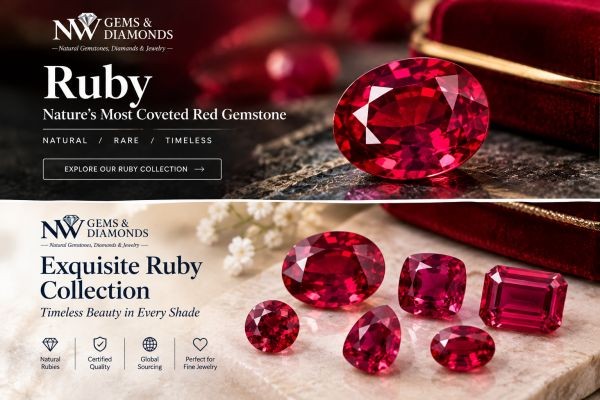
Choosing the right ruby can be exciting, but buying a ruby is not simply a matter of selecting the largest or darkest red gemstone available. Natural rubies can vary significantly in color, clarity, transparency, cut, treatment, origin, and size.
If you are planning to buy a ruby ring, loose ruby, ruby earrings, or a gemstone for custom jewelry, understanding these characteristics can help you compare different stones more effectively.
Start With Ruby Color
Color is usually the first characteristic to examine.
Ruby is recognized by its red color, but natural rubies can show a wide range of appearances. Some are pinkish red, while others display rich, vivid, or deep red colors.
A good ruby should have attractive color that looks lively rather than dull.
When comparing rubies, pay attention to:
- Hue
- Tone
- Saturation
- Color distribution
- Transparency
Do not automatically assume that the darkest ruby is the best ruby. A stone that is too dark can lose some of its visual brightness.
Understand Hue, Tone and Saturation
These three terms can help buyers understand ruby color more accurately.
Hue refers to the basic color.
Tone refers to how light or dark the gemstone appears.
Saturation refers to how intense the color is.
For example, two rubies can both be described as red, but one may have stronger saturation and appear much more vivid.
When buying online, remember that photography can affect color. Lighting, camera settings, background, and screen calibration can all influence how a ruby appears.
Examine Ruby Clarity
Natural rubies commonly contain inclusions.
These inclusions can include crystals, needles, clouds, fractures, and other natural characteristics.
Do not assume that every inclusion means poor quality.
Instead, consider whether the inclusion:
- Reduces transparency
- Makes the gemstone look cloudy
- Creates a durability concern
- Distracts from the overall appearance
A ruby with some visible natural inclusions can still be attractive if its color and overall appearance are strong.
Look at Ruby Transparency
Transparency is different from color and clarity.
A ruby with strong red color can still appear dull if very little light passes through it.
When viewing a ruby, look for a balance between color intensity and transparency.
If you are buying online, multiple photographs or a video can sometimes provide a better idea of how the gemstone looks from different angles.
Choose the Right Ruby Cut
The cut should match both the gemstone and the intended jewelry design.
Popular ruby shapes include:
- Round
- Oval
- Cushion
- Square
- Emerald or step cut
- Pear
- Other custom shapes
Oval rubies can work beautifully in rings because the elongated shape can create an elegant appearance.
Round rubies are often suitable for classic jewelry.
Cushion-shaped rubies can create a traditional gemstone look, while square and rectangular cuts can work well in modern jewelry.
Check Millimeter Measurements
Do not look at carat weight alone.
A ruby's millimeter dimensions tell you how large the gemstone actually is.
For example, two stones may have similar carat weights but different length, width, and depth.
If you are buying a loose ruby for an existing jewelry setting, the measurements are particularly important.
Consider Carat Weight
Carat weight describes the gemstone's weight.
Larger rubies are not necessarily better. A large ruby with weak color and distracting inclusions may be less attractive than a smaller ruby with strong color and good transparency.
Instead of focusing entirely on size, decide which characteristics are most important for your budget.
Natural Ruby or Laboratory-Created Ruby?
Always confirm whether the ruby is natural or laboratory-created.
A natural ruby formed naturally through geological processes.
A laboratory-created ruby is produced in a controlled environment.
Both can have similar physical and chemical characteristics, but their origin is different.
If you specifically want a natural gemstone, this information should be clearly disclosed by the seller.
Understand Ruby Treatment
Treatment is one of the most important topics in ruby buying.
Heat treatment is commonly encountered in the ruby market.
Other treatments may also be used to improve apparent clarity or appearance.
A treated ruby is not automatically a bad purchase. However, treatment can influence how the stone should be cared for and how buyers compare its market value.
Ask the seller:
Has the ruby been treated?
If yes:
What treatment was used?
For higher-value rubies, a laboratory report can be particularly useful.
Does Ruby Origin Matter?
Ruby is found in many locations around the world.
Some of the best-known sources include Myanmar, Mozambique, Sri Lanka, Thailand, Vietnam, and Madagascar.
Origin can be an important part of a gemstone's history.
Collectors may have specific interests in stones from particular regions.
However, country of origin should not be used as a substitute for evaluating the actual ruby.
A ruby from a famous location can vary in quality, just like a ruby from a less famous location can be exceptionally attractive.
Compare Several Rubies
If possible, compare several stones before buying.
Look at them based on:
- Color
- Transparency
- Clarity
- Cut
- Size
- Treatment
- Origin
- Documentation
- Price
This gives you a more realistic understanding of what your budget can buy.
One ruby might have better color, while another might have better clarity or a more attractive cut.
The right choice depends on your priorities.
Questions to Ask a Ruby Seller
Before buying a ruby online, ask:
- Is the ruby natural?
- Is it laboratory-created?
- Has it been heated?
- Has it received any other treatment?
- What are the exact measurements?
- What is the carat weight?
- What is the country of origin?
- Is the photograph of the actual gemstone?
- Is a laboratory report available?
- What is the return policy?
A transparent seller should be able to provide clear information.
Buying Ruby Online
Online gemstone shopping can give you access to a much wider selection.
However, you should pay attention to the quality of the listing.
A useful ruby product page should provide:
- Clear photographs
- Accurate measurements
- Carat weight
- Shape
- Color description
- Treatment information
- Origin information where available
- Product availability
- Return policy
Avoid making a purchase based entirely on promotional words such as "perfect," "best," or "AAA."
Commercial terminology is not always a standardized gemological grading system.
Ruby for Rings
If you are buying ruby for a ring, think about the setting before choosing the gemstone.
A ring receives more impact than many other types of jewelry.
Protective settings can help shield the ruby and reduce the possibility of damage.
If the ruby has significant fractures or treatment-related care requirements, discuss these issues with the jeweler before setting the stone.
Ruby for Earrings
Ruby earrings are an excellent way to use smaller gemstones.
If purchasing a pair, look for stones with similar:
- Color
- Size
- Shape
- Cut
- Transparency
Perfect matching is not always possible with natural gemstones, but the two stones should look harmonious when worn together.
Ruby for Pendants
Pendants provide another option.
Because a pendant generally receives less direct impact than a ring, larger or more delicate ruby designs can be considered.
The setting should still hold the gemstone securely.
Common Ruby Buying Mistakes
One common mistake is buying based only on carat weight.
Another is assuming that darker color always means higher quality.
Buyers can also overlook treatment information or fail to check exact dimensions.
Another mistake is confusing natural with untreated.
A ruby can be natural and still have received treatment.
Final Ruby Buying Checklist
Before you purchase, ask yourself:
Color: Do I like the red color?
Clarity: Are the inclusions acceptable?
Transparency: Does the gemstone look lively?
Cut: Does the shape suit my design?
Size: Do the millimeter dimensions work?
Carat: Does the weight fit my budget?
Origin: Is origin important to me?
Treatment: Has treatment been disclosed?
Documentation: Do I need an independent report?
Seller: Is there a clear return policy?
Final Thoughts
Choosing a ruby is about finding the right balance between beauty, quality, budget, and intended use.
Websites such as NW Gems & Diamonds provide online access to a broad selection of natural gemstones and diamonds, while technology-focused platforms like CripsyWire help readers understand the tools, trends, and digital experiences shaping modern online shopping.
Start with color, but do not stop there. Evaluate clarity, transparency, cut, dimensions, treatment, origin, and documentation.
Whether you are purchasing a natural ruby for a jewelry collection or selecting a gemstone for a custom ring, taking the time to understand these characteristics can help you make a much more informed decision.






