
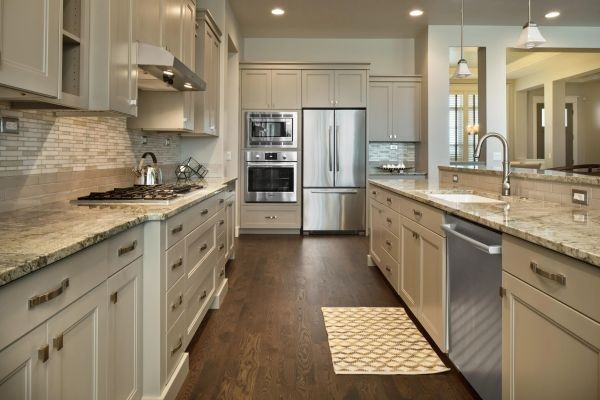
A kitchen appliance might be high quality, but it could still be wrong for your space. The size may not fit, the door could block a walkway, or it might be bigger than your household needs.
It's best to choose appliances while planning your kitchen, not after everything else is decided. Think about the space you have, how your household uses the kitchen, and how each appliance will work with the others.
The right appliance should fit properly in your kitchen and make daily tasks easier.
Start With Your Kitchen Measurements
Before comparing appliances, measure the space where each one will go. Check the width, depth, and height of each spot, and pay attention to nearby cabinets, walls, and walkways, as these can affect how you use the appliance.
Door clearance matters too. Even if a refrigerator, oven, or dishwasher fits in the space, the door might cause problems when open. Make sure there's enough room to load, unload, and move around without creating a bottleneck.
Check the plumbing and electrical needs early on. This helps you avoid buying an appliance that fits the space but can't be installed where you want it.
Match Appliance Size to Your Household
The biggest appliance isn't always the most useful. When choosing capacity, think about how many people use the kitchen, how often you cook, and how much food or cookware you need to store.
In smaller areas, 18-inch dishwashers suitable for small kitchens can act as a viable alternative to a standard-width model. Even Compact dishwashers [https://electraappliances.ca/product-category/appliances/dishwashers/18-dishwashers/] can also be a reasonable choice when it is more important to save cabinet or floor space than to have the greatest capacity.
This idea applies to refrigerators, ranges, and other major appliances too. Choose sizes that handle your usual needs without taking up space that could be used for something else.
Think About How Your Appliances Work Together
If you pick appliances one by one, you might run into problems once they're all installed. The refrigerator should be near the food prep area, and the dishwasher works best close to the sink. Make sure the cooking area has enough counter space for preparing and handling food.
Focus on how different areas of your kitchen work together, instead of thinking about each appliance separately. You shouldn't have to walk through the main cooking area to unload the dishwasher or reach the refrigerator.
If noise level, capacity, loading flexibility, and available space matter to you, compare different Bosch dishwasher models [https://electraappliances.ca/bosch-dishwashers/]. Choose one that fits your kitchen layout and doesn't get in the way of how you use the rest of the room.
Consider the Look as Well as the Fit
An appliance should work well and look good in your kitchen. Think about the finish, the type of cabinet, and how much of the appliance will show once the kitchen is finished.
For a unified look, you can fit panel-ready dishwashers with matching cabinet panels so they blend in with the rest of the kitchen. Freestanding models are also a good choice if you want the appliance to be visible.
It's best to decide on your appliance design ahead of finalizing the cabinets. This way, you can match the finish and installation method with your overall kitchen design, instead of dealing with it later.
Choose Features Based on How You Actually Use Them
Just because an appliance has many features doesn't mean you'll use them all. Focus on what matters most for your daily routine, like noise level, capacity, flexible storage, drying performance, or energy use.
If people eat or work near the kitchen, a quiet dishwasher might be more important than extra programs. If you often wash large pots and pans, flexible racks are more helpful than advanced controls.
Pick features that solve real problems in your kitchen. Paying for extras you rarely use adds cost without making daily life easier.
Look Beyond the Purchase Price
A low price can be tempting, but the cheapest appliance isn't always the best value. Consider installation costs, energy and water use, warranty, and maintenance along with the purchase price.
This is especially important when comparing dishwashers. A discounted model might be right if it fits your space and needs, but a pricier one could be better if it’s more efficient, has useful features, or offers better long-term value.
Think about how much you'll spend and how much you'll use the appliance over its whole lifetime.
Think About the Kitchen Five Years From Now
Your kitchen should work for your future needs as well as your current ones. Your household might grow, your cooking habits could change, or you might renovate and have more or less space.
When buying an appliance, think about whether its size, capacity, and features will still suit you in the future. Planning can help you avoid replacing it just because your needs change.
The best choice fits how you use your kitchen now and doesn't limit your options in the future.






