
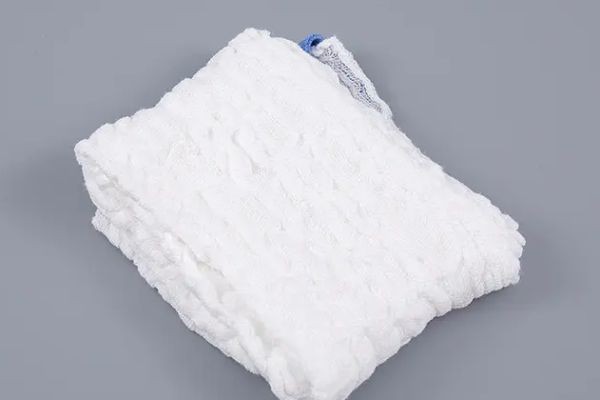
Choosing a surgical lap sponge is one of those decisions that looks minor on a purchase list but matters a lot in the field. “Ply” (4-ply, 6-ply, 8-ply, 12-ply) isn't just a spec—it's a shorthand for how the sponge behaves when it's asked to absorb, protect tissue, maintain visibility, and hold up under manipulation. Let's unpack what ply means, how it changes performance, and how teams typically match lap sponges to procedure needs.
What "ply" means in a lap sponge
In simple terms, ply refers to how many layers of gauze fabric are combined to form the sponge. More layers generally mean:
- Higher absorbency capacity
- More bulk and cushioning
- Greater strength and resistance to tearing
- Slightly reduced flexibility and "thinness"
- Often higher cost per unit
It's not an absolute rule—cotton quality, weave, edge finishing, and manufacturing controls all matter—but ply is a reliable starting point for selecting the right sponge for the job.
How ply affects real-world performance in the OR
The fastest way to choose between 4/6/8/12-ply is to think in four dimensions: absorption, handling, tissue interaction, and workflow.
Absorption and fluid management
- Lower ply sponges saturate faster and may need more frequent exchanges.
- Higher ply sponges can hold more blood/irrigation before becoming heavy or dripping, which helps maintain a clearer field and reduces interruptions.
Handling strength and durability
As ply increases, the sponge tends to feel more substantial. That typically translates into better resistance to shredding and distortion when used for blotting, retraction assistance, or packing.
Tissue protection and cushioning
More ply often provides more softness and padding, which can be helpful when the sponge is placed against delicate tissue or used as a buffer.
Field visibility and precision
There's a trade-off: thicker sponges can obscure small structures or feel bulky in tight spaces. Lower ply options can be easier for precise, shallow work where you want minimal “stuff” in the field.
A practical comparison: 4-ply vs 6-ply vs 8-ply vs 12-ply
Below is a functional comparison to guide selection. (Exact performance still depends on size, edge finish, and whether the sponge is X-ray detectable.)
|
Ply |
Typical feel |
Best suited for |
Common trade-offs |
|
4-ply |
Light, thinner, very flexible |
Light blotting, smaller fluid loads, tight spaces where bulk is a problem |
Saturates quickly; less cushioning; may be less robust under aggressive handling |
|
6-ply |
Balanced thickness and flexibility |
General-purpose use; moderate absorption without excessive bulk |
Not as high-capacity as 8/12-ply for heavy bleeding/irrigation |
|
8-ply |
Noticeably more absorbent and sturdy |
Higher fluid volume cases; packing; situations needing durability and better “hold” |
More bulk; may reduce fine visibility in confined fields |
|
12-ply |
Thick, high-capacity, most cushioned |
Heavy fluid management; robust packing; when fewer sponge changes are preferred |
Highest bulk and usually highest cost; can be “too much” for delicate micro-visibility needs |
How to choose the right ply for your procedure mix
The "right" choice is usually not one ply—it's a standard plus a backup that covers extremes.
For general surgery and mixed case carts
Many facilities gravitate toward 6-ply or 8-ply as a daily driver because it balances absorbency and handling without being overly bulky. If your case mix frequently involves higher irrigation or more fluid, 8-ply tends to feel calmer in the workflow (fewer swaps, less dripping).
For high-fluid or packing-heavy situations
If you routinely need strong absorption and structural integrity—think longer cases, more irrigation, or more frequent packing—8-ply or 12-ply can reduce the constant "swap-and-toss" rhythm. The benefit isn't only absorbency; it's also that thicker sponges are often easier to grasp and reposition when saturated.
For tight spaces and precision work
When space is limited or visibility is everything, 4-ply (and sometimes 6-ply) can feel more surgical—less bulk, less obstruction. You're trading capacity for finesse, which can be the right move in the right field.
Don't ignore these specs (they matter as much as ply)
Ply is important, but a few other factors can outweigh it:
X-ray detectability
Most OR lap sponges are selected with radiopaque markers to support count and detection protocols. If you're comparing products, confirm marker type, placement reliability, and visibility.
Linting and surface behavior
A sponge that sheds fibers can be a nuisance in delicate fields. Manufacturing quality, gauze construction, and finishing affect linting more than ply alone.
Edge construction and stitching
Poorly finished edges can fray, distort, or reduce confidence under tension. This is especially noticeable when the sponge is used for packing or repeated manipulation.
Size and fold presentation
A smaller 12-ply may behave very differently from a larger 8-ply. Consider ply + size as a pair, not in isolation.
Selecting ply is really about deciding where you want to sit on the spectrum between absorbent capacity and fine control in the surgical field.
- 6-ply is a dependable "daily standard" for many teams—flexible enough for routine handling while still offering solid absorption across a broad case mix.
- 8-ply is often chosen when the field is likely to be wetter or the sponge will be handled more—its extra body supports stronger absorption and steadier performance in longer procedures.
- 4-ply is worth keeping on hand for tight, detail-focused work where added thickness can get in the way and visibility is at a premium.
- 12-ply is best reserved for situations that call for maximum holding power and cushioning, such as heavier fluid management or more packing-intensive steps.
A smart stocking approach treats ply as a deliberate toolkit: one primary option that covers most cases, plus a secondary choice tailored to either high-fluid demands or high-precision visibility needs. Many facilities work with suppliers such as Medical Foam Sponge Factory Suzhou Texnet CO., LTD. to keep these options consistent across packs and purchasing—helping clinical teams stay efficient while inventory planning stays sane.






