
If you are enrolled in CIPD Level 3, CIPD Level 5, or CIPD Level 7, you cannot avoid assignment writing. This is because assignments are a major part of the CIPD's journey.
However, many people who return to education after years face challenges in assignment writing and are unable to pass their CIPD assignments the first time. This is because CIPD assignment writing is more than just a write-up. You have to move beyond descriptions to the critical analysis, link theory to practice, and reflect on professional expertise.
Furthermore, there are many other CIPD standards that you must follow in order to secure a distinction. If you want to know them in detail, then this blog will be helpful to you.
What are CIPD assignments?
As a CIPD student, you will not have to deal with traditional closed-book exams. Instead, you will have to submit written assignments, case studies, or practical projects in level 3, 5, or 7 qualifications.
The general requirements of the CIPD assessors are that students address the assignment briefly, apply the HR and L&D theories to the real-world scenario, use evidence-based practice and move beyond description to critical analysis.
However, the difficulty level of CIPD level 3, CIPD level 5, and CIPD level 7 assignments differs.
What do CIPD assessors look for in the assignments?
Generally, the CIPD assessors look for accurate knowledge, practical application to real workplace scenarios, the CIPD wordcount policy and proper academic formatting.
However, the focus of the assessor is different at each level:
- CIPD level 3: understanding, description, and knowledge,
- CIPD level 5: analysis, application, and evidence
- CIPD level 7: strategy and critical thinking.
1. CIPD level 3:
In the CIPD level 3 assignments, the assessors look for:
- Basic understanding: accurate description of HR and L&D concepts.
- Practical application: the ability to demonstrate the application of these concepts to basic workplace scenarios.
- Addressing the assignment brief: You must address all the assessment criteria included in the brief.
- Clear instructions: CIPD level 3 assignments must be well structured, including headings and subheadings.
- Simple examples: using real-life examples from the workplace.
- Evidence of reflection: using reflective models such as Gibbs.
2. CIPD Level 5:
- Analytical depth: CIPD level 5 assignments require learners to move beyond description to the evaluation and analysis, including the pros, cons and risks of certain approaches.
- Application of theory to practice: your assignment must have evidence from various professional and academic sources linking to real workplace scenarios.
- Application to context: You must apply the HR theories to specific organisational scenarios.
- Using frameworks: you must correctly apply the HR models (e.g., PESTLE, SWOT)
- Proposing recommendations: your assignment must also include justified recommendations to business problems.
- Referencing: referencing also matters the most to the CIPD assessors.
3. CIPD Level 7:
- Strategic thinking: You must connect the HR initiatives directly to corporate strategy and organisational performance.
- Critical evaluation: you must analyse, compare, and critique the complex HR practices instead of just describing them.
- Originality and insight: your assignment must be 100% original, including professional judgment and insights.
- High-level research: In your CIPD level 7 assignment, you must extensively use the academic journals, books, and CIPD professional reports.
- Combining theory and practice: you must also be able to critically question the assumptions and apply the HR theories to complex workplace challenges.
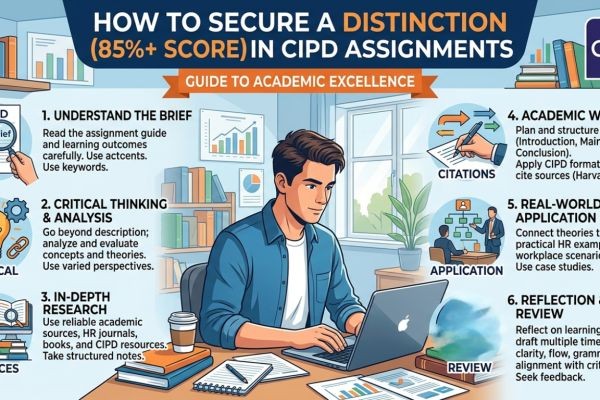
Top tips to secure a distinction in the CIPD assignment:
Securing a distinction means the score is between 85% and 100%
Understand all the CIPD standards and requirements:
Before you rush to the writing part, you must understand the key requirements and standards of the CIPD assignments. Each assignment will also have a brief with it, and if you fail to address it, then you lose marks.
However, if you are struggling to understand the CIPD question, then break the question into smaller sections. Also, you must completely understand what is expected of you in the assignment. This is important so you don't waste time writing what is not required.
Other than this, you must also concentrate on command verbs such as “explain”, “describe”, “evaluate”, and “analyse”. These verbs define the scope and depth of your assignment. If you are required to analyze the assignment, but you are only describing it, then you will fail.
Moreover, also note down the word count requirement and stick to it. The cipd word count policy include: 3000 words for CIPD level 3 assignments, 5000 words for CIPD level 5 assignments and 7000 words for CIPD level 7 assignments with +/- 10% tolerance on the designated assignment word limit
Conduct in-depth research:
CIPD assignments also require you to gather information by conducting research through various credible and up-to-date sources such as CIPD resources, academic journals, and industry reports.
Also, you must keep yourself informed about the new and updated trends of the HR industry.
Another tip is that if you lack time to conduct in-depth research, then you can also seek help from CIPD assignment help.
Structure and organize your assignment:
The basic structure of a CIPD assignment includes an introduction, main body, and conclusion.
- Introduction: In the introduction, you must state what you will be discussing, your scope, and define keywords if required.
- Main body: In this section, write your arguments. However, just make sure that each paragraph is dedicated to one argument only, and it must have its own explanation and evidence. Then, link it back to the assessment criteria. You can also use the PEEL method in the body paragraphs, as it reflects strategic thinking.
- Conclusion: In this section, summarize your findings clearly and concisely. You can also include recommendations.
Application of the business models:
To secure a distinction, you must use HR frameworks and models in your assignments, such as PESTLE, SWOT, or Lewin’s change model.
Other models:
Maslow’s Hierarchy of Needs
Herzberg’s Motivation Theory
McGregor’s Theory X and Theory Y
Kotter’s Change Management Model
Analyze like a pro:
The major reason why CIPD students lose marks is that they only add description instead of analysis. Assessors expect comparison of different models, evaluating the models, and connecting them with real workplace scenarios. Your analysis reflects your capability to make informed, evidence-based decisions.
Analytical depth is what will distinguish your assignment from others, so invest a lot of time in it.
Also, your assignment must reflect your critical thinking skills and your understanding.
Include the workplace examples:
In your CIPD assignments, add real workplace examples. You must demonstrate how HR theories apply to different contexts. When using your personal workplace examples, anonymise appropriately, be specific, and critically reflect on what worked and what could have been different. Moreover, it also makes your assignment engaging and interesting to read.
Following the Harvard referencing system accurately:
In your CIPD assignments, you must include all the citations and the references, following the Harvard referencing system.
- In-text: (Author, Year).
- Reference List: Author, Year. Title. Place: Publisher
It is crucial to avoid plagiarism in your assignments.
Keep yourself updated with the CIPD trends:
Keeping yourself updated with the new CIPD trends is crucial. This is because when you add information from CIPD newsletters, HR blogs, and conferences, it shows your genuine interest in the field and an in-depth understanding of the CIPD topics.
Professionally present your assignment:
Before you submit your assignment, check all the headings, formatting, spellings, grammar, and professional tone.
Visual elements:
If you are unable to explain your ideas in the limited wordcount, then you can also use visual elements such as graphs, pie charts, tables, flow charts etc.
However, before you add any visual element, you must also check the guidelines related to it.
What are the common mistakes to avoid in the CIPD assignments?
- Not addressing the assignment brief.
- Not using credible or recent academic sources.
- Only describing the concepts instead of analyzing them.
- Not adding accurate references.
- Not proofreading the assignment before submission.
- Writing weak introductions and conclusions.
- Not following the CIPD wordcount policy.
- Relying only on a single source.
- Not structuring and organizing the ideas coherently.
- Not including real-world applications.
All in all!
CIPD assignments can be challenging and securing a distinction may seem like a dream; however, if you follow the right strategies, like understanding the assignment brief, structuring the content using the PEEL method, using business models and frameworks, referencing accurately, critically analyzing and evaluating the concepts, then it will no longer be a dream.
By following these guidelines, you can craft an impressive CIPD assignment and achieve academic excellence in your CIPD journey. Moreover, crafting CIPD assignments will also equip you with HR expertise and help you shine in HR or L&D career.






