
Accurate vehicle owner verification is a foundational requirement for industries such as insurance, lending, logistics, fleet management, and digital vehicle platforms. Any mismatch between a vehicleᴙs Registration Certificate (RC) and the claimed owner can lead to fraud, disputes, regulatory exposure, and financial loss.
Despite this risk, many businesses still rely on manual RC checks or self-declared information to verify ownership. These methods are slow, inconsistent, and difficult to scale. To address these gaps, organizations are increasingly using the Vehicle RC to Mobile Number API to strengthen and accelerate vehicle owner verification.
By validating the link between a vehicleᴙs RC and a mobile number, this API adds a powerful trust layer to digital and large-scale verification workflows.
What Is Vehicle RC to Mobile Number API?
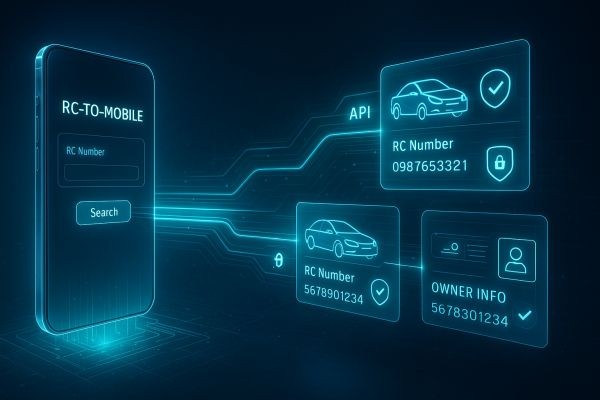
Vehicle RC to Mobile Number API is a verification service that checks whether a given vehicle registration number is associated with a specific mobile number. Instead of validating RC details in isolation, the API confirms the relationship between the vehicle and a reachable contact identity.
This approach supports stronger vehicle owner verification by ensuring that:
- The vehicle exists and is registered
- The mobile number provided is linked to the vehicle
- Ownership or control claims are consistent with verified records
It is especially useful in digital journeys where contact verification and ownership validation must happen quickly.
Why Vehicle Owner Verification Is a Major Business Challenge
Vehicle ownership fraud often enters systems through small verification gaps. These gaps grow into serious issues over time.
Common challenges include:
- Fake or reused RC documents
- Incorrect ownership claims during onboarding
- Duplicate vehicle entries across platforms
- Disputes during claims, recovery, or resale
Without validating the connection between the vehicle and the ownerᴙs mobile number, businesses rely heavily on documents that can be manipulated or outdated.
How RC to Mobile Number API Improves Owner Verification
RC to Mobile verification strengthens ownership checks by adding a second verification dimension. Instead of validating only the RC, the API confirms whether the declared mobile number aligns with the vehicle record.
This helps businesses:
- Detect ownership mismatches early
- Reduce reliance on document uploads
- Validate contact authenticity alongside vehicle data
- Flag suspicious or inconsistent records automatically
By combining vehicle and contact verification, ownership validation becomes more reliable and defensible.
How the RC to Mobile Verification Process Works
The verification process is simple and automated.
First, the business submits the vehicle registration number and mobile number.
The system sends these details to the RC to Mobile API.
The API checks verified vehicle records for linkage.
The response confirms whether the mobile number is associated with the RC.
This real-time response allows systems to approve, reject, or flag the verification instantly.
Key Ownership Indicators Validated by the API
RC to Mobile Number API supports validation of several ownership-related signals.
Vehicle Existence and Registration Status
Confirms that the vehicle is registered and active, preventing fake or deregistered vehicles from entering systems.
Contact-to-Vehicle Linkage
Validates whether the mobile number provided is associated with the vehicle, improving ownership confidence.
Consistency Checks
Helps identify mismatches between declared owner details and verified records, reducing disputes later.
These indicators strengthen trust without slowing down workflows.
Use Cases Across Industries
RC to Mobile Number API improves vehicle owner verification across multiple sectors.
In insurance, it helps confirm policyholder-vehicle linkage during issuance and renewal.
In NBFC lending, it strengthens collateral verification for vehicle loans.
In logistics and fleet operations, it ensures vehicles are linked to genuine owners or operators.
In used vehicle marketplaces, it reduces fake listings and improves buyer trust.
In each case, ownership verification becomes faster and more accurate.
Reducing Fraud and Disputes
Ownership disputes often arise during claims, recovery, or resale. These disputes are costly and time-consuming.
By validating RC-to-mobile linkage upfront, businesses can:
- Prevent fraudulent ownership claims
- Reduce downstream disputes
- Improve confidence in verified records
Early verification minimizes long-term risk.
Supporting Digital and Self-Service Workflows
Modern platforms aim to reduce document uploads and manual intervention. RC to Mobile verification aligns well with this goal.
The API supports:
- Faster onboarding without paperwork
- Seamless digital verification journeys
- Scalable, automated decision-making
This improves both operational efficiency and user experience.
Improving Data Accuracy Across Systems
Vehicle data flows across underwriting, operations, analytics, and compliance systems. Inaccurate ownership data creates inconsistencies and errors.
RC to Mobile Number API provides standardized verification outputs that improve data consistency across platforms and teams.
Compliance and Audit Readiness
Regulatory and audit reviews often require proof that ownership checks were performed accurately at the time of transaction.
RC to Mobile verification generates structured, time-stamped results that support audit trails and regulatory confidence.
Handling Exceptions and Edge Cases
There may be situations where mobile numbers are recently changed or ownership records are not yet updated.
Best practice is to use RC to Mobile verification as the primary check, with manual review or RC-only verification for genuine exceptions. This hybrid approach balances speed and coverage.
Benefits of Using Vehicle RC to Mobile Number API
- Stronger vehicle owner verification
- Reduced fraud risk
- Faster digital onboarding
- Lower dependency on documents
- Improved data integrity
- Scalable verification processes
These benefits make the API a valuable component of modern vehicle verification strategies.
Conclusion
Vehicle owner verification is no longer limited to checking RC documents. In digital and high-volume environments, businesses need stronger validation methods that combine vehicle data with contact identity.
Vehicle RC to Mobile Number API improves vehicle owner verification by confirming the linkage between a vehicle and a mobile number in real time. It reduces fraud, improves accuracy, and supports faster, more reliable verification workflows.
For businesses operating in insurance, lending, logistics, or digital vehicle platforms, RC to Mobile verification is not just an enhancement. It is a critical trust layer for secure and scalable vehicle operations.






