
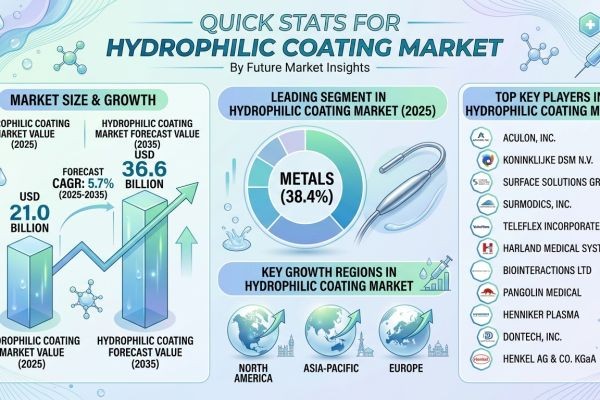
The global hydrophilic coating market is projected to witness strong expansion over the next decade, supported by the rising demand for minimally invasive medical procedures and increasing applications in the automotive and aerospace sectors. The market is expected to grow steadily, reaching approximately USD 27.2 billion by 2036, registering a CAGR of 6.2%, according to the latest analysis by Future Market Insights (FMI).
Market growth is being shaped by the increasing integration of lubricious coatings in medical devices, growing consumer demand for anti-fog and anti-reflective surfaces in optics, and rapid technological advancements in polymer chemistry. Hydrophilic coatings have evolved from specialized laboratory applications into essential requirements across healthcare, automotive, and electronics industries to improve performance and durability.
Hydrophilic Coating Market Snapshot (2026–2036)
- Market size outlook toward 2036: USD 27.2 billion
- Forecast CAGR: 6.2%
- Dominant substrate category: Polymers
- Fastest-growing segment: Medical Devices (Cardiovascular & Urology)
- Key growth regions: North America, Europe, East Asia
- Primary demand channel: Medical OEM and Industrial Manufacturing
Momentum in the Market
Beginning from steady global adoption levels, the hydrophilic coating market demonstrates accelerated growth throughout the forecast period as healthcare infrastructure expands and surgical techniques become more sophisticated. Between 2026 and 2036, the rising geriatric population and the prevalence of chronic diseases are expected to significantly boost demand for coated catheters, stents, and guidewires.
Increasing innovation in nanotechnology and "smart" coatings is encouraging manufacturers to prioritize high-performance materials. From 2030 onward, the development of antimicrobial hydrophilic coatings and their integration into wearable electronics and high-end automotive sensors is expected to further strengthen market expansion. These coatings, capable of reducing friction to near-zero levels while maintaining biocompatibility, are emerging as key differentiators in competitive manufacturing.
The Reasons Behind the Market’s Growth
Demand for hydrophilic coatings is rising due to multiple structural and technological factors reshaping the global industrial ecosystem.
Growth in Minimally Invasive Surgeries Healthcare providers are shifting toward minimally invasive procedures that require devices to navigate complex anatomical structures. Hydrophilic coatings provide the necessary lubricity to reduce tissue trauma and improve patient outcomes.
Expansion of the Medical Device Industry Rapid expansion of medical manufacturing hubs, particularly in North America and Asia-Pacific, is driving large-scale OEM adoption of coating services for surgical instruments.
Technological Advancements in Automotive and Aerospace The automotive sector is increasingly utilizing these coatings for windshields and sensor covers to improve visibility and maintain the functionality of autonomous driving systems under wet conditions.
Rising R&D Investment Significant investments in material science are leading to the creation of more durable, UV-curable coatings that offer faster processing times and better adhesion to a variety of substrates like glass, metal, and plastic.
Top Segment Application Type
Medical Devices Lead Market Demand The medical device segment accounts for the majority of hydrophilic coating installations globally. This is supported by the high demand for cardiovascular, urological, and neurovascular devices where low friction is critical for safety.
Substrate Analysis
- Polymers: ~6.5% CAGR driven by their widespread use in flexible medical tubing.
- Glass/Ceramics: ~5.8% CAGR supported by optical and solar panel applications.
- Metals: ~5.5% CAGR with rising use in orthopedic implants and specialized tools.
- Nanomaterials: ~7.2% CAGR, the fastest-growing segment due to precision engineering.
Regional Development: Manufacturing Ecosystem Drives Expansion
The market is evolving into a global network of specialized coating providers, supported by cost-efficient production and expanding healthcare networks.
- North America: The dominant market leader due to advanced healthcare infrastructure and high R&D spending.
- Europe: Focused on stringent regulatory standards and sustainable, water-based coating innovations.
- East Asia (China & Japan): Rapidly expanding manufacturing capabilities and increasing domestic demand for high-tech medical devices.
- South Asia & Pacific: Emerging as a hub for medical device outsourcing and industrial applications.
Challenges, Trends, Opportunities, and Drivers
Drivers
- Increasing number of cardiovascular and urological procedures
- Growth in the geriatric population worldwide
- Demand for anti-fogging properties in consumer electronics
- Technological shifts toward automated coating processes
Opportunities
- Development of drug-eluting hydrophilic coatings
- Expansion into the renewable energy sector (solar panels)
- Bio-based and eco-friendly coating formulations
- Integration with 3D-printed medical components
Trends
- Transition toward UV-cured coatings for efficiency
- Rising adoption of antimicrobial properties within coatings
- Increased use in ADAS (Advanced Driver Assistance Systems) sensors
- Focus on multi-functional coatings (anti-reflective + hydrophilic)
Challenges
- Strict regulatory approval processes (FDA/CE Mark)
- High costs associated with specialized raw materials
- Durability concerns in harsh environmental industrial applications
The Competitive Environment
The hydrophilic coating market is moderately consolidated, with global chemical and medical technology providers competing through innovation and localized service centers. Leading companies include:
- Surmodics, Inc.
- Royal DSM
- Biocoat, Inc.
- Hydromer, Inc.
- Harland Medical Systems, Inc.
These players are investing heavily in customized coating solutions and automated application equipment to strengthen supply chains and accelerate product delivery to OEMs.
Future Outlook: Toward High-Performance Surface Engineering
The hydrophilic coating market is entering a transformative decade shaped by precision medicine and cross-industry material innovation. Future coatings are expected to function as active interfaces, potentially incorporating sensors or therapeutic agents. As global industries demand higher efficiency and better safety profiles, hydrophilic coatings will remain central to achieving the next generation of medical and industrial excellence.
For a comprehensive strategic outlook and detailed analysis of technological developments shaping the industry, readers can explore the full report on the official Future Market Insights website: https://www.futuremarketinsights.com/reports/hydrophilic-coating-market






