
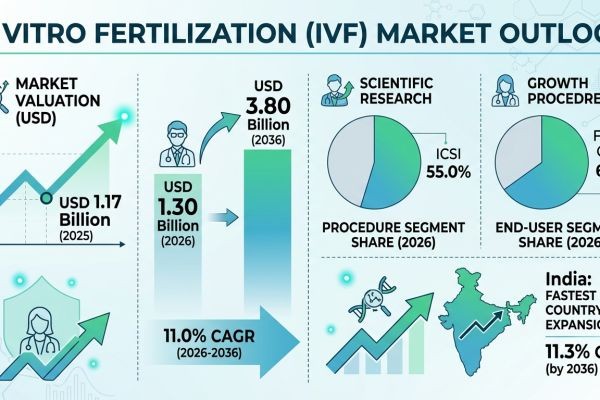
The global in vitro fertilization (IVF) market is projected to witness strong expansion over the next decade, supported by a demographic shift toward delayed childbearing and rapid adoption of advanced reproductive technologies. The market is expected to grow steadily, reaching approximately USD 3.80 billion by 2036, registering a CAGR of 11.0%, according to the latest analysis by Future Market Insights (FMI).
Market growth is being shaped by increasing demographic shifts, growing integration of genetic testing, and rising availability of specialized fertility insurance and funding options. Assisted reproductive technologies have evolved from exceptional interventions into structured medical workflows across fertility networks. While traditional IVF continues to support millions of families, clinics are increasingly integrating advanced workflows like ICSI (intracytoplasmic sperm injection) and preimplantation genetic testing (PGT) to improve pregnancy success rates and reduce miscarriage outcomes.
In Vitro Fertilization Market Snapshot (2026–2036)
- Market size valuation (2025): USD 1.17 billion
- Market size outlook toward 2036: USD 3.80 billion
- Forecast CAGR (2026–2036): 11.0%
- Dominant procedure category: Intracytoplasmic Sperm Injection (ICSI) (~55.0% share)
- Fastest-growing country market: India (11.3% CAGR)
- Primary demand channel: Specialized fertility clinics (~65.0% share)
Momentum in the Market
Beginning from steady international adoption levels, the in vitro fertilization market demonstrates accelerated growth throughout the forecast period as diagnostic accuracy and embryo viability assessments improve. Between 2026 and 2036, expanding clinic networks and rising disposable income among couples choosing to conceive later in life are expected to significantly boost demand for integrated laboratory hardware and reagents.
Increasing age-related infertility and a global decline in gamete quality are encouraging healthcare providers and manufacturers to prioritize advanced incubation and laboratory screening technologies. From 2036 onward, innovation in AI-powered embryo selection tools and undisturbed time-lapse incubation environments is expected to further strengthen market expansion. Smart systems capable of analyzing embryo development patterns without environmental disruption are emerging as key differentiators in modern embryology labs.
The Reasons Behind the Market’s Growth
Demand for in vitro fertilization solutions is rising due to multiple structural and technological factors reshaping the global reproductive healthcare ecosystem.
Demographic Shift Toward Delayed Childbearing Couples are increasingly choosing to establish careers before starting families, leading to a natural decline in gamete quality with age. This shifting biological timeline makes medical intervention an essential path to conception for a growing share of the population.
Integration of Preimplantation Genetic Testing (PGT) Clinics are adding comprehensive genetic screenings directly into their standard workflows. By identifying chromosomal abnormalities before embryo transfer, clinics can drastically optimize transfer success rates, raising the overall value per treatment cycle.
Expanding Fertility Insurance Coverage and Funding Governments and corporate benefit programs are progressively introducing specialized insurance subsidies for reproductive treatments. Lowering these upfront financial barriers unlocks access for a vast pool of previously underserved patients.
Rise in Male-Factor Infertility Dropping sperm counts and rising male reproductive challenges globally have increased reliance on precise laboratory manipulation techniques, ensuring a continuous influx of patients requiring specialized microfluidic sorting and injection workflows.
Top Segment Application Type
Fertility Clinics Lead Market Demand Standalone fertility clinics account for the majority of IVF equipment and consumable procurement globally, supported by their high operational throughput, specialized expertise, and targeted capital investments into modern lab infrastructures over general hospitals.
Procedure and Product Analysis
- ICSI Procedures: Holding a dominant 55.0% market share in 2026, driven by its high efficacy in overcoming male-factor infertility constraints.
- Consumables & Reagents: Serving as the recurring revenue backbone of the industry due to the continuous requirement for single-use media and lab plastics.
- Frozen Embryo Transfer (FET): Gaining strong momentum as "freeze-all" strategies become the clinical standard to optimize endometrial receptivity.
Regional Development: Asia Pacific Drives Global Volume Expansion
The Asia Pacific region is rapidly evolving into a high-volume hub for reproductive medicine, supported by large population baselines and expanding private clinic networks.
- India: Leading global country-level expansion with an estimated 11.3% CAGR through 2036, fueled by localized device manufacturing under the "Make in India" initiative and new public fertility treatment subsidies.
- China: Projecting a robust 10.5% CAGR as adjusted family planning policies encourage older demographics to pursue delayed childbearing solutions.
- United States & Canada: Maintaining strong market expansion (11.0% and 10.7% CAGR respectively) driven by employer-sponsored fertility benefits and rapid adoption of automation tools in high-throughput labs.
Challenges, Trends, Opportunities, and Drivers
Drivers
- Widespread delays in parental age and childbearing
- Rising global incidence of male-factor infertility
- Increased integration of genetic screening and PGT
- Expansion of corporate and state fertility subsidies
Opportunities
- AI-enabled embryo selection software models
- Microfluidic sperm sorting and density testing devices
- Advanced cryopreservation biobanking for donor services
- Time-lapse undisturbed embryo incubation systems
Trends
- Transition from fresh embryo transfers toward "freeze-all" cycles
- Automation of inventory using smart-tagged consumables
- Vertical integration of carrier screening within fertility chains
- Focus on premium lot-to-lot consistency in culture media
Challenges
- High out-of-pocket costs in non-reimbursed regions
- Patient dropout rates due to cumulative financial burdens
- Strict and evolving cross-border regulatory compliance guidelines
The Competitive Environment
The global in vitro fertilization market features active competition among international medical device providers, biotechnology innovators, and specialized genomic suppliers. Leading companies include Vitrolife, CooperSurgical, and Thermo Fisher Scientific. These players are investing heavily in automated culture media stability, AI-based morphological assessment tools, and integrated genomic testing platforms while securing long-term supply agreements with multi-clinic fertility networks to secure market presence.
Future Outlook: Toward Outcome-Focused Fertility Care
The in vitro fertilization market is entering a transformative decade shaped by automation, genomic precision, and enhanced regulatory validation. Future laboratory setups are expected to focus heavily on predictable, outcome-based metrics, shifting from raw cycle volumes to maximizing the safety and viability of every single transfer. As clinical workflows become more standardized and financial accessibility spreads, IVF will remain central to addressing global reproductive health challenges and shaping modern family planning worldwide.
For a comprehensive strategic outlook and detailed analysis of technological developments shaping the industry, readers can explore the full report on the official Future Market Insights website: https://www.futuremarketinsights.com/reports/in-vitro-fertilization-market






