
According to IMARC Group's report titled "India Aviation Market Size, Share, Trends and Forecast by Aircraft Type and Region, 2026-2034", the report offers a comprehensive analysis of the industry, including market share of aviation sector in India, its growth, trends, and regional insights.
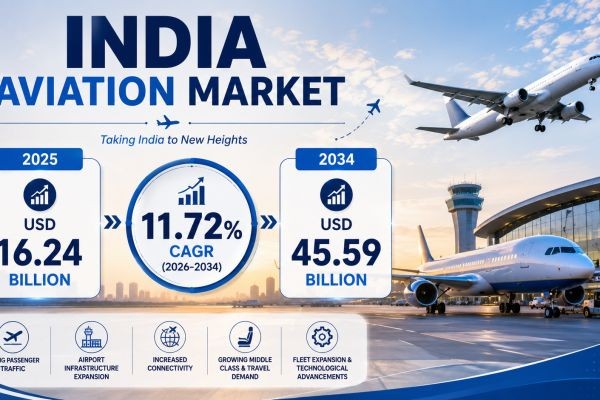
The India aviation market size was valued at USD 16.24 Billion in 2025 and is projected to reach USD 45.59 Billion by 2034, growing at a compound annual growth rate (CAGR) of 11.72% during the forecast period from 2026-2034.
Market Statistics At-A-Glance
- Current Market Size 2025: USD 16.24 Billion
- Projected Market Size 2034: USD 45.59 Billion
- CAGR: 11.72%
- Forecast Period: 2026-2034
The India Aviation Market: A USD 45.59 Billion Aerospace and Mobility Transformation Powered by UDAN Regional Connectivity, Atmanirbhar Bharat Defense Aviation & Greenfield Airport Infrastructure signals a decisive pivot from a concentrated, congestion-constrained aviation ecosystem to a nationwide, multi-modal, technology-integrated air travel network. For airline investors, airport infrastructure funds, and aerospace decision-makers, this represents a structurally sound, policy-backed opportunity at the intersection of India's surging aspirational middle class, the world's largest aviation greenfield program, and next-generation defense aviation indigenization.
Why Invest in India Aviation Market – Key Growth Drivers
- UDAN Scheme and Greenfield Airport Investment Under PM Gati Shakti Democratizing Air Travel: India's UDAN Regional Connectivity Scheme, launched in October 2016, has connected 90 airports across 625 UDAN routes with more than 1.49 crore passengers benefiting from affordable regional air travel, while India's airport network expanded from 74 airports in 2014 to 159 in 2024, with greenfield investments including Navi Mumbai International Airport, Jewar Noida International Airport, Bhogapuram International Airport, and UDAN airports collectively representing the world's largest aviation infrastructure buildout program.
- India's Surging Middle Class and Structural Aviation Underpenetration Creating Demand Floor: By 2030, India will add approximately 75 million middle-class households entering air-travel-capable income levels, while only 3-5% of India's 1.4 billion population flies today, creating the deepest aviation underpenetration among billion-population nations and positioning every incremental income gain as a structural first-time flier demand catalyst that is demographically and economically guaranteed through 2034.
- Atmanirbhar Bharat Defense Aviation Push Driving Military Segment Growth: Military aviation is the fastest-growing segment at approximately 13.5% CAGR, driven by the September 2025 Ministry of Defence contract with HAL for 97 Tejas Mark-1A combat aircraft valued at over ₹62,370 crore, representing India's definitive transition from import-dependent to domestically manufactured combat aircraft and creating a defense aviation demand floor independent of commercial aviation's cyclical dynamics.
- Tourism Growth and India's Hospitality Sector Boom Expanding International Aviation: India recorded approximately 56 lakh Foreign Tourist Arrivals and 303.59 crore Domestic Tourist Visits till August 2025, making tourism the fastest-growing demand segment for Indian carriers, with improving visa-on-arrival programs and government promotional campaigns under Incredible India systematically expanding international visitor volumes.
- Air India's Tata Transformation and IndiGo's 1,000-Aircraft Order Creating Fleet Momentum: Air India's Vihaan.AI transformation program under CEO Campbell Wilson represents Asia's most ambitious airline turnaround, while IndiGo's 2023 announcement of 500 additional Airbus A320 family aircraft creating a 1,000-aircraft firm order from a single airline for the first time in aviation history reflects deep structural confidence in India's aviation growth trajectory through 2034.
- DigiYatra and Digital Aviation Infrastructure Improving Passenger Experience at Scale: DigiYatra, India's biometric-enabled seamless airport journey platform, is making India's aviation ecosystem the world's largest-scale implementation of paperless biometric travel, improving throughput efficiency, passenger satisfaction, and operational cost metrics across India's busiest airports while positioning Indian aviation as a global benchmark for digital travel identity.
➤ Evaluate Market Opportunity Before Investing – Request for a Sample Report
What are the Key Emerging Trends in India Aviation Market?
- Navi Mumbai International Airport Rebalancing India's Aviation Geography: Mumbai's Chhatrapati Shivaji Maharaj International Airport recorded peak passenger traffic of 55.5 million in 2025 comprising 39.2 million domestic and 16.3 million international passengers, operating at chronic overcapacity, with Navi Mumbai International Airport's commissioning set to fundamentally rebalance India's aviation geography by creating a second gateway for Mumbai, the world's highest-value underduplicated aviation hub.
- HAL's Tejas Mk1A and India's Military Aviation Industrial Revolution: HAL's Tejas Light Combat Aircraft Mk1A program at 83 aircraft and INR 48,000 crore represents the largest domestic Indian defense aviation contract in history, with the September 2025 addition of 97 Tejas Mark-1A aircraft at ₹62,370 crore creating a production ramp that will define HAL's manufacturing capacity and supply chain ecosystem through the entire forecast period.
- Urban Air Mobility and eVTOL Creating India's Next Aviation Growth Frontier: India's cities with chronic road congestion represent Asia's most compelling urban air mobility addressable market, with the Mumbai-Pune-Nashik and Delhi-NCR corridors combining high population density and inadequate surface transport to create one of the world's largest potential urban air mobility markets outside the US and China, growing at 25-30% CAGR from a small 2025 base.
- MRO Hub Development as India's Fastest-Emerging Aviation Revenue Opportunity: MRO services are growing at approximately 15-18% CAGR as India's rapidly expanding airline fleet creates proportionally expanding maintenance requirements, with MoCA's India MRO Strategy targeting the reduction of Indian airline MRO expenditure abroad by developing domestic MRO capability across airframe, engine, and avionics categories.
Market Segmentation Breakdown
Aircraft Type Insights:
- Commercial Aviation
- Military Aviation
- General Aviation
Commercial aviation leads with a market share of 79.4% of the total India aviation market in 2025, encompassing airline ticket revenue, airport charges, cargo revenue, and aviation ancillary services. Military aviation at 13.8% and General aviation at 6.8% complete the segment breakdown.
Regional Insights:
- West India
- North India
- South India
- East India
West India leads with a 32.5% share of the total India aviation market in 2025, anchored by Mumbai CSMIA's primacy as India's international aviation gateway. North India follows at 27.6%, led by Delhi IGIA as India's busiest airport by total passengers. South India at 22.4% is driven by Bengaluru KIA as India's third-busiest airport, and East India at 17.5% represents India's highest-potential underpenetrated aviation development region with approximately 12.8% CAGR as the fastest-growing region.
By IMARC Group — Top Competitive Landscape & Positioning:
Covering an in-depth analysis of the competitive landscape, market structure, key player positioning, competitive dashboards, top winning strategies, and detailed profiles of all major industry participants, you will gain access to all these exclusive insights within the full research report.
Key players shaping India's aviation landscape include:
- IndiGo
- Air India Ltd.
- Hindustan Aeronautics Limited (HAL)
- GMR Aviation Pvt Ltd
- Akasa Air
- SpiceJet Ltd.
- Adani Airport Holdings Ltd.
Recent News & Developments:
- In December 2025, Hindustan Aeronautics Limited completed the maiden flight of the Dhruv–New Generation (NG) in Bengaluru, signaling HAL's strategic entry into civil and export-focused helicopter markets and reinforcing its expanding portfolio beyond combat aircraft into commercial and utility aviation segments.
- In October 2025, Air India launched India's first non-stop flight to the Philippines, with the inaugural flight to Manila departing from Delhi's Indira Gandhi International Airport, reinforcing Air India's international route network expansion strategy and Tata Group's ambition to build a full-service global carrier with comprehensive Asia-Pacific connectivity.
- In April 2025, IndiGo enhanced its premium offering by expanding IndiGoStretch, its tailor-made business product, to the Delhi–Hyderabad route, building on existing service between Delhi–Mumbai and Delhi–Bengaluru and signaling the carrier's commercial strategy of capturing revenue uplift through premium cabin differentiation on high-demand trunk routes.
Note: If you need specific information that is not currently within the scope of the report, we can provide it to you as a part of the customization.
➤ Request Customized Data Tailored to Your Interest
Frequently Asked Questions (FAQs):
Q1. What is the current size of the India aviation market?
The India aviation market was valued at USD 16.24 Billion in 2025 and is projected to reach USD 45.59 Billion by 2034.
Q2. What is the CAGR of the India aviation market from 2026-2034?
The India aviation market is forecast to grow at a CAGR of 11.72% during 2026-2034, driven by UDAN regional connectivity, India's middle-class air travel demand, defense aviation self-reliance, and greenfield airport infrastructure investment.
Q3. Which aircraft type dominates the India aviation market?
Commercial aviation leads with a 79.4% revenue share in 2025, with IndiGo's high domestic seat share and Air India's expanding international route network driving commercial aviation's market primacy as India's low-cost carrier model continues democratizing air travel to price points approaching premium train fares on routes above 500 km.
Q4. Which region dominates the India aviation market?
West India leads with a 32.5% revenue share in 2025, driven by Mumbai CSMIA's primacy as India's international aviation gateway handling peak passenger traffic of 55.5 million in 2025, with Navi Mumbai International Airport's upcoming commissioning set to fundamentally rebalance India's aviation geography.
Q5. Who are the top companies in the India aviation market?
Key companies include IndiGo, Air India Ltd., Hindustan Aeronautics Limited (HAL), GMR Aviation Pvt Ltd., Akasa Air, and Adani Airport Holdings Ltd.
Q6. What investment opportunities exist in India's aviation market?
Top opportunities include India MRO hub development targeting the reduction of overseas MRO expenditure, Navi Mumbai International Airport and Jewar Noida Airport infrastructure investment, HAL Tejas supply chain MSME investment, eVTOL urban air mobility platforms for Mumbai-Pune-Nashik and Delhi-NCR corridors, drone logistics for agricultural and last-mile delivery, and defense FDI in aerospace manufacturing partnerships under Atmanirbhar Bharat.
Strategic Insight & Verdict:
India's aviation market is positioned at the most consequential intersection of demographic destiny and infrastructure ambition in global aviation, representing one of the highest-conviction growth opportunities in the Asia-Pacific transportation sector. The market's path from USD 16.24 Billion in 2025 to USD 45.59 Billion by 2034 is underpinned by three structural realities unique to India among the world's major aviation markets: the deepest aviation underpenetration among billion-population nations creating demographic demand guarantees, the world's largest aviation greenfield construction program adding passenger capacity through 2030 across Navi Mumbai, Jewar Noida, and UDAN airports, and India's military aviation modernization providing a defense procurement demand floor independent of commercial aviation cycles.
For investors and operators, the most compelling opportunities lie in greenfield airport infrastructure capturing India's uncongested demand from tier-2 and tier-3 catchments, MRO hub development retaining maintenance revenue currently exported abroad, urban air mobility and eVTOL positioning ahead of regulatory formalization, defense aviation supply chain investment benefiting from HAL's Tejas production ramp, and airline equity in carriers positioned to capture India's structurally guaranteed first-time flier expansion — making this the most structurally compelling aviation investment in Asia's emerging market landscape through 2034.






