
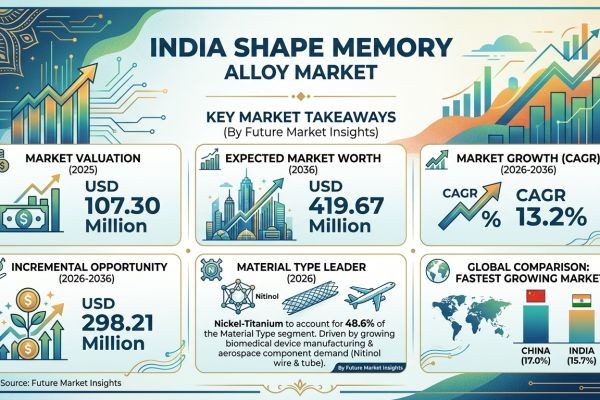
The India shape memory alloy market is projected to witness significant expansion over the next decade, driven by rising demand across biomedical, aerospace, automotive, and precision engineering industries. The market is expected to grow from approximately USD 121.46 million in 2026 to nearly USD 419.67 million by 2036, registering a CAGR of 13.2%, according to the latest analysis by Future Market Insights (FMI).
Market growth is being fueled by increasing adoption of nickel-titanium (Nitinol) alloys in medical devices, expanding domestic aerospace manufacturing, and rising use of smart materials in automotive electronics and industrial automation. Shape memory alloys are gaining strategic importance because of their ability to recover original shapes under thermal or mechanical stimuli, making them highly suitable for high-precision applications.
India Shape Memory Alloy Market Snapshot (2026–2036)
Market size in 2026: USD 121.46 million
Projected market value by 2036: USD 419.67 million
Forecast CAGR (2026–2036): 13.2%
Leading material segment: Nickel-Titanium (48.6% share)
Dominant functionality: Superelasticity (41.2% share)
Fastest-growing application areas: Biomedical and aerospace systems
Primary demand channels: Direct industrial sales and OEM procurement
Momentum in the Market
The India shape memory alloy market is entering a high-growth phase as domestic industries increasingly adopt advanced functional materials for performance-critical applications. Between 2026 and 2036, growth is expected to accelerate due to expanding medical device manufacturing, defense modernization initiatives, and increasing localization of advanced alloy production.
Biomedical applications are emerging as one of the strongest growth engines for the industry. Nitinol-based wires and tubes are being widely used in stents, guidewires, orthodontic products, and minimally invasive surgical devices due to their superior flexibility and biocompatibility.
The aerospace and defense sector is also creating strong procurement demand for shape memory actuators, valves, and coupling systems under India’s “Make in India” manufacturing initiatives. In parallel, automotive manufacturers are integrating shape memory alloy-based actuators and thermal management systems into modern vehicle platforms.
The Reasons Behind the Market’s Growth
Expanding Biomedical Device Manufacturing
India’s growing healthcare manufacturing ecosystem is significantly increasing demand for medical-grade Nitinol components. Shape memory alloys are increasingly used in advanced medical devices because of their durability, flexibility, and corrosion resistance.
Aerospace and Defense Localization
Domestic defense manufacturing programs are accelerating the adoption of shape memory alloy actuators, structural couplings, and aerospace-grade smart materials for lightweight and high-performance applications.
Rising Automotive Electronics Integration
Modern vehicles are incorporating advanced sensors, thermal systems, and precision actuators, creating new opportunities for shape memory alloys in automotive engineering.
Growth in Precision Manufacturing
Industrial automation and precision engineering industries are increasingly utilizing smart alloys for sensors, transducers, and motion-control systems.
Top Segment Analysis
Material Type Analysis
Nickel-Titanium (Nitinol) dominates the market with an expected 48.6% share in 2026, supported by strong demand from biomedical, aerospace, and industrial applications.
Other material categories include:
- Copper-based alloys
- Fe-Mn-Si alloys
- Specialized industrial shape memory materials
Functionality Analysis
Superelasticity is projected to account for 41.2% of the market, driven by increasing use in medical devices requiring high elastic recovery and fatigue resistance.
Key functionality categories include:
- Superelasticity
- Shape memory effect
- Constrained recovery systems
Regional and Industrial Development Trends
India is rapidly strengthening its advanced materials ecosystem through investments in domestic aerospace, medical technology, and automotive manufacturing infrastructure. Increasing collaboration between research institutions, alloy manufacturers, and OEMs is improving product innovation and supply chain capabilities.
The country is also witnessing rising demand for specialty alloys in consumer electronics, smart sensors, and industrial robotics applications.
Challenges, Trends, Opportunities, and Drivers
Drivers
- Expansion of biomedical manufacturing
- Growth in aerospace and defense production
- Increasing automotive electronics integration
- Government support for advanced materials manufacturing
Opportunities
- Development of high-performance smart actuators
- Expansion in minimally invasive medical devices
- Localization of specialty alloy manufacturing
- Integration into industrial automation systems
Trends
- Rising adoption of Nitinol-based medical components
- Increasing use in smart sensors and robotics
- Precision alloy engineering advancements
- Lightweight materials adoption in aerospace systems
Challenges
- Dependence on imported specialty alloy materials
- High manufacturing and processing costs
- Technical complexity in precision fabrication
- Supply chain limitations for raw materials
Country Growth Outlook
India is expected to emerge as one of the fastest-growing markets globally for shape memory alloys, supported by strong biomedical manufacturing growth and government-backed industrial programs. The country is projected to expand at a CAGR of 15.7% during the forecast period.
China remains the leading growth market globally at 17.0%, while Germany and the United States continue to see strong demand driven by aerospace and precision engineering applications.
The Competitive Environment
The India shape memory alloy market is moderately consolidated, with domestic and international players competing through advanced alloy development, manufacturing precision, and strategic industrial partnerships.
Leading companies include:
- Mishra Dhatu Nigam Ltd
- SMA Wires India
- Thermo Fisher Scientific India Private Limited
- ATI Specialty Alloy & Components
- SAES Getters
- Furukawa Electric Co., Ltd.
Manufacturers are investing heavily in advanced alloy processing, precision component manufacturing, and localized production capabilities to strengthen their market positions.
Future Outlook: Toward Smart and Adaptive Materials
The India shape memory alloy market is expected to play a crucial role in the future of smart manufacturing, biomedical innovation, aerospace engineering, and automotive electronics. As industries increasingly prioritize lightweight, adaptive, and high-performance materials, shape memory alloys are expected to become integral to next-generation product development.
Growing investments in domestic manufacturing infrastructure, combined with technological advancements in smart materials and precision engineering, are expected to position India as a key growth hub in the global shape memory alloy industry.
Report Link:
https://www.futuremarketinsights.com/reports/india-shape-memory-alloy-market






