
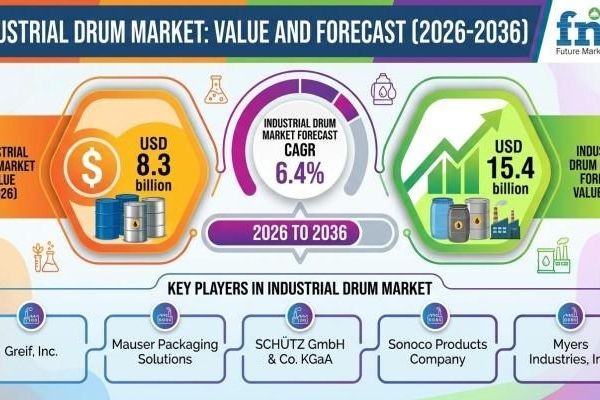
According to the latest analysis by Future Market Insights, the global industrial drum market [https://www.futuremarketinsights.com/reports/industrial-drums-market] is undergoing a major transformation from a traditional bulk packaging segment into a critical component of industrial logistics, hazardous goods transport, and circular packaging infrastructure. Valued at USD 8.3 billion in 2026, the market is projected to reach USD 15.4 billion by 2036, expanding at a CAGR of 6.4% during the forecast period.
The shift reflects changing industrial packaging priorities, where manufacturers increasingly demand durable, reusable, regulation-compliant, and application-specific transport solutions for chemicals, lubricants, agrochemicals, coatings, and industrial liquids.
As industrial supply chains become more safety-focused and sustainability-driven, industrial drums are evolving beyond one-time containment products into long-term operational assets supporting reuse, compliance, and transport efficiency.
Quick Market Highlights
- Market Value (2026): USD 8.3 billion
- Forecast Market Value (2036): USD 15.4 billion
- CAGR (2026–2036): 6.4%
- Leading Material Segment: Steel drums (46.5% share)
- Dominant Capacity Segment: 200–250 liters (52.0% share)
- Leading Head Type: Tight head drums (58.0% share)
- Top Product Category: New drums (72.0% share)
Get complete market forecasts, pricing analysis, and competitive intelligence:
https://www.futuremarketinsights.com/reports/sample/rep-gb-6374
Industrial Packaging Is Becoming More Strategic
The industrial drum market is entering a sustained growth cycle fueled by rising movement of industrial liquids, increasing hazardous material handling requirements, and stronger global emphasis on transport safety and packaging reliability.
Traditionally used as standardized containers for industrial liquids and chemicals, industrial drums are now becoming strategically important logistics tools within global manufacturing and supply chain systems.
Industrial buyers are no longer selecting drums solely on storage volume. Purchasing decisions increasingly depend on:
- Material compatibility
- UN certification standards
- Reusability and recovery potential
- Durability during long-distance transport
- Sealing reliability
- Reverse logistics compatibility
This transition is reshaping industrial drums from low-value packaging commodities into performance-oriented industrial logistics solutions.
Simultaneously, the rise of reconditioning and closed-loop recovery systems is creating new commercial opportunities across industrial packaging ecosystems, especially among large chemical and lubricant manufacturers seeking lower lifecycle packaging costs and improved sustainability performance.
Key Growth Drivers Fueling Market Expansion
Expansion of Chemical and Lubricant Supply Chains
Global growth in chemicals, industrial oils, lubricants, coatings, and agrochemicals continues to generate strong demand for high-performance industrial drums.
These industries require reliable packaging systems capable of transporting hazardous and high-volume liquid products safely across complex international supply chains.
Steel drums continue to dominate heavy-duty industrial applications due to their strength, impact resistance, and secure sealing capabilities.
Rising Adoption of Reconditioned Drums
Industrial companies are increasingly implementing reusable and reconditioned drum programs to reduce procurement costs and strengthen sustainability initiatives.
Reconditioned steel drums are cleaned, tested, inspected, and reused across repeat industrial transport routes where collection and recovery systems are well established.
This trend is gaining strong traction among chemical producers and industrial fillers aiming to reduce packaging waste without compromising safety or compliance.
Regulatory Compliance and Hazardous Goods Transport
Global transport regulations governing hazardous materials continue to tighten, increasing demand for certified industrial drums with proven sealing performance and documented compliance standards.
Manufacturers capable of providing:
- UN-certified packaging
- Testing documentation
- Material compatibility support
- Quality assurance systems
are becoming preferred suppliers across industrial markets.
Market Challenges Remain Significant
Despite favorable long-term growth prospects, industrial drum manufacturers continue to face several operational and cost-related pressures.
Raw Material Price Volatility
- Fluctuations in steel, plastic resin, adhesives, and paperboard prices continue to affect manufacturing economics.
- Steel drum manufacturers remain exposed to metal pricing instability, while plastic drum suppliers face resin cost sensitivity.
- Rising input costs can compress margins and influence customer preferences regarding packaging material selection.
Compliance and Quality Complexity
- Industrial drums used for hazardous materials must meet stringent international transport standards and testing requirements.
- Compliance processes involving inspection, certification, documentation, and quality control increase operational complexity for manufacturers.
- Because packaging failures can create major financial and safety liabilities, buyers increasingly prioritize reliability and certification consistency when selecting suppliers.
Emerging Opportunities Reshaping the Market
Several high-value growth areas are expected to influence the future trajectory of the industrial drum industry:
- Expansion of reconditioning and recovery infrastructure
- Rising demand for UN-certified hazardous goods packaging
- Growing adoption of corrosion-resistant plastic drums
- Increasing use of reusable industrial packaging systems
- Regional manufacturing expansion supporting localized production
- Stronger export demand for durable industrial transport packaging
Competitive Landscape
The industrial drum market remains moderately consolidated, with global manufacturers competing alongside regional producers and packaging reconditioners.
Key companies shaping the market include:
- Greif
- Mauser Packaging Solutions
- SCHÜTZ
- Time Technoplast
- Balmer Lawrie
- Myers Industries
- TPL Plastech
Manufacturers are increasingly differentiating themselves through:
- UN-certified packaging capabilities
- Regional manufacturing networks
- Recovery and reconditioning infrastructure
- Material compatibility expertise
- Quality assurance consistency
- Specialized industrial drum formats and closure systems
For industrial buyers, supplier selection is increasingly influenced by operational reliability, certification support, and long-term logistics performance rather than price alone.
Future Outlook: Toward Circular Industrial Packaging Systems
Over the next decade, the industrial drum industry is expected to transition from a transactional packaging category into an integrated part of industrial sustainability and reverse logistics ecosystems.
Key long-term trends shaping the market include:
- Wider implementation of reusable drum programs
- Growth of certified hazardous goods packaging systems
- Increasing use of corrosion-resistant plastic drums
- Expansion of reverse logistics and recovery infrastructure
- Stronger sustainability focus across industrial packaging
- Regionalization of industrial supply chains
As industrial operations prioritize safety, efficiency, and reuse economics, industrial drums are increasingly becoming strategic logistics assets supporting long-term operational resilience.
Executive Takeaways
- Industrial drum demand continues to rise alongside global chemical and industrial liquid movement.
- Steel drums remain dominant due to strength, certification readiness, and hazardous goods compatibility.
- Reconditioning is becoming commercially important as companies seek cost-efficient reusable packaging solutions.
- Compliance, transport certification, and operational reliability are becoming critical supplier selection criteria.
- India and China are emerging as major long-term growth engines.
- Competitive differentiation is increasingly centered on certification support, quality consistency, and regional supply capabilities.
- The next phase of market evolution will focus heavily on reusable industrial packaging systems and circular logistics infrastructure.
About Future Market Insights (FMI)
Future Market Insights, Inc. (FMI) is an ESOMAR-certified, ISO 9001:2015 market research and consulting organization, trusted by Fortune 500 clients and global enterprises. With operations in the U.S., UK, India, and Dubai, FMI provides data-backed insights and strategic intelligence across 30+ industries and 1200 markets worldwide.






