
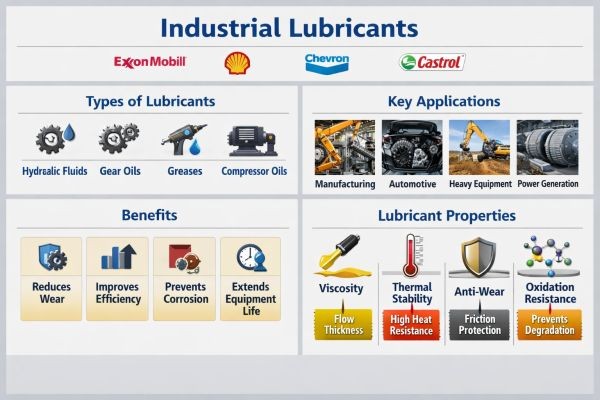
The industrial lubricants market size is projected to reach US$ 113.78 billion by 2031 from US$ 89.58 billion in 2024, registering a CAGR of 3.7% from 2025 to 2031, with historical data covering 2021 to 2023 and base year 2024. This Industrial Lubricants Market Report by The Insight Partners examines market dynamics across mineral oil, synthetic oil, and bio-based oil types and product types including hydraulic fluid, engine oil, driveline lubricants, metalworking fluids, grease, process oils, coolants, and others, serving building and construction, power generation, mining and metallurgy, food processing, oil and gas, marine, aviation, and other end-use industries globally.
Industrial lubricants are the circulatory system of the global manufacturing economy. Every machine that moves, rotates, cuts, compresses, or generates power creates friction at its contact surfaces, and lubricants are the chemical engineering solution that manages that friction in ways determining whether equipment lasts days or decades. The economic significance of lubricant quality is not proportional to its cost in the total manufacturing budget but to the machinery uptime, maintenance cost reduction, and product quality outcomes it enables across the entire operational lifetime of industrial assets.
Segments Covered
By Type:
- Mineral Oil
- Synthetic Oil
- Bio-Based Oil
By Product Type:
- Hydraulic Fluid
- Engine Oil
- Driveline Lubricants
- Metalworking Fluids
- Grease
- Process Oils
- Coolants
- Others
By End-Use Industry:
- Building and Construction
- Power Generation
- Mining and Metallurgy
- Food Processing
- Oil and Gas
- Marine
- Aviation
- Others
What is driving the industrial lubricants market beyond simple machinery growth?
Mechanization and automation in industries have created a dependence on high-performance lubricants as a way of reducing friction, wear, and heat, and ensuring the smooth operation of high-endurance machinery in extreme conditions. As production lines operate at higher speeds, higher temperatures, and higher loads to meet competitive efficiency requirements, lubricant performance specifications are being continuously raised in ways that drive procurement toward premium synthetic and semi-synthetic products.
Request Sample Pages of this Research Study @ https://www.theinsightpartners.com/sample/TIPRE00004232
Key Market Players
- China Petroleum and Chemical Corp (Sinopec)
- Exxon Mobil Corp
- BP Plc
- Shell Plc
- Kluber Lubrication GmbH and Co KG
- Chevron Corp
- Phillips 66
- TotalEnergies SE
- Valvoline Inc
- Fuchs SE
Market Overview
The synthetic oil segment holds the largest market share, reflecting the progressive adoption of synthetically formulated lubricants across industrial applications where temperature stability, oxidation resistance, and consistent viscosity under extreme operating conditions are required. Synthetically formulated lubricants provide performance advantages that mineral oil alternatives cannot match in demanding applications, justifying the premium pricing that supports synthetic segment revenue leadership. Asia Pacific is the largest and fastest-growing regional market, driven by the scale of manufacturing, infrastructure, and industrial operations across China, India, Japan, and South Korea.
Market Drivers
Rapid industrial growth and expanding machine use in manufacturing, automotive, construction, and power sectors are creating strong demand for industrial lubricants globally. As industries grow and deploy new machinery, they need high-performance lubricants to reduce friction, prevent wear, and increase service life across diverse operating environments. Emerging economies in Asia Pacific, the Middle East, and Latin America are investing significantly in infrastructure and industrial projects, which directly boosts lubricant consumption across every end-use category.
More automation and the increasing use of heavy machinery in factories and production lines make lubricants crucial for smooth operations. This trend is expected to continue as industries focus on efficiency, equipment reliability, and reduced downtime, driving long-term market growth that is fundamentally linked to capital expenditure in productive industrial assets rather than to discretionary consumption.
What is the most commercially significant technology trend reshaping industrial lubricant specifications?
The progression of machinery toward higher precision, higher speed, and more extreme temperature operating conditions is continuously raising the performance bar that lubricants must meet. Equipment designed for greater energy efficiency operates closer to its metallurgical performance limits, requiring lubricants that maintain film integrity under conditions that would cause conventional mineral oil to oxidize, thin out, or carbonize. This machinery evolution creates upgrade cycles that drive procurement toward premium synthetic formulations.
Regional Analysis
Asia Pacific leads global market revenues and is expected to register the highest CAGR during the forecast period, driven by the manufacturing expansion of China and India alongside Japan and South Korea's advanced industrial operations. North America and Europe contribute significant revenues from premium synthetic lubricant adoption in advanced manufacturing, aviation, and specialty industrial applications. The Middle East and Africa are growing markets linked to oil and gas sector investment and expanding industrial infrastructure.
Also Available in: Korean | German | Japanese | French | Chinese | Italian | Spanish






