
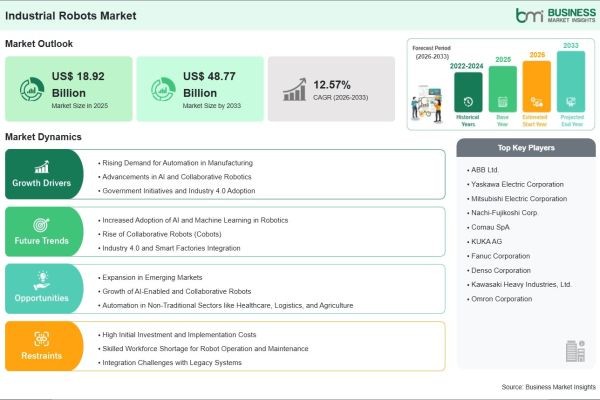
The Industrial Robots Industry is experiencing steady growth worldwide, driven by the escalating adoption of factory automation across diverse manufacturing sectors, a rising global focus on operational efficiency and precision, and the pressing need to mitigate labor shortages.
According to Business Market Insights, the global Industrial Robots Market size is expected to reach US$ 48.77 Billion by 2033 from US$ 18.92 Billion in 2025. The market is estimated to record a CAGR of 12.57% from 2026 to 2033.
Advancements in collaborative robotics (cobots), artificial intelligence (AI) integration, and machine vision technologies, along with the rising deployment of automated systems in secondary industries like food processing and logistics, are significantly transforming the market landscape. Manufacturers are increasingly prioritizing high-payload capacities, flexible multi-axis mobility, and cloud-connected diagnostics to meet shifting industrial preferences for flexible manufacturing and rapid production turnaround.
Download Sample Report : https://www.businessmarketinsights.com/sample/BMIPUB00032681
What Is an Industrial Robot?
Industrial robots encompass a comprehensive range of automatically controlled, reprogrammable, multipurpose manipulators programmable in three or more axes, designed for heavy-duty industrial automation applications. Their primary objective is to execute highly repetitive, precise, or hazardous physical tasks at high speeds without human intervention.
Because modern manufacturing demands continuous throughput and zero-defect quality control, industrial robots are extensively deployed across automotive, electronics, and heavy machinery production facilities. Traditional setups rely strictly on rigid, hard-coded linear paths enclosed in safety cages. In contrast, advanced industrial robotic configurations integrate sophisticated force-torque sensors, deep-learning vision algorithms, and smart gripping systems tailored to handle delicate assemblies and dynamic, variable product lines.
Market Drivers
A primary driver for the Industrial Robots Industry is the rapid automation of the automotive and electronics manufacturing sectors, particularly in the production of electric vehicles (EVs) and complex semiconductor components. These high-tech fields require sub-millimeter placement precision and high-speed material handling that manual labor cannot consistently achieve.
The rising labor costs and widening workforce shortages across major industrial nations also act as a vital growth factor. Implementing robotic systems allows manufacturing facilities to run continuous 24/7 production cycles, helping companies maintain high output levels while shielding their operational overhead from domestic labor market volatility.
Furthermore, stringent workplace safety regulations and corporate welfare initiatives aimed at reducing occupational hazards significantly contribute to market demand. The growing transition toward deploying specialized robots for dangerous tasks—such as heavy lifting, high-temperature foundry operations, toxic chemical spraying, and arc welding—is heavily driving market volume.
Additionally, the increasing financial accessibility of small-scale collaborative robots (cobots) is prompting small and medium enterprises (SMEs) to adopt automation, removing the historical barrier of high upfront capital requirements and further propelling sustained market growth.
Market Segmentation
By Robot Type
- Articulated Robots
- Cartesian Robots
- SCARA Robots
- Delta Robots
- Collaborative Robots (Cobots)
By Application
- Material Handling and Logistics
- Welding and Soldering
- Assembly and Disassembly
- Painting and Dispensing
- Processing and Cleanroom Applications
By End-Use Industry
- Automotive
- Electrical and Electronics
- Food and Beverages
- Pharmaceuticals and Cosmetics
- Metal and Machinery
The articulated robots segment dominates the market due to its high flexibility, extensive reach, and established history of handling diverse payloads in heavy manufacturing. The collaborative robots (cobots) segment is witnessing the fastest growth, heavily supported by its ease of programming, lower space requirements, and ability to work safely alongside human operators without protective fencing.
Regional Insights
- Asia-Pacific dominates the Industrial Robots Industry, driven by rapid industrialization, massive production capacities in China, Japan, and South Korea, and heavy government subsidization of local factory automation projects.
- Europe exhibits steady growth, heavily regulated by strict industrial safety standards and a strong regional focus on "Industry 4.0" initiatives that encourage the deployment of certified energy-efficient and connected robotic frameworks.
- North America accounts for a substantial market share, supported by high capital investments in advanced manufacturing, the accelerating reshoring of industrial supply chains, and strong demand for robotic logistics solutions.
- Middle East & Africa and South & Central America are gradually expanding due to escalating investments in automotive manufacturing clusters and efforts to modernize regional mineral processing facilities.
Top Players in the Industrial Robots Industry
The market is highly competitive, with leading manufacturers focusing on R&D investments, strategic software provider acquisitions, and expanding their global maintenance networks to optimize long-term equipment uptime.
- FANUC Corporation
- Yaskawa Electric Corporation
- ABB Ltd
- KUKA AG
- Kawasaki Heavy Industries, Ltd.
- Mitsubishi Electric Corporation
- Nachi-Fujikoshi Corp.
- Stäubli International AG
- Universal Robots A/S (Teradyne)
- Comau S.p.A.
These companies continue to invest heavily in advanced mechanical engineering and control systems to produce tailored industrial solutions that meet the exact speed, payload rigidity, and software interoperability requirements of their global manufacturing clientele.
Technological Innovations
Technological advancements in edge computing and artificial intelligence are significantly transforming the Industrial Robots Market. Manufacturers are optimizing modern robotic arms by integrating machine learning models capable of path self-optimization, enabling systems to dynamically adjust to moving conveyor lines and correct errors in real time.
Furthermore, innovations in 3D bin-picking and smart vision tracking are gaining traction. Companies are increasingly commercializing high-resolution vision systems that allow robots to orient, identify, and pick unorganized, randomly placed parts out of deep bins, completely removing the need for structured manual parts staging.
The development of unified digital twin platforms is also opening new frontiers, allowing engineers to completely simulate, test, and debug entire robotic production lines virtually before deploying physical hardware to the factory floor, minimizing costly downtime.
Future Market Outlook
The future outlook for the Industrial Robots Industry remains highly positive. As global supply chains increasingly prioritize regional resilience, operational agility, and sustainable resource management, the industrial sector will continue to transition away from manual fixed-line operations toward highly adaptive, modular robotic arrays.
The ongoing expansion of subscription-based "Robotics-as-a-Service" (RaaS) business models, alongside the rising integration of 5G connectivity for ultra-low latency industrial fleet coordination, is expected to create substantial growth opportunities. Manufacturers that prioritize seamless software plug-and-play features, robust cyber-physical security measures, and lightweight, high-efficiency servo motors will be best positioned to capture market share in the coming years.
Frequently Asked Questions (FAQs)
What is the difference between an articulated robot and a cobot?
An articulated robot is a traditional industrial manipulator designed for high-speed, heavy-payload tasks, requiring safety caging due to high operational force. A collaborative robot (cobot) is built with integrated force sensors and rounded edges, allowing it to work safely alongside human operators without safety barriers.
What is a SCARA robot best used for?
SCARA (Selective Compliance Assembly Robot Arm) robots feature a rigid vertical axis and flexible horizontal movement, making them highly efficient for rapid pick-and-place, sorting, and small-component assembly operations in electronics and consumer goods production.
How does a digital twin help in industrial robotics?
A digital twin is a virtual replica of a physical robotic system. It allows manufacturing engineers to program, optimize, and stress-test the robot's movements in a digital space, ensuring zero physical collisions and saving significant time during actual implementation.
Can industrial robots operate in cleanrooms?
Yes, many manufacturers produce specialized cleanroom-certified robots. These systems feature fully sealed joints, specialized low-outgassing lubricants, and smooth external coatings designed to prevent particulate generation, making them suitable for pharmaceutical and semiconductor manufacturing.
Browse More Reports:
https://www.businessmarketinsights.com/reports/latin-america-laser-ablation-market
https://www.businessmarketinsights.com/reports/asia-pacific-pulsed-field-ablation-market
https://www.businessmarketinsights.com/reports/gcc-pulsed-field-ablation-market
About Us
Business Market Insights is a market research platform that provides subscription service for industry and company reports. Our research team has extensive professional expertise in domains such as Electronics & Semiconductor; Aerospace & Defense; Automotive & Transportation; Energy & Power; Healthcare; Manufacturing & Construction; Food & Beverages; Chemicals & Materials; and Technology, Media, & Telecommunications.
Contact Us
If you have any questions about this report or would like further information, please contact us:
Contact person: Ankit Mathur
Email: sales@businessmarketinsights.com
Phone: +16467917070






