
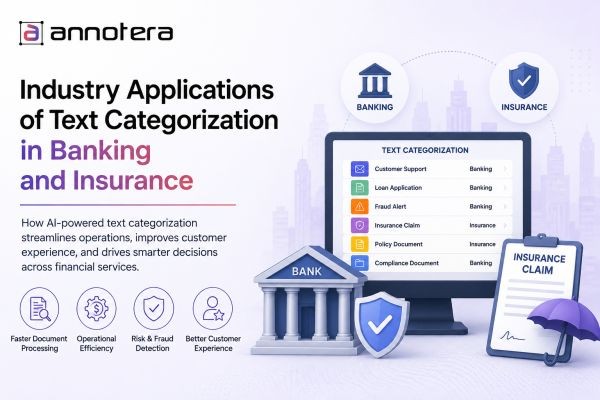
The banking and insurance sectors process enormous volumes of unstructured text every day. From customer emails and insurance claims to loan applications, policy documents, and compliance reports, organizations are inundated with information that must be sorted, analyzed, and acted upon quickly. Manual handling of this data is not only time-consuming but also prone to inconsistencies and delays.
This is where text categorization has become a critical AI capability. By automatically organizing textual data into predefined categories, financial institutions can streamline operations, improve customer experiences, strengthen fraud detection, and ensure regulatory compliance. However, the success of any text categorization system depends on accurately labeled training data, making collaboration with an experienced data annotation company essential for achieving reliable AI outcomes.
In this blog, we'll explore how text categorization is transforming banking and insurance while highlighting the importance of high-quality text annotation in building intelligent financial AI systems.
What Is Text Categorization?
Text categorization is a Natural Language Processing (NLP) technique that automatically assigns text documents to one or more predefined categories based on their content.
For example:
- Customer complaint → Customer Support
- Loan application → Lending
- Insurance claim → Claims Processing
- Fraud alert → Risk Management
- KYC documentation → Compliance
Unlike manual document sorting, AI-powered text categorization processes thousands of documents within seconds while maintaining consistency across workflows.
Why Banking and Insurance Need Text Categorization
Financial institutions deal with massive volumes of textual information generated from:
- Customer emails
- Chat conversations
- Loan applications
- Insurance claims
- Internal reports
- Legal contracts
- Compliance documentation
- Risk assessments
- Financial statements
- Transaction notes
Without automation, employees spend significant time identifying document types before actual processing begins.
Text categorization enables organizations to:
- Reduce operational costs
- Accelerate document processing
- Improve response times
- Enhance customer satisfaction
- Minimize manual errors
- Support digital transformation initiatives
These advantages are driving widespread adoption of AI-powered document intelligence across financial services.
Key Applications of Text Categorization in Banking
1. Customer Support Ticket Routing
Banks receive thousands of customer inquiries every day regarding:
- Credit cards
- Account access
- Loan services
- Online banking
- Fraud reporting
- Payment disputes
Text categorization automatically identifies the topic of each inquiry and routes it to the appropriate department.
Benefits include:
- Faster response times
- Reduced workload for support teams
- Improved customer satisfaction
- Consistent issue prioritization
2. Loan Application Processing
Loan applications contain various supporting documents, including:
- Income statements
- Employment verification
- Tax records
- Identity documents
- Property information
Text categorization automatically classifies these documents, enabling faster underwriting and reducing manual document review.
This significantly improves loan processing efficiency while reducing turnaround times.
3. Fraud Detection
Banks continuously monitor customer communications and transaction-related information for suspicious behavior.
AI models categorize text into classes such as:
- Suspicious transaction
- Identity theft
- Account takeover
- Phishing attempt
- Normal inquiry
Combined with fraud detection algorithms, text categorization helps investigators identify high-risk cases much earlier.
4. Regulatory Compliance
Financial institutions must comply with strict regulations regarding:
- Anti-Money Laundering (AML)
- Know Your Customer (KYC)
- GDPR
- Financial reporting
- Risk disclosures
AI categorizes incoming compliance documents, making regulatory audits more efficient while reducing administrative effort.
5. Customer Feedback Analysis
Banks receive customer feedback through:
- Surveys
- Social media
- Emails
- Mobile applications
- Online reviews
Text categorization organizes feedback into themes such as:
- Mobile banking
- Branch services
- Loan experience
- Card issues
- Customer service
This enables decision-makers to quickly identify recurring issues and improve customer experience.
Industry Applications in Insurance
Insurance companies also manage massive collections of text documents throughout the policy lifecycle.
1. Insurance Claim Classification
Claims arrive in various forms, including:
- Medical claims
- Vehicle accident reports
- Property damage claims
- Travel insurance claims
- Life insurance documentation
Text categorization identifies claim types instantly, directing them to specialized claims teams for faster processing.
The result is improved operational efficiency and shorter claim settlement times.
2. Policy Document Organization
Insurance providers maintain millions of policy documents across different product lines.
AI categorizes policies based on:
- Coverage type
- Customer segment
- Renewal status
- Geographic region
- Product category
This enables employees to retrieve relevant documents quickly while improving internal knowledge management.
3. Fraud Investigation
Insurance fraud remains one of the industry's largest operational challenges.
Text categorization assists investigators by identifying claims that exhibit patterns associated with:
- Duplicate submissions
- Suspicious narratives
- Inconsistent documentation
- High-risk claim descriptions
These cases can then undergo additional review before settlement.
4. Customer Communication Management
Insurance companies receive communications involving:
- Policy renewals
- Premium inquiries
- Coverage questions
- Claim status requests
- Complaint resolution
AI categorizes each communication automatically, ensuring it reaches the correct department without manual intervention.
5. Risk Assessment
Underwriters evaluate numerous textual documents before issuing policies.
These include:
- Medical histories
- Inspection reports
- Financial disclosures
- Business risk reports
Text categorization organizes these documents into structured workflows that accelerate underwriting decisions.
Why High-Quality Annotation Matters
Even the most sophisticated AI model performs poorly without quality training data.
Financial terminology often includes:
- Complex legal language
- Industry-specific abbreviations
- Sensitive customer information
- Domain-specific vocabulary
Creating accurate datasets requires experienced human annotators who understand financial contexts.
A trusted text annotation company [https://www.annotera.ai/services/text-annotation/] ensures documents are consistently categorized according to well-defined annotation guidelines, enabling AI models to achieve higher accuracy in production environments.
Organizations often choose text annotation outsourcing to gain access to skilled annotation teams, scalable operations, and rigorous quality assurance without expanding internal resources.
Likewise, partnering with a specialized data annotation company helps financial institutions build datasets that support continuous AI improvement while maintaining consistency across evolving business requirements.
Best Practices for Implementing Text Categorization
Organizations should follow several best practices when deploying text categorization solutions:
- Define clear category hierarchies.
- Use domain-specific annotation guidelines.
- Include diverse training examples across document types.
- Continuously update datasets as regulations evolve.
- Perform regular quality audits.
- Incorporate human validation for ambiguous cases.
- Monitor model performance using real-world data.
- Partner with reliable data annotation outsourcing providers to scale annotation projects efficiently while maintaining high-quality standards.
These practices improve model accuracy and help AI adapt to changing business environments.
How Annotera Supports Financial AI
At Annotera, we help banking, insurance, and financial organizations build reliable AI systems through high-quality text annotation services.
Our experienced annotation specialists support projects involving:
- Text categorization
- Document classification
- Named Entity Recognition (NER)
- Sentiment analysis
- Intent classification
- Compliance document labeling
- Financial document annotation
- AI training data quality assurance
Our scalable workflows combine expert human annotation with rigorous quality control to deliver datasets tailored to enterprise AI requirements. Whether you're developing intelligent document processing solutions, customer support automation, or fraud detection systems, Annotera provides dependable annotation support that helps improve model performance while reducing development time.
Conclusion
Text categorization has become a foundational technology for modern banking and insurance organizations. From automating customer support and loan processing to accelerating claims management and regulatory compliance, AI-powered categorization enables faster, more accurate decision-making across the financial ecosystem.
However, the effectiveness of these AI systems depends heavily on the quality of their training data. By partnering with an experienced data annotation company, organizations can build accurate datasets that improve model reliability, scalability, and long-term performance. Leveraging data annotation outsourcing and working with a trusted text annotation company offering text annotation outsourcing services allows financial institutions to deploy AI solutions with greater confidence, ensuring operational efficiency and enhanced customer experiences in an increasingly digital world.






