
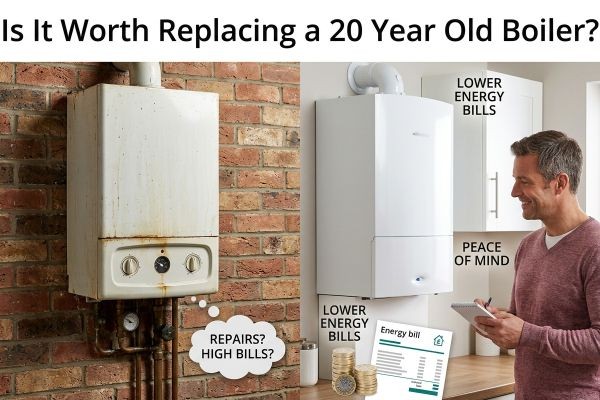
If your boiler has been quietly doing its job for two decades, it’s understandable to hesitate before replacing it. After all, if it still works, why spend money?
But age matters more than many people realise. A 20-year-old boiler sits well beyond the typical lifespan of most systems. At that point, the question isn’t just about performance, it’s about efficiency, safety, and long-term cost.
Let’s look at whether replacing it actually makes sense, and where schemes like the Boiler Upgrade Scheme fit into the decision.
How long should a boiler realistically last?
Most boilers are designed to last around 10 to 15 years with proper maintenance. Some older models stretch beyond that, especially if they’ve been well looked after.
However, once you reach the 20-year mark, the system is operating outside its expected lifecycle. Components wear down, efficiency drops, and spare parts become harder to find.
So even if it still turns on, it may not be performing anywhere near its original standard.
What problems do older boilers usually have?
Age shows up in subtle ways at first, then more clearly over time.
Reduced efficiency
Older boilers waste more energy. They burn more fuel to produce the same level of heat, which pushes up your energy bills.
Frequent breakdowns
Parts like pumps, valves, and heat exchangers wear out. Repairs become more common and often more expensive.
Inconsistent heating
You might notice uneven temperatures, slow heating, or a fluctuating hot water supply.
Safety concerns
While not every old boiler is unsafe, ageing systems carry a higher risk of faults, including carbon monoxide issues if not properly maintained.
These issues don’t always appear at once, but they tend to increase with time.
Does replacing an old boiler actually save money?
This is where things get a bit more nuanced.
A new boiler, or a modern heating system, usually runs far more efficiently. That means lower energy use over time. However, the upfront cost of replacement can be significant.
So the real comparison looks like this:
- Keep the old boiler: Lower short-term cost, but higher bills and repair expenses
- Replace it: Higher upfront cost, but better efficiency and fewer breakdowns
Over several years, many homeowners find the balance shifts toward replacement, especially if repair costs start adding up.
What about switching to newer heating systems?
This is where the conversation has changed in recent years.
Instead of simply replacing an old gas boiler with a new one, many people now consider low-carbon alternatives. The Boiler Upgrade Scheme supports this shift by offering grants for systems like heat pumps.
These systems don’t generate heat in the same way as traditional boilers. Instead, they transfer heat, which can be more efficient under the right conditions.
However, they’re not a perfect fit for every home. Installation requirements, insulation levels, and available space all play a role.
When is replacement clearly the better option?
There are situations where replacing a 20-year-old boiler becomes the sensible choice.
- Your boiler breaks down regularly
- Repairs are becoming expensive or difficult
- Your energy bills are noticeably high
- Parts are no longer easily available
- You’re planning to stay in your home long-term
In these cases, holding on to the old system often costs more in the long run.
When might it make sense to wait?
Not every situation calls for immediate replacement.
You might hold off if:
- The boiler is still reliable and has been recently serviced
- Your home isn’t yet suitable for a newer system
- You’re planning to move in the near future
- You’re waiting for changes in grants or technology
That said, waiting carries some risk. Older systems can fail without much warning, often at inconvenient times.
How does the Boiler Upgrade Scheme affect your decision?
The Boiler Upgrade Scheme can shift the financial side of the equation.
Reducing the upfront cost of installing a low-carbon system, it makes alternatives more accessible. For homeowners already considering a replacement, this can make the decision easier.
However, it’s important to check whether your home is suitable before relying on the scheme. Heat pumps, for example, work best in well-insulated properties.
So while the scheme helps with cost, it doesn’t remove the need for a proper assessment.
Practical steps before deciding
If you’re unsure what to do next, a few simple actions can help:
- Have your current boiler inspected by a qualified engineer
- Ask about efficiency levels and expected remaining lifespan
- Compare repair costs with replacement estimates
- Check your home’s insulation and heating requirements
- Explore whether you qualify for support under the Boiler Upgrade Scheme
Taking these steps gives you a clearer, more grounded view of your options.
Final thoughts
Replacing a 20-year-old boiler isn’t just about upgrading; it’s about avoiding the slow decline that comes with ageing systems.
While it may still be working today, the combination of lower efficiency, rising repair costs, and potential reliability issues often makes replacement the more practical choice over time.
That doesn’t mean you need to rush into it. But if your system is showing signs of age, it’s worth planning ahead rather than waiting for a breakdown.
With options like the Boiler Upgrade Scheme available, the decision isn’t only about replacing what you have; it’s also about choosing what comes next, checking an eligibility guide for the boiler upgrade scheme. can help you understand your options more clearly.






