
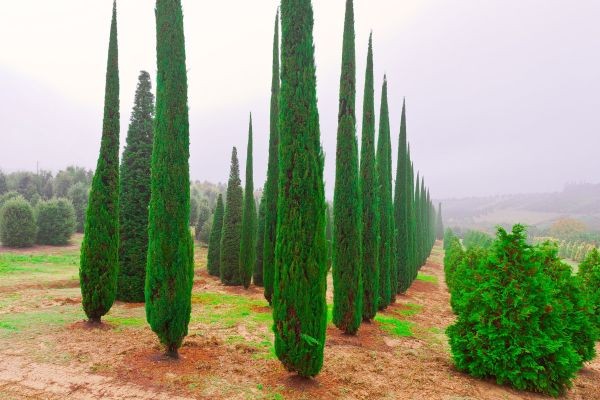
Tall, narrow, and visually striking, italian cypress is one of the most recognizable evergreen trees used in landscape design. Known for its upright growth and formal appearance, it is widely chosen to create structure in gardens, frame entrances, and add vertical interest without taking up much ground space. These trees are especially popular in Mediterranean-style landscapes but are now commonly used in modern residential and commercial gardens as well.
Because of italian cypress slim shape and evergreen nature, these trees are often selected for decorative planting as well as functional landscaping purposes such as boundary definition and visual screening. Their ability to maintain greenery throughout the year makes them a reliable choice for consistent outdoor appeal.
Key Characteristics of Italian Cypress
Italian cypress is a fast-growing evergreen conifer that naturally grows in a narrow, column-like form. Unlike many other trees that spread outward as they mature, this species maintains a tight vertical structure, making it ideal for compact spaces.
Its dense green foliage grows closely along the trunk, giving it a clean and structured appearance. In many landscapes, these trees are planted in rows to create symmetry and visual rhythm, especially along driveways or garden pathways.
Another notable feature is its adaptability to warm and dry climates. Once established, it requires relatively low maintenance compared to many ornamental trees.
Benefits of Using Italian Cypress in Landscaping
One of the main reasons homeowners and landscapers choose this tree is its combination of beauty and practicality.
Space-Efficient Growth
Because of its narrow profile, it can be planted in areas where wider trees would not fit. This makes it suitable for small gardens, tight boundaries, or areas where vertical design is preferred over horizontal spread.
Year-Round Green Structure
Unlike seasonal plants, it maintains its foliage throughout the year. This ensures consistent structure and color in outdoor spaces regardless of seasonal changes.
Natural Screening Effect
When planted in groups, these trees can form a natural visual barrier. While they may not completely block sound or visibility like dense hedges, they still provide a soft screening effect that enhances privacy and aesthetics.
Ideal Growing Conditions
To ensure healthy growth, proper planting conditions are important.
Sunlight Requirements
These trees grow best in full sunlight. Adequate sun exposure helps maintain strong growth and dense foliage. In shaded areas, growth may become slower and less uniform.
Soil and Drainage
Well-draining soil is essential. Excess water retention can affect root health, so areas with good drainage are preferred. Sandy or loamy soils are generally suitable.
Watering Needs
Young trees require regular watering during the establishment phase. Once mature, they become more drought-tolerant and require less frequent irrigation, making them suitable for low-maintenance landscapes.
Common Uses in Outdoor Design
Italian is widely used for both decorative and functional landscaping purposes.
Entrance and Driveway Framing
Many homeowners use these trees to create a formal entrance effect. When placed along driveways or gates, they add a sense of symmetry and elegance.
Garden Accents
They are often used as standalone feature trees in gardens to create vertical contrast against lower shrubs and flowering plants.
Boundary Definition
In some landscapes, they are planted along property lines to subtly define space without the heaviness of solid fencing.
Maintenance and Care
This tree is considered relatively easy to maintain once established. Minimal pruning is required, as its natural shape remains upright without much intervention.
Occasional trimming may be done to maintain alignment in formal rows. It is also important to ensure proper spacing between trees to allow airflow and reduce the risk of disease.
Gardeners also often explore when looking for additional natural screening options that combine greenery with more dense coverage for outdoor spaces.
Conclusion
With its elegant form, low-maintenance nature, and year-round greenery, Italian remains a popular choice for structured and decorative landscaping. When planned carefully, it can bring long-lasting visual balance and natural sophistication to outdoor environments, while also working well alongside privacy trees for enhanced garden screening and privacy solutions. Its ability to add height without occupying much space makes it suitable for a wide range of garden designs, from formal entrances to modern outdoor layouts.






