
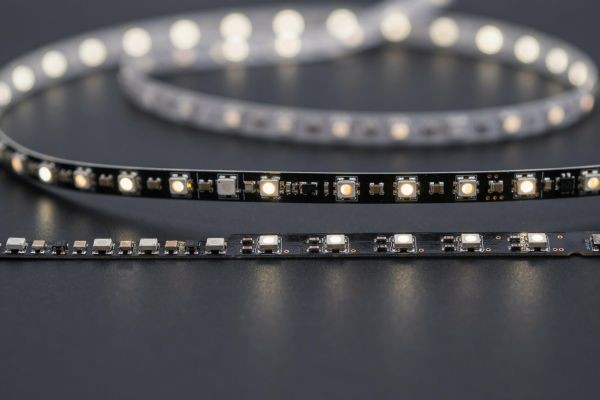
Ask any two LED strip suppliers to explain the difference between a "3014" strip and a "5050" strip, and you'll often get an answer focused only on physical package size. That's part of the picture, but for LED strip OEM manufacturer buyers making a package selection decision, the more useful comparison is luminous efficiency, thermal behavior, and how each package trades off brightness against strip width and cost. This is the comparison that actually determines which package fits a given fixture design.
What the Numbers Actually Mean
The numeric designation on an SMD LED package (3014, 2835, 5050, and so on) refers to the physical package dimensions in tenths of a millimeter a 5050 package measures roughly 5.0mm by 5.0mm, a 3014 measures roughly 3.0mm by 1.4mm, and so on. Package size correlates with, but doesn't fully determine, output the internal chip size, phosphor formulation, and thermal design within a given package all affect actual lumen output per LED.
Luminous Efficiency Comparison
As reference points drawn from common production-grade packages: a 3014 package commonly delivers in the range of 12–14 lumens per LED, while a 2835 package in a higher-output configuration can reach roughly 26–30 lumens per LED meaningfully higher output per individual diode despite a comparable or smaller physical footprint, reflecting improvements in chip efficiency and phosphor design in the 2835 package family relative to older 3014 designs.
This matters directly for OEM fixture design because achieving a target brightness with fewer, more efficient LEDs generally means lower total power draw for the same lumen output, less heat generated per unit of light produced, and often lower total component cost across a production run all genuine engineering advantages, not just a marketing distinction between package numbers.
Width and Form Factor Tradeoffs
Package selection isn't purely about efficiency physical strip width is a real design constraint for many fixtures, particularly in slim architectural channels, furniture-integrated lighting, or signage lettering with limited depth. Narrower packages like 3014 and certain 2835 configurations allow for narrower PCB widths (commonly around 8mm), while 5050 packages, being larger, typically require or are paired with wider board widths to accommodate the package footprint and adequate copper trace clearance around it.
For OEM fixture designs where board width is fixed by the housing dimension, package selection often works backward from that width constraint first, then optimizes for efficiency within whatever packages fit rather than selecting the most efficient package in isolation and hoping it fits the housing.
Copper Foil and Thermal Design Interact With Package Choice
Higher-output packages draw more current per LED, which places more demand on the copper trace carrying that current along the strip length. This is why higher-output package configurations are frequently paired with thicker copper foil commonly 3oz on higher-density, higher-output product lines to manage the additional resistive heating that comes with higher per-LED current draw. Selecting a high-output package without correspondingly evaluating copper trace thickness is a common OEM design oversight that can lead to premature solder-joint fatigue on strip run at sustained high output.
Matching Package Choice to Application
- Signage backlighting (light needs to push through a diffusing panel): favor higher-output packages like 2835 at higher density, where raw lumen output per meter matters more than package width
- Slim architectural channels or furniture integration: favor narrower packages (3014, narrow-form 2835) where board width is the binding constraint
- General cove and accent lighting: 5050-family packages remain a reliable, well-supported default, particularly for RGB and RGBW configurations where the larger package accommodates multiple diode dies within one component
Working With an OEM Manufacturer on Package Selection
Any LED strip OEM manufacturer capable of genuine engineering input not just relabeling a fixed catalog SKU should be able to walk through this tradeoff explicitly: given a target lumen output, a fixed board width constraint, and a target unit cost, which package family actually achieves the brief most efficiently. This is a meaningfully different conversation than simply picking a package number off a datasheet and assuming it's the right fit because it's the most commonly used option in the catalog.
For OEM projects that also incorporate discrete LED modules alongside continuous strip point-source accents paired with a continuous run, for instance reviewing a dedicated LED module distributor catalog alongside the strip package decision ensures color temperature and CRI are matched consistently between the two product types, since mismatched module and strip color rendering in the same visible fixture is a common and avoidable coordination gap in mixed-format designs.
Specification Summary
- Package number indicates physical size, not output always request measured lumens-per-LED, not just package designation
- Higher-output packages (like higher-tier 2835 configurations) generally offer better efficiency per LED than older, lower-output package designs
- Board width constraints from the fixture housing should inform package selection alongside not after efficiency targets
- Higher-output package selections should be paired with adequate copper foil thickness to manage the additional current draw
Package selection is one of the earliest decisions in an OEM strip design, and it's also one of the decisions with the most downstream leverage it shapes board width, driver sizing, thermal behavior, and ultimately unit cost, all from a single choice made at the very start of the design process.






