
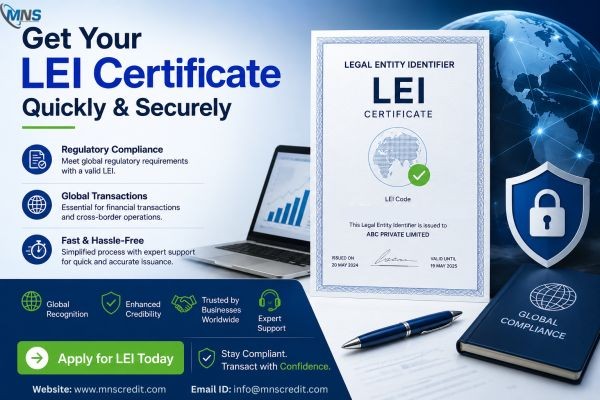
In today's interconnected financial environment, accurately identifying businesses and financial counterparties is essential. Banks, NBFCs, fintech companies, lenders, insurers, investment firms, and enterprises regularly transact with multiple legal entities across domestic and international markets. The LEI Certificate helps provide a standardized way to identify these entities.
A Legal Entity Identifier (LEI) is a unique 20-character alphanumeric identifier assigned to a legal entity. The associated LEI record contains verified information about the entity and can help financial institutions and businesses improve transparency, compliance, and counterparty risk management.
For organizations involved in regulated financial transactions, maintaining an active LEI can be an important part of their financial and compliance processes.
What Is an LEI Certificate?
An LEI Certificate is a document or digital record associated with an entity's Legal Entity Identifier. It confirms the entity's LEI and provides key information connected with the registered legal entity.
An LEI record can contain information such as:
- Legal entity name
- LEI code
- Registered address
- Legal jurisdiction
- Entity status
- Registration details
- LEI registration or renewal information
The LEI itself is the standardized identifier. The certificate serves as supporting evidence of the entity's LEI registration and associated information.
The LEI system is maintained within the global framework overseen by the Global Legal Entity Identifier Foundation (GLEIF), while LEIs are issued and maintained by authorized organizations within the LEI system.
Why Is an LEI Certificate Important?
The primary purpose of an LEI is to make legal-entity identification more consistent across financial markets.
Improving Entity Identification
Businesses can have similar names, subsidiaries, branches, or complex ownership structures. A unique LEI provides a standardized identifier that can distinguish one legal entity from another.
For example, a bank dealing with several companies within the same corporate group can use LEI information as one additional reference for identifying the relevant legal entity.
Supporting Regulatory Compliance
Certain financial transactions and regulatory frameworks may require eligible entities to have an active LEI.
Financial institutions can therefore use LEI information as part of their transaction processing, reporting, and compliance workflows where applicable.
Strengthening Counterparty Risk Management
An LEI does not determine whether a company is financially strong or creditworthy. However, it improves the accuracy of entity identification, which is an important foundation for counterparty risk analysis.
Financial institutions can combine LEI information with credit reports, financial statements, payment behavior, ownership information, and other risk indicators.
What Information Does an LEI Certificate Contain?
The exact presentation may differ depending on the issuing or servicing organization, but an LEI certificate or related record generally identifies the registered entity and its LEI.
Legal Entity Name
This is the official legal name associated with the LEI record.
LEI Code
The LEI is a globally recognized 20-character alphanumeric identifier.
Entity Status
The record indicates the current status of the LEI and associated entity information.
Registration Information
The record can contain relevant registration and maintenance information, including details relating to the LEI's lifecycle.
Registered Address
The entity's registered address is another important reference for verifying its legal identity.
Who Needs an LEI Certificate?
The requirement for an LEI depends on the entity's activities, jurisdiction, and applicable regulatory requirements.
Organizations that may use or require LEIs include:
- Banks
- NBFCs
- Investment firms
- Insurance companies
- Corporates
- Financial institutions
- Asset managers
- Large enterprises
- Other participants in regulated financial markets
In India, certain financial-market and banking activities may be subject to LEI-related requirements. Organizations should therefore verify the applicable requirements for their specific transaction and regulatory category.
How to Get an LEI Certificate
Obtaining an LEI generally involves registering the legal entity through an authorized LEI issuer or registration agent.
Step 1: Provide Entity Information
The applicant provides information such as the legal name, registration details, address, and other required corporate information.
Step 2: Submit Supporting Information
The registration provider verifies the information against appropriate authoritative sources.
Step 3: Complete the Registration
After the required verification and payment process is completed, an LEI is assigned to the entity.
Step 4: Access the LEI Record or Certificate
Once issued, the organization can access its LEI information and supporting registration documentation through the relevant provider.
LEI Certificate and Financial Transactions
An active LEI can simplify entity identification in financial workflows.
For example, a financial institution processing a transaction involving a corporate counterparty can use the LEI as an additional identifier alongside the company's legal name and registration information.
This can reduce ambiguity and improve the consistency of entity data used across internal systems.
For fintech companies, standardized identifiers can also support data integration between onboarding, risk management, transaction monitoring, and reporting systems.
LEI Certificate and Risk Management
An LEI should not be confused with a credit report or due diligence report.
An LEI primarily answers the question: Which legal entity is this?
A credit report or due diligence report addresses broader questions such as:
- Is the company financially stable?
- What is its payment behavior?
- Who owns or controls it?
- Does it have significant legal exposure?
- What are its credit risks?
Using these information sources together can provide a stronger basis for financial decision-making.
LEI Renewal and Maintaining an Active Status
An LEI is generally subject to annual renewal and validation requirements. Keeping the LEI record current is important because entity information may change over time.
Organizations should monitor:
- Renewal dates
- Legal name changes
- Registered address changes
- Corporate restructuring
- Merger or acquisition activity
- Other relevant entity information
An expired or lapsed LEI may create issues where an active LEI is required for a particular transaction or regulatory process.
How MNS Credit Management Group Can Help
MNS Credit Management Group provides professional LEI registration and LEI-related services to businesses that need support with entity identification and financial compliance requirements.
MNS also offers LEI Renewal, Business Information Reports, Due Diligence Reports, Credit Opinion Reports, MCA Master Data, Supplier Verification, Debt Collection, and Accounts Receivable Management.
By combining LEI-related services with broader business intelligence and credit management solutions, MNS can help organizations strengthen entity verification and support more informed financial and commercial decisions.
Conclusion
An LEI Certificate provides useful evidence of a legal entity's participation in the global Legal Entity Identifier system. For banks, NBFCs, fintech companies, lenders, insurers, and enterprises, LEI information can support entity identification, regulatory processes, transaction reporting, and counterparty risk management.
However, an LEI is not a substitute for financial due diligence or credit assessment. Its greatest value comes when it is integrated with other business and financial information.
By maintaining accurate and active LEI records and combining them with reliable credit and corporate intelligence, organizations can improve data quality, reduce identification risks, and make more confident financial decisions.
FAQs About LEI Certificates
What is an LEI Certificate?
An LEI Certificate is documentation or a digital record associated with a Legal Entity Identifier, confirming the LEI assigned to a legal entity and providing related registration information.
What is an LEI used for?
An LEI is used to uniquely identify legal entities participating in financial transactions and markets, supporting transparency, regulatory reporting, and counterparty identification.
Is an LEI Certificate the same as a credit report?
No. An LEI identifies a legal entity, while a credit report evaluates financial reliability, repayment behavior, and credit risk.
How long is an LEI valid?
An LEI generally requires annual renewal and validation to keep the associated record current and active.
Who may need an LEI Certificate?
Entities participating in financial markets or transactions subject to LEI requirements may need an LEI. The specific requirement depends on the applicable regulation, transaction type, jurisdiction, and entity category.






