
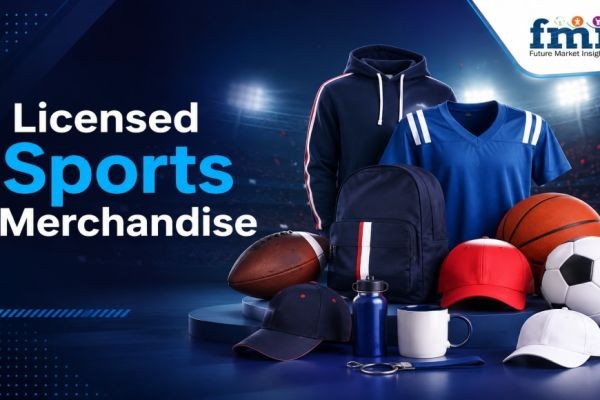
The global Licensed Sports Merchandise Market is projected to grow from USD 40.5 billion in 2026 to USD 64.6 billion by 2036, expanding at a 4.8% CAGR during the forecast period. The market was valued at USD 38.6 billion in 2025. Growth is being supported by rising demand for officially licensed sports apparel, expanding online fan commerce, event-driven merchandise launches, stronger league and club licensing programs, and increasing use of sports merchandise beyond matchday settings.
According to Future Market Insights (FMI), licensed sports merchandise is evolving from an event-focused purchasing category into a broader lifestyle and fan-identity market. Consumers increasingly seek officially licensed jerseys, hoodies, jackets, headwear, collectibles, and accessories that can be incorporated into everyday wardrobes.
Quick Stats: Licensed Sports Merchandise Market
- Market Size (2025): USD 38.6 Billion
- Market Size (2026): USD 40.5 Billion
- Market Size (2036): USD 64.6 Billion
- Growth Rate: 4.8% CAGR (2026–2036)
- Incremental Opportunity: USD 24.1 Billion
- Leading Product Type: Sports Apparel (46.5% share)
- Leading Distribution Channel: Online Channels (61.0% share)
- Leading License Type: League and Club (48.0% share)
- Fastest-Growing Country: South Korea (5.1% CAGR)
Get detailed market forecasts, competitive benchmarking, and pricing trends through the FMI report: https://www.futuremarketinsights.com/reports/sample/rep-gb-16642
Market Overview
The licensed sports merchandise market covers officially licensed apparel, headwear, collectibles, and fan products sold through authorized channels. Sports apparel leads demand, supported by its everyday use and repeat purchasing.
Online retail is expanding access through official stores, personalized products, and limited releases. Major tournaments, playoffs, and athlete visibility also create short-term demand spikes, benefiting retailers with efficient inventory planning and rapid replenishment.
Growth Drivers
Key factors supporting market growth include:
- Rising demand for authentic licensed merchandise.
- Growing use of sports apparel as everyday wear.
- Expansion of online stores and team e-commerce.
- Increasing league, club, athlete, and event licensing.
- Strong demand for jerseys, hoodies, jackets, and headwear.
- Growth of tournament- and event-driven merchandise.
- Rising fan engagement through mobile and social platforms.
- Increasing adoption of controlled product launches.
FMI analysis indicates that effective licensing, inventory planning, online fulfillment, and fast replenishment will remain critical to capturing changing fan demand.
Analyst Perspective
Rahul Pandita, Principal Consultant for Consumer Product at Future Market Insights, said:
“The licensed sports merchandise market is expected to favor rights owners and licensees with sharper release planning and reliable online fulfillment.”
FMI analysts view the category as a repeat-purchase system rather than a single souvenir purchase. Suppliers that maintain visible official channels and replenish core products quickly can retain more fan spending while reducing substitution by unauthorized sellers.
Segment Analysis
- By Product Type
Sports apparel is projected to lead the product type segment with a 46.5% share in 2026. Jerseys, tops, sweatshirts, and jackets benefit from repeat use and strong connections between team identity and everyday clothing.
- By Distribution Channel
Online channels are expected to account for 61.0% of distribution demand in 2026. Official online stores provide broader geographic access and allow retailers to manage assortments, launches, and inventory more efficiently.
- By Sport Type
Football is estimated to account for 31.0% of sport type demand in 2026. Club and national-team loyalty supports recurring purchases, while international tournaments create additional merchandise opportunities.
- By License Type
League and club licenses are projected to hold a 48.0% share in 2026. Club identity supports repeat purchases through annual kits, seasonal collections, rivalry products, and heritage merchandise.
- By Release Model
Core season releases are expected to represent 52.0% of demand in 2026. Annual kits and established team assortments provide a predictable demand base, while limited drops and event capsules create additional sales peaks.
Regional Outlook
South Korea is projected to be the fastest-growing major market, registering a 5.1% CAGR through 2036. Mobile-first fan engagement, online retail adoption, and rapid product discovery are supporting merchandise conversion.
- South Korea: 5.1% CAGR
- United States: 5.0% CAGR
- China: 5.0% CAGR
- India: 5.0% CAGR
- Japan: 4.9% CAGR
- United Kingdom: 4.8% CAGR
- Germany: 4.7% CAGR
The United States benefits from large professional sports leagues, team stores, e-commerce, and event retail. China and India offer opportunities through expanding online retail and sports participation. Japan's premium retail environment supports demand for quality licensed products, while the United Kingdom and Germany benefit from established football cultures.
Strategic Shifts Through 2036
Retail control is expected to become increasingly important as licensed merchandise moves toward direct-to-consumer and event-linked models. Official storefronts help rights owners maintain authenticity, manage pricing, and strengthen visibility across digital channels.
Inventory responsiveness will also become a competitive differentiator. Demand can rise sharply following championships, player performances, tournament milestones, or other high-visibility sporting moments. Retailers with connected inventory systems can capture these short purchasing windows before demand shifts toward unauthorized sellers.
Counterfeit merchandise remains a significant restraint. Unauthorized products compete primarily on price and can weaken the perceived value of official merchandise. Rights owners and licensees are therefore expected to strengthen authentication, marketplace monitoring, and licensing compliance.
Competitive Landscape
Competition is shaped by licensing rights, product design, event retail capabilities, online fulfillment, geographic reach, and inventory management.
Fanatics Inc. maintains a strong position across official league retail, team e-commerce, and event merchandise. Nike, Inc., Adidas AG, and Puma SE compete through club, federation, and sportswear licensing programs. New Era Cap, LLC contributes strongly in licensed headwear, while DICK’S Sporting Goods Inc., VF Corporation, Hanesbrands Inc., and G-III Apparel Group, Ltd. add retail and apparel capabilities.
Key Companies Profiled
- Fanatics Inc.
- Nike, Inc.
- Adidas AG
- Puma SE
- Under Armour, Inc.
- New Era Cap, LLC
- DICK’S Sporting Goods Inc.
- VF Corporation
- Hanesbrands Inc.
- G-III Apparel Group, Ltd.
- Frasers Group
- Sports Direct International plc
The competitive environment is expected to remain focused on securing attractive rights while improving product launches, authentication, fulfillment, and event retail execution.
Future Outlook
The Licensed Sports Merchandise Market is set for steady growth through 2036, creating an incremental opportunity of USD 24.1 billion. Growth will be driven by sports apparel, online storefronts, personalized products, controlled launches, and event-based retail. Companies with strong licensing partnerships, efficient inventory management, and reliable fulfillment will be better positioned to capture repeat fan demand.
Explore More Insights from the Consumer Product Industry Analysis
https://www.openpr.com/news/4379942/global-waterproof-makeup-market-forecast-to-reach-usd-31-9
https://www.openpr.com/news/4380097/global-professional-cleaning-products-market-to-reach-usd-97-5
FMI Custom Research: Strategic Intelligence for Confident Decision-Making
In today’s rapidly evolving business environment, leadership teams need more than market data — they need clear, actionable intelligence tailored to their strategic objectives. FMI’s Custom Research solutions are designed around the specific business questions organizations need answered, enabling executives to evaluate growth opportunities, validate investments, assess competitive dynamics, and reduce uncertainty before making critical decisions. By combining deep industry expertise, primary research, and proprietary market intelligence, FMI delivers insights that help organizations move from assumptions to evidence-based strategies with greater speed and confidence.
Key Executive Benefits
- Decision-Ready Insights: Research tailored to your specific business challenges, growth plans, and investment priorities.
- Reduced Strategic Risk: Validate market opportunities, customer demand, and competitive positioning before committing resources.
- Market Entry Confidence: Assess opportunity size, regulatory barriers, channel dynamics, and competitive landscapes with precision.
- Competitive Advantage: Gain proprietary intelligence unavailable through syndicated reports or internal datasets.
- Faster Growth Decisions: Accelerate expansion, product development, portfolio optimization, and investment planning.
- Primary Market Validation: Access real-world customer, buyer, and stakeholder insights that support high-confidence decision-making.
- Global Industry Expertise: Powered by 100+ analysts, 20,000+ published reports, and 1.6 million+ hours of research experience.
- Proven Track Record: Over 7,000 market-entry engagements completed across six regions and 14 industry sectors with strong client retention.
Business Impact
FMI helps organizations transform market complexity into strategic clarity, enabling leadership teams to identify growth opportunities faster, optimize resource allocation, strengthen competitive positioning, and make high-stakes business decisions with confidence.
To explore how FMI Custom Research can support your strategic priorities, please connect with our team at — sales@futuremarketinsights.com






