
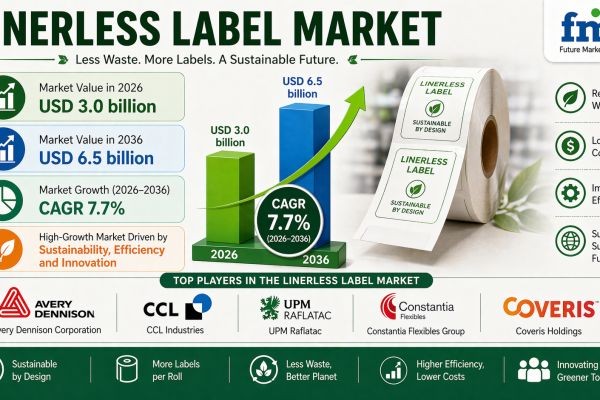
The global linerless label market is projected to grow from USD 3.0 billion in 2026 to USD 6.5 billion by 2036, expanding at a CAGR of 7.7%. This strong growth trajectory is primarily driven by the increasing demand for sustainable, waste-reducing labeling solutions across industries such as food & beverage, retail, and logistics.
Linerless labels, which eliminate the need for release liners, offer higher material efficiency, reduced waste generation, and improved operational productivity, making them a preferred alternative to traditional pressure-sensitive labels.
Get Access of Research Report Sample: https://www.futuremarketinsights.com/reports/sample/rep-gb-1822
Market Drivers: Sustainability and Efficiency Reshape Labeling Systems
The shift toward environmentally responsible packaging is accelerating the adoption of linerless labeling technologies.
Key growth drivers include:
- Rising demand for eco-friendly and low-waste packaging solutions
• Increasing adoption of automated retail and logistics labeling systems
• Need for cost-efficient, high-volume labeling operations
• Growing focus on carbon footprint reduction and material optimization
• Expansion of e-commerce and fresh food retail sectors
Linerless labels enhance roll capacity and reduce downtime, enabling businesses to improve efficiency while aligning with sustainability goals.
Segment Insights: Primary Labels and Food Sector Lead Demand
Primary Labels Dominate with 48% Market Share
Primary labels remain the most widely used product category due to their essential role in product identification.
Key advantages include:
- High material efficiency and reduced waste output
• Compatibility with thermal printing and automated systems
• Reliable adhesive performance across applications
• Cost-effective solution for high-volume operations
Their versatility ensures continued dominance across retail, logistics, and food packaging applications.
Food & Beverage Segment Accounts for 41% Demand
The food & beverage industry represents the largest application segment, driven by strict regulatory and operational requirements.
Key demand factors include:
- Need for traceability and compliance labeling
• Integration with weighing and pricing systems
• High demand for moisture-resistant and durable labels
• Growing focus on fresh food packaging efficiency
Linerless labels are widely used in meat, produce, deli, and bakery segments, where accuracy and hygiene are critical.
Read Full Report- https://www.futuremarketinsights.com/reports/linerless-labels-market
Technology Trends: Advanced Adhesives and Printing Innovation Fuel Adoption
Technological advancements are enhancing the performance and application scope of linerless labels.
Key innovations include:
- Development of high-performance pressure-sensitive adhesives
• Improved release coating and print quality consistency
• Enhanced durability in diverse environmental conditions
• Integration with automated print-and-apply systems
• Expansion of variable information labeling capabilities
These advancements enable linerless labels to deliver reliable performance across fast-paced industrial environments.
Regional Outlook: Asia-Pacific Leads Growth While Developed Markets Drive Innovation
Country-level growth highlights:
- China (8.6% CAGR):Strong growth driven by retail expansion and e-commerce
• India (8.3%): Rapid adoption fueled by supermarket growth and logistics modernization
• USA (7.9%): Driven by food safety regulations and automation
• Germany (7.5%): Sustainability-focused adoption in retail and manufacturing
• Japan (3.2%): Steady growth with emphasis on precision and quality
Asia-Pacific is emerging as the fastest-growing region, while North America and Europe lead in technological innovation and regulatory adoption.
Market Challenges: Compatibility and Adhesive Performance Limitations
Despite strong growth, the market faces several operational challenges:
- Compatibility issues with legacy printing systems
• Adhesive performance limitations in extreme temperatures or humidity
• Lack of standardization in adhesive and coating technologies
• Constraints in frozen food and specialized applications
Addressing these challenges will be critical for wider adoption and scalability.
Competitive Landscape: Innovation and Sustainability Define Market Leaders
The linerless label market is highly competitive, with key players focusing on technology development and eco-friendly solutions.
Key companies include: Avery Dennison Corporation, CCL Industries, UPM Raflatac, Constantia Flexibles Group, Coveris Holdings, HERMA GmbH, 3M Company, Ritrama S.p.A., Optimum Group, Ravenwood Packaging
Competitive strategies include:
- Investment in advanced adhesive and coating technologies
• Collaboration with OEMs for equipment compatibility
• Expansion of sustainable and recyclable label solutions
• Development of automation-friendly labeling systems
• Focus on high-speed production and operational efficiency
Companies that combine sustainability with performance and system compatibility are gaining a competitive advantage.
Analyst Perspective: Linerless Labels Transition from Niche to Mainstream
Industry experts highlight that linerless labels are evolving into a core component of modern packaging ecosystems:
- Waste reduction is becoming a non-negotiable requirement
• Automation compatibility is driving procurement decisions
• Retail and logistics sectors are accelerating large-scale adoption
As sustainability regulations tighten globally, linerless labels are expected to move from optional innovation to standard practice.
Future Outlook: Sustainable Labeling and Automation Integration to Drive Next Phase
The future of the linerless label market will be shaped by innovation and regulatory alignment.
Key opportunities include:
- Expansion of eco-friendly labeling technologies
• Growth in automated retail and logistics infrastructure
• Development of temperature-resistant adhesive solutions
• Integration with smart packaging and traceability systems
• Increasing demand from emerging retail markets
As industries prioritize efficiency, sustainability, and compliance, linerless labels are set to play a crucial role in the next generation of packaging solutions
Why FMI: https://www.futuremarketinsights.com/why-fmi
Have a Look at Related Research Reports on the Packaging Domain:
Label Printing Software Market: https://www.futuremarketinsights.com/reports/label-printing-software-market
Label Applicators Market: https://www.futuremarketinsights.com/reports/label-applicators-market
Label Printers Market: https://www.futuremarketinsights.com/reports/label-printer-market
Contact Us:
Future Market Insights Inc.
Christiana Corporate, 200 Continental Drive,
Suite 401, Newark, Delaware - 19713, USA
T: +1-347-918-3531
For Sales Enquiries: sales@futuremarketinsights.com
Website: https://www.futuremarketinsights.com
About Future Market Insights (FMI)
Future Market Insights, Inc. (FMI) is an ESOMAR-certified, ISO 9001:2015 market research and consulting organization, trusted by Fortune 500 clients and global enterprises. With operations in the U.S., UK, India, and Dubai, FMI provides data-backed insights and strategic intelligence across 30+ industries and 1200 markets worldwide.






