
Fastener failure rarely announces itself politely. Joints loosen gradually, vibration works its damage quietly, and then — at the worst possible moment — something critical comes apart. Lock nuts exist precisely to interrupt that sequence before it reaches a dangerous conclusion. These specialized threaded fasteners add a secondary resistance mechanism that standard hex nuts simply don't provide, keeping assemblies tight across thousands of operating hours and millions of vibration cycles.
Understanding why standard nuts loosen helps clarify what lock nuts actually accomplish. Every threaded joint relies on friction between mating threads and between the nut bearing face and the clamped material. Vibration reduces that friction incrementally, allowing the nut to rotate backward in tiny increments. Lock nuts counter this rotation either mechanically, chemically, or structurally, depending on the specific type selected for the application.
Nylon insert lock nuts — often called nyloc nuts — represent the most widely recognized lock nut variety. A nylon collar embedded in the upper portion of the nut deforms around the bolt threads during installation, creating interference that resists backward rotation independently of joint clamp load. This makes nylon insert lock nuts valuable in applications where vibration is present but temperatures remain moderate, since extreme heat degrades the nylon insert and reduces its locking effectiveness significantly.
All-metal lock nuts handle elevated temperature environments where nylon inserts would fail. Prevailing torque all-metal lock nuts achieve their locking action through a distorted thread section — typically an oval or constricted top section — that creates mechanical interference against the bolt threads without any polymer components. These lock nuts maintain locking performance in engine compartments, exhaust systems, industrial ovens, and other hot environments where nyloc designs cannot operate reliably.
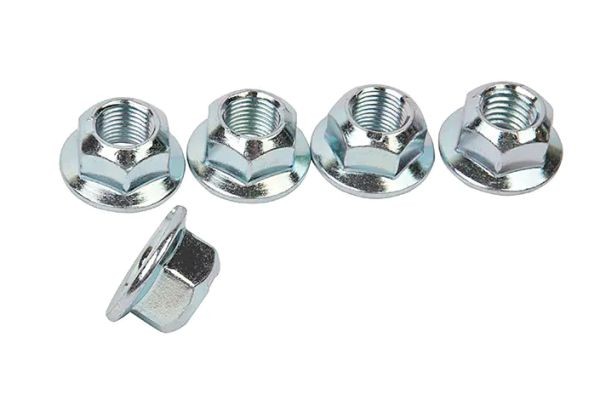
Serrated flange lock nuts combine a standard hex nut profile with a built-in serrated bearing flange that bites into the clamped surface during tightening. This serration resists rotation mechanically even if thread friction decreases, making serrated flange lock nuts popular in automotive body assembly, electrical enclosures, and sheet metal fabrication where speed and simplicity matter alongside reliable locking.






