
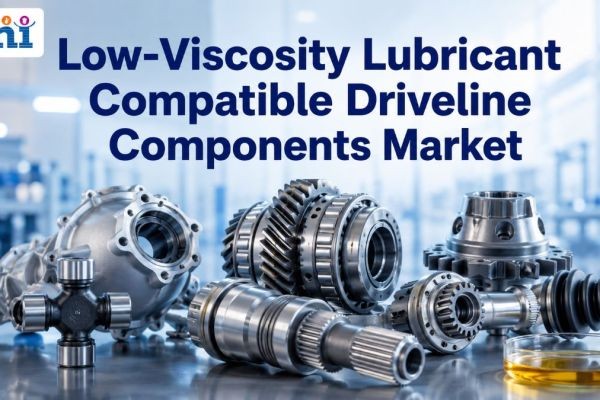
According to Future Market Insights (FMI), the Low-Viscosity Lubricant Compatible Driveline Components Market [https://www.futuremarketinsights.com/reports/low-viscosity-lubricant-compatible-driveline-components-market] was valued at USD 4.1 billion in 2025 and is estimated to reach USD 4.4 billion in 2026, rising to USD 8.3 billion by 2036 at a 6.6% CAGR from 2026 to 2036. Growth is supported by increasing demand for lower-friction driveline systems, expanding electric and hybrid vehicle production, compact e-axle designs, and the need for components compatible with thinner transmission and e-drive fluids.
The market is shifting toward specialized bearings, gears, seals, clutch packs, and synchronizers designed to maintain durability while reducing energy loss inside transmissions and electric drive units. Increasing OEM focus on drivetrain efficiency is encouraging suppliers to develop components with improved friction control, heat resistance, lubricant compatibility, and long-term durability.
Get Detailed Market Forecasts, Competitive Benchmarking, and Pricing Trends: https://www.futuremarketinsights.com/reports/sample/rep-gb-33289
Quick Stats for Low-Viscosity Lubricant Compatible Driveline Components Market
- Low-Viscosity Lubricant Compatible Driveline Components Market Value (2025): USD 4.1 billion
- Market Value (2026): USD 4.4 billion
- Market Forecast Value (2036): USD 8.3 billion
- Market Forecast CAGR: 6.6%
- Leading Component Type: Bearings (38.0%)
- Leading Driveline System: Automatic transmissions and CVT units (32.5%)
- Leading Lubricant Type: Low-viscosity ATF (42.0%)
- Leading Vehicle Type: Passenger Cars (61.0%)
- Leading Sales Channel: OEM Fitment (72.0%)
- Fastest-Growing Country: China (7.8% CAGR)
- Key Players: Schaeffler AG, NSK Ltd., NTN Corporation, SKF Group, JTEKT Corporation, ZF Friedrichshafen AG, AISIN Corporation, BorgWarner Inc., Freudenberg Sealing Technologies, Trelleborg Sealing Solutions, Dana Incorporated
Why is the Low-Viscosity Lubricant Compatible Driveline Components Market Growing?
Market growth is driven by automakers’ efforts to reduce energy losses and improve transmission and electric drive efficiency. Low-viscosity fluids help reduce drag but require components that can perform reliably under thinner lubricant films.
The growth of electric and hybrid vehicles is further increasing demand for durable bearings, gears, and seals suited to compact, high-speed e-axles and integrated drive units.
Rising EV and hybrid repair activity is also supporting demand for compatible bearings, seals, clutch components, and driveline repair kits tailored to specific systems and lubricant requirements.
Opportunity Pathways -- Low-Viscosity Lubricant Compatible Driveline Components Market
The market presents several opportunities as automotive manufacturers and component suppliers focus on efficient and compact driveline architectures.
- Pathway A -- EV and E-Axle Expansion: Growing electric vehicle production is increasing demand for compact bearings, gears, and seals capable of operating in high-speed e-drive systems.
- Pathway B -- Low-Friction Component Development: Suppliers can strengthen their market positions by developing components that reduce torque loss while maintaining durability.
- Pathway C -- Lubricant-Component Compatibility: Testing components alongside low-viscosity ATF and e-drive fluids creates opportunities for suppliers capable of providing validated system-level performance.
- Pathway D -- EV Aftermarket Repair: Increasing numbers of aging EVs and hybrid vehicles are creating opportunities for bearing, seal, clutch, and e-axle repair kits.
- Pathway E -- Compact Driveline Engineering: Smaller and more integrated transmission and e-axle architectures are creating demand for lightweight and space-efficient components.
- Pathway F -- OEM Qualification: Suppliers with strong testing capabilities and clear friction, wear, and lubricant compatibility data can gain earlier access to vehicle development programs.
Segmental Analysis
Demand is segmented by component type, driveline system, lubricant type, vehicle type, and sales channel. Key components include bearings, gears, seals, clutch packs, and synchronizers, while major driveline systems include automatic transmissions, e-axles, differentials, and transfer cases.
By Component Type, Bearings Account for 38.0% Share
The bearings segment is expected to account for 38.0% of component demand in 2026, driven by their role in reducing friction and supporting smooth operation in transmissions and e-axles. Rising EV adoption is also increasing demand for compact, high-speed, and durable bearing designs.
By Driveline System, Automatic Transmissions and CVT Units Account for 32.5% Share
Automatic transmissions and CVT units are expected to hold a 32.5% share in 2026, supported by the growing use of low-viscosity ATF to reduce drag and improve drivetrain efficiency. Hybrid transmission systems are further increasing compatibility requirements for bearings, clutch packs, and other components.
By Lubricant Type, Low-Viscosity ATF Accounts for 42.0% Share
The low-viscosity ATF segment is estimated to account for 42.0% share in 2026. Its ability to reduce internal drag is supporting adoption, while compatible seals, clutch components, and other driveline parts remain essential for reliable performance.
By Vehicle Type, Passenger Cars Account for 61.0% Share
Passenger cars are expected to represent 61.0% share in 2026, supported by the large-scale adoption of conventional, hybrid, and electric vehicle platforms. Compact and efficient driveline systems are creating additional opportunities for compatible components.
By Sales Channel, OEM Fitment Accounts for 72.0% Share
OEM fitment is projected to account for 72.0% share in 2026, supported by growing compatibility testing during vehicle development. Aftermarket demand is also expected to increase as EVs and hybrids enter repair cycles.
What are the Drivers, Restraints, and Key Trends?
Drivers: Rising demand for energy efficiency, EV and hybrid vehicle production, compact e-axles, low-viscosity fluids, and growing EV repair activity are driving market growth.
Restraints: High OEM qualification requirements, lubricant compatibility testing costs, thinner lubricant film concerns, and the complexity of high-speed electric drive systems may restrict growth.
Key Trends: Suppliers are developing lightweight and low-torque bearings, integrated gear-and-bearing systems, advanced seals, insulated bearings, and repair-ready driveline components. OEMs are also emphasizing component validation with production-specific lubricants.
What is the Demand for Low-Viscosity Lubricant Compatible Driveline Components in Different Countries?
- China: 7.8% CAGR
- India: 7.5% CAGR
- South Korea: 6.8% CAGR
- United States: 6.3% CAGR
- Germany: 5.9% CAGR
- Japan: 5.6% CAGR
- France: 5.4% CAGR
China leads country-level growth, driven by its strong EV and hybrid manufacturing base and expanding e-axle production, while India benefits from rising vehicle electrification and localized component manufacturing. South Korea gains from growing EV programs, the United States from hybrid platforms and EV repairs, and Germany and Japan from their established drivetrain and component engineering capabilities.
What is the Competitive Landscape of the Low-Viscosity Lubricant Compatible Driveline Components Market?
Competition is focused on low-friction performance, durability, lubricant compatibility, e-axle applications, OEM capabilities, and global supply networks. Companies are advancing bearing technologies, sealing systems, gears, and driveline components designed for high-speed electric drive units.
Leading players include Schaeffler AG, NSK Ltd., NTN Corporation, SKF Group, JTEKT Corporation, ZF Friedrichshafen AG, AISIN Corporation, BorgWarner Inc., Freudenberg Sealing Technologies, Trelleborg Sealing Solutions, and Dana Incorporated.
Future Outlook
The Low-Viscosity Lubricant Compatible Driveline Components Market is projected to reach USD 8.3 billion by 2036, expanding at a 6.6% CAGR from 2026 to 2036. Growth will be driven by electric and hybrid drivetrains, low-viscosity fluids, compact e-axles, and demand for energy-efficient power transfer.
Explore More Related Studies Published by FMI Research
https://www.openpr.com/news/4595796/scope-3-emission-reducing-pvc-solutions-for-construction-oems
https://www.openpr.com/news/4595799/safety-enhanced-battery-separator-materials-for-energy
https://www.openpr.com/news/4595802/renewable-energy-powered-pvc-resin-production-platforms
FMI Custom Research: Strategic Intelligence for Confident Decision-Making
In today's rapidly evolving healthcare and logistics environment, leadership teams need more than market data—they need actionable intelligence tailored to their strategic priorities. FMI's Custom Research solutions help organizations evaluate growth opportunities, validate investments, assess competitive dynamics, and reduce uncertainty before making critical business decisions.
Key Executive Benefits
- Decision-Ready Insights: Research tailored to specific business challenges, growth plans, and investment priorities.
- Reduced Strategic Risk: Validate market opportunities, customer demand, and competitive positioning before committing resources.
- Market Entry Confidence: Assess opportunity size, regulatory barriers, channel dynamics, and competitive landscapes.
- Competitive Advantage: Gain proprietary intelligence unavailable through syndicated reports or internal datasets.
- Faster Growth Decisions: Accelerate expansion, product development, portfolio optimization, and investment planning.
Business Impact
FMI helps organizations transform market complexity into strategic clarity, enabling leadership teams to identify growth opportunities faster, optimize resource allocation, strengthen competitive positioning, and make high-stakes business decisions with confidence.
To explore how FMI Custom Research can support your strategic priorities, connect with the team at sales@futuremarketinsights.com.






