
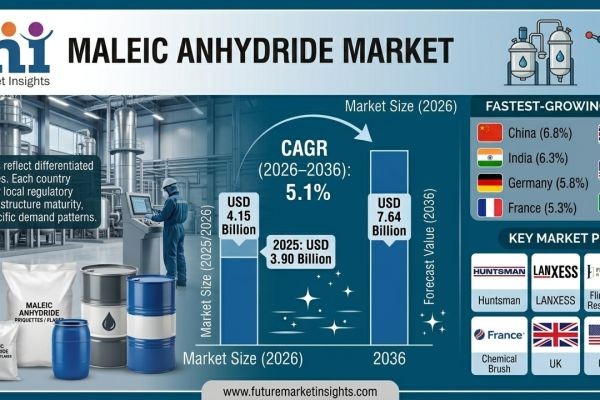
The global maleic anhydride market is expected to witness substantial expansion over the forecast period, supported by rising demand from construction materials, automotive components, unsaturated polyester resins (UPR), and specialty chemical applications. According to the latest insights by Future Market Insights, the market is projected to grow steadily between 2026 and 2036 as industrial manufacturing activities accelerate worldwide.
Market growth is being driven by increasing consumption of lightweight composite materials, rapid infrastructure development, and expanding applications in coatings, lubricants, agricultural chemicals, and food additives. Maleic anhydride continues to play a critical role as a versatile chemical intermediate used across multiple industrial sectors.
While traditional applications in unsaturated polyester resins remain dominant, manufacturers are increasingly focusing on high-performance and sustainable formulations to meet evolving environmental regulations and industrial efficiency requirements. The market is also benefiting from advancements in bio-based maleic anhydride production technologies aimed at reducing dependence on fossil-fuel-derived feedstocks.
Maleic Anhydride Market Snapshot (2026–2036)
- Forecast period: 2026–2036
- Market growth outlook: Strong industrial expansion anticipated globally
- Key application segment: Unsaturated polyester resins (UPR)
- Fastest-growing demand area: Construction and automotive composites
- Major growth regions: Asia Pacific, North America, and Europe
- Primary end-use industries: Construction, automotive, chemicals, coatings, and agriculture
Momentum in the Market
Beginning from stable industrial demand levels, the maleic anhydride market is expected to experience accelerated growth throughout the forecast period due to rising investments in infrastructure, urban development, and advanced manufacturing industries.
Between 2026 and 2036, increasing production of fiberglass-reinforced plastics and lightweight automotive components is projected to significantly strengthen market demand. Construction activities across emerging economies are driving higher consumption of unsaturated polyester resins, which remain one of the largest application areas for maleic anhydride.
The automotive sector is also contributing to market expansion through growing adoption of lightweight composite materials that improve fuel efficiency and reduce vehicle emissions. Maleic anhydride-based materials are increasingly used in automotive body panels, under-the-hood components, and specialty coatings.
From 2030 onward, the market is expected to witness stronger adoption of sustainable production technologies and bio-based alternatives as manufacturers align with global environmental and decarbonization goals.
The Reasons Behind the Market’s Growth
Demand for maleic anhydride is increasing due to several industrial and technological factors shaping the global chemical sector.
Rising Demand for Unsaturated Polyester Resins
Maleic anhydride serves as a key raw material in UPR production used extensively in construction panels, pipes, tanks, marine products, and automotive composites. Growth in infrastructure and industrial manufacturing is accelerating resin consumption globally.
Expansion of Construction Activities
Rapid urbanization and infrastructure development projects are boosting demand for durable composite materials, coatings, adhesives, and insulation systems derived from maleic anhydride applications.
Automotive Lightweighting Trends
Automotive manufacturers are increasingly utilizing lightweight composite materials to improve fuel efficiency and meet emission standards. Maleic anhydride-based resins contribute significantly to advanced composite production.
Growth in Agricultural Chemicals
Maleic anhydride is widely used in the production of pesticides, soil conditioners, and crop protection chemicals, supporting market growth alongside rising global agricultural productivity requirements.
Technological Advancements in Chemical Manufacturing
Continuous innovations in catalytic oxidation processes and bio-based feedstock development are improving production efficiency while supporting sustainability initiatives.
Top Segment Analysis
Unsaturated Polyester Resins Lead Market Demand
Unsaturated polyester resins remain the dominant application segment due to extensive usage across construction, transportation, marine, and industrial manufacturing sectors.
Application Analysis
- Unsaturated polyester resins: Largest market share globally
- Lubricant additives: Rising industrial machinery demand
- Copolymers and additives: Increasing packaging and plastics applications
- Agricultural chemicals: Expanding agrochemical production
- Coatings and paints: Growing infrastructure and automotive demand
Regional Development: Asia Pacific Emerges as Manufacturing Hub
Asia Pacific is expected to remain the leading regional market for maleic anhydride due to rapid industrialization, infrastructure investments, and strong chemical manufacturing capabilities.
China
China continues to dominate global production and consumption owing to its massive construction, automotive, and chemical industries.
India
Rising infrastructure projects, expanding automotive production, and increasing demand for specialty chemicals are strengthening market growth across India.
Southeast Asia
Industrial expansion and manufacturing relocation trends are boosting demand for composite materials and industrial chemicals throughout ASEAN economies.
North America and Europe
These regions continue to witness stable demand supported by advanced manufacturing industries, automotive innovation, and sustainability-driven chemical technologies.
Challenges, Trends, Opportunities, and Drivers
Drivers
- Rising demand for composite materials
- Growth in construction and infrastructure projects
- Expanding automotive production
- Increasing industrial chemical consumption
Opportunities
- Bio-based maleic anhydride production
- Sustainable resin technologies
- High-performance lightweight composites
- Advanced specialty chemical applications
Trends
- Shift toward environmentally sustainable manufacturing
- Increasing use of lightweight automotive materials
- Technological advancements in catalytic production processes
- Integration of high-performance polymer systems
Challenges
- Volatility in raw material prices
- Environmental regulations on chemical manufacturing
- Energy-intensive production processes
- Supply chain fluctuations in petrochemical feedstocks
Country Growth Outlook
The market’s growth trajectory is strongly influenced by industrial manufacturing expansion and infrastructure investments across major economies:
- China: Large-scale chemical manufacturing leadership
- India: Fast-growing infrastructure and automotive sectors
- United States: Advanced composite material innovation
- Germany: Strong industrial and automotive applications
- Japan: High-performance specialty chemical demand
The Competitive Environment
The global maleic anhydride market remains moderately consolidated, with major chemical manufacturers competing through production capacity expansion, sustainability initiatives, and technological innovation.
Leading companies are focusing on:
- Advanced catalyst technologies
- Expansion of regional manufacturing facilities
- Sustainable and bio-based production methods
- Strategic partnerships with downstream resin manufacturers
Manufacturers are also investing in process optimization and energy-efficient technologies to strengthen profitability and regulatory compliance.
Future Outlook: Toward Sustainable Industrial Chemistry
The maleic anhydride market is entering a transformative decade shaped by industrial modernization, lightweight material demand, and sustainability-driven chemical innovation. Future growth is expected to be closely linked with the expansion of advanced composites, renewable chemical technologies, and environmentally efficient manufacturing systems.
As industries continue prioritizing performance, efficiency, and sustainability, maleic anhydride will remain a vital chemical intermediate supporting next-generation construction materials, automotive solutions, coatings, and specialty industrial applications worldwide.
For a comprehensive strategic outlook and detailed analysis of technological developments shaping the industry, readers can explore the full report on the official Future Market Insights website:
https://www.futuremarketinsights.com/reports/maleic-anhydride-marke






