
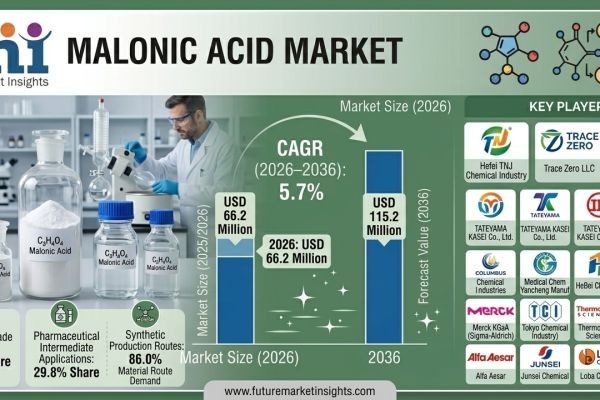
The global malonic acid market is expected to witness stable expansion throughout the forecast period, supported by increasing utilization across pharmaceuticals, agrochemicals, food additives, and specialty chemical manufacturing. According to latest insights by Future Market Insights, the market is projected to grow steadily between 2026 and 2036 as manufacturers expand production capabilities and industries increase demand for high-purity chemical intermediates.
Market growth is being shaped by rising pharmaceutical synthesis activities, expanding demand for specialty polymers, and increasing use of malonic acid derivatives in flavoring agents and fine chemicals. The compound continues to gain industrial importance due to its versatility as a precursor in organic synthesis and chemical manufacturing processes.
While pharmaceutical applications remain the dominant demand segment, emerging opportunities in biodegradable materials, specialty coatings, and advanced chemical formulations are expected to create additional momentum for the market over the coming decade.
Malonic Acid Market Snapshot (2026–2036)
- Market growth period: 2026–2036
- Forecast outlook: Steady global expansion across pharmaceutical and specialty chemical sectors
- Key end-use industries: Pharmaceuticals, agrochemicals, food additives, specialty chemicals
- Fastest-growing application: Pharmaceutical intermediates and fine chemical synthesis
- Major growth regions: Asia Pacific, North America, Europe
- Primary demand driver: Rising consumption of specialty chemical intermediates
Momentum in the Market
Beginning from strong industrial demand fundamentals, the malonic acid market is projected to experience sustained growth throughout the forecast timeline. Between 2026 and 2036, increasing investments in pharmaceutical manufacturing and specialty chemical production are expected to significantly support market expansion.
The pharmaceutical sector continues to represent one of the most important application areas for malonic acid due to its role in the synthesis of vitamins, active pharmaceutical ingredients (APIs), and advanced drug compounds. Growing global healthcare expenditure and rising production of pharmaceutical formulations are expected to reinforce long-term demand.
At the same time, the agrochemical industry is contributing to market growth through rising utilization of malonic acid derivatives in crop protection formulations and chemical synthesis applications. Expanding agricultural productivity initiatives worldwide are expected to further strengthen consumption levels.
From 2030 onward, advancements in sustainable chemistry and bio-based production technologies are anticipated to create new growth opportunities for manufacturers focusing on environmentally responsible chemical production.
The Reasons Behind the Market’s Growth
Demand for malonic acid is increasing due to several industrial and technological factors reshaping global chemical manufacturing ecosystems.
Expanding Pharmaceutical Industry
Malonic acid is widely used as a chemical intermediate in pharmaceutical synthesis, particularly in the production of vitamins, barbiturates, and specialty medicinal compounds. Growth in pharmaceutical R&D activities is accelerating demand globally.
Rising Specialty Chemical Consumption
The increasing use of specialty chemicals across coatings, polymers, adhesives, and fine chemical applications is creating strong growth opportunities for malonic acid manufacturers.
Growing Agrochemical Applications
Agricultural chemical producers are utilizing malonic acid derivatives in pesticide and herbicide synthesis, supporting demand from global farming and food production sectors.
Demand for Food Additives and Flavoring Agents
Malonic acid is increasingly being utilized in food-related applications due to its role in flavor enhancement and specialty additive formulations.
Top Segment Analysis
Pharmaceutical Applications Lead Market Demand
Pharmaceutical manufacturing continues to dominate market consumption, supported by increasing production of active pharmaceutical ingredients and growing investments in drug development infrastructure worldwide.
Application Type Analysis
- Pharmaceutical intermediates: Strong growth driven by API production
- Agrochemical synthesis: Rising demand from crop protection industries
- Specialty chemicals: Expanding industrial utilization across manufacturing sectors
- Food additives: Increasing adoption in flavor and additive applications
- Fine chemicals: Growing importance in advanced organic synthesis
Regional Development: Asia Pacific Emerges as a Manufacturing Hub
Asia Pacific is expected to remain a key growth region for the malonic acid market due to rapid industrialization, pharmaceutical manufacturing expansion, and increasing chemical production investments.
China
China continues to dominate regional chemical manufacturing capacity with strong pharmaceutical and specialty chemical production infrastructure.
India
India is witnessing rising demand driven by expanding pharmaceutical exports and increasing domestic chemical manufacturing capabilities.
North America & Europe
Advanced pharmaceutical research activities and strong specialty chemical industries are supporting stable market demand across developed economies.
Localized manufacturing expansion and strategic supply chain investments are improving production efficiency while helping companies address rising industrial demand.
Challenges, Trends, Opportunities, and Drivers
Drivers
- Rising pharmaceutical manufacturing activities
- Increasing specialty chemical demand
- Expanding agrochemical production
- Growth in fine chemical synthesis applications
Opportunities
- Bio-based malonic acid production technologies
- Sustainable and green chemistry initiatives
- High-purity pharmaceutical-grade product development
- Expansion into advanced material applications
Trends
- Growing adoption of environmentally friendly chemical synthesis
- Increasing investment in specialty intermediates
- Expansion of pharmaceutical R&D activities
- Technological advancements in chemical processing
Challenges
- Volatility in raw material pricing
- Regulatory compliance requirements
- Competitive pressure from substitute intermediates
- Complex manufacturing and purification processes
Country Growth Outlook
The market’s long-term growth trajectory is closely linked to pharmaceutical production, industrial chemical demand, and specialty manufacturing expansion across major economies.
- China: Large-scale chemical manufacturing leadership
- India: Rapid pharmaceutical sector expansion
- United States: Advanced specialty chemical demand
- Germany: Strong industrial chemical innovation ecosystem
- Japan: High-purity chemical manufacturing growth
The Competitive Environment
The global malonic acid market remains competitive, with manufacturers focusing on production efficiency, purity enhancement, and expansion of specialty application portfolios.
Leading companies are investing in:
- Advanced chemical synthesis technologies
- Sustainable production methods
- Pharmaceutical-grade malonic acid development
- Strategic partnerships and regional expansion initiatives
Manufacturers are also emphasizing innovation in high-performance intermediates to strengthen market positioning and address evolving customer requirements across pharmaceutical and industrial sectors.
Future Outlook: Toward Advanced and Sustainable Chemical Manufacturing
The malonic acid market is entering a period of sustained industrial transformation shaped by pharmaceutical innovation, specialty chemical expansion, and increasing focus on sustainable production practices.
Future growth is expected to be supported by advancements in green chemistry, bio-based synthesis technologies, and rising demand for high-value chemical intermediates across global manufacturing ecosystems.
As industries continue prioritizing efficiency, purity, and sustainability, malonic acid is expected to remain a critical component within pharmaceutical, agrochemical, and specialty chemical value chains over the next decade.
For a comprehensive strategic outlook and detailed analysis of technological developments shaping the industry, readers can explore the full report on the official Future Market Insights website:
https://www.futuremarketinsights.com/reports/malonic-acid-marke






