Introduction to Yoke Shafts in Industrial Machinery
Yoke shafts are some of those parts that are often unseen yet are instrumental in ensuring the smooth running of heavy machinery. They may not be as glamorous as the heavy-duty engines or the robust gear systems, but these parts are vital in ensuring the smooth running of the driveline system of heavy machinery. From tractors used for farming to mining equipment and heavy-duty machinery, these parts are instrumental in ensuring the smooth movement of power from one machine part to another. While designing heavy-duty machinery for use in extreme situations, the quality and strength of the yoke shaft are a vital consideration.
For instance, a drivetrain system consists of a chain of parts that are meant for the transfer of power. The failure of any single part in the chain could cause the entire machine to fail. The same principle applies to the yoke shafts. These parts are meant for ensuring the smooth movement of the machine while maintaining the alignment of the parts. The use of low-grade yoke shafts could cause the machine to vibrate and ultimately fail.
Firms like Arm & Hammer Forgings Pvt. Ltd. have earned a name for manufacturing robust forged components that can withstand harsh operating conditions. With over 14 years of experience in precision forging and CNC machining, they deliver components that cater to different industries, including agriculture, mining, oil & gas, railways, and defense sectors. With their expertise, it is guaranteed that each yoke shaft is delivered with high mechanical and quality requirements.
Knowing the significance of materials and sophisticated forging processes is vital for anyone associated with mechanical design or procurement activities. We will learn more about the significance of materials that can transform an ordinary forged part into a robust engineering part.
Overview of Arm & Hammer Forgings Pvt. Ltd.
Arm & Hammer Forgings Pvt. Ltd. has established itself as a major player in the Indian forging industry, specifically in the field of precision forging. The company is based in Faridabad, Haryana, and has the advantage of having advanced manufacturing capabilities with equipment such as forging hammers, CNC machining centers, and heat treatment facilities. From the time the company began operations, the focus has been on providing rugged and reliable forged components for industrial applications.
One of the major reasons the company stands out from the majority of its competitors is the fact that the organization has adopted the approach of in-house manufacturing, which means that the company does not outsource any of the major operations such as forging, machining, and testing. This enables the engineers to keep track of all the operations and ensure that the final product meets the requirements in terms of precision and mechanical properties. Another advantage is the reduction in time, which is crucial for industries where timely delivery of components is important.
Over the years, the company has been able to serve customers in over 24 countries, supplying millions of forged components to various industries. They can produce forged components that weigh between 1 kg and 150 kg, meeting both small and large industrial requirements. They also have advanced chemical and mechanical testing labs that enable them to test their components' material quality and performance.
As a renowned yoke shaft manufacturing company in India, they understand that precision engineering, quality control, and innovation are essential. Their product range includes forged shafts, control arms, linkages, brackets, and yoke shafts. They are able to provide these products to various industries due to their ISO-certified processes and advanced manufacturing capabilities.
Importance of Material Selection in Yoke Shaft Manufacturing
Material selection is an important factor that has a major impact on the performance and longevity of a yoke shaft. This is often compared to selecting an appropriate foundation for a building. Regardless of how complex the design is, it is inevitable that it will fail over time if it is made of material that is incapable of handling stress.
In mechanical systems, for example, torque is transmitted uniformly, but loads change frequently. In this case, material selection is very important as it has a direct impact on performance. One of the key requirements for yoke shafts is that they must have high tensile strength. This is because these components have to withstand rotational stress as well as bending stress when they are in operation. If they do not have enough strength, for example, microscopic cracks will start to appear over time, leading to failure. For this reason, forging manufacturers select appropriate steels that have optimal properties for their products.
Another factor is the materials used, which affects the cost and efficiency in the manufacturing process. Although high-alloy steels provide superior strength, they may demand intricate heat treatment. However, manufacturers consider the cost and machinability of the materials. The aim is to design a yoke shaft that is economically viable and capable of providing satisfactory long-term performance.
Key Materials Used for High-Strength Yoke Shafts
Carbon steel still ranks as one of the top materials for forging various components, including yoke shafts. Its wide adoption can be attributed to its balanced composition of strength, machinability, and cost-effectiveness. Carbon steel can provide adequate tensile strength and durability for moderate load applications without increasing production costs. As a result, this material can be perfectly utilized for components that are part of automotive driveline systems and various industrial machines.
Carbon Steel for Strength and Cost Efficiency
Carbon steel can also undergo various heat treatments. By varying the composition of carbon, manufacturers can subject this material to specific temperature conditions, allowing them to attain a particular level of hardness. With this, engineers can adjust the characteristics of the yoke shaft depending on its application.
Carbon steel can also be easily forged. Since this material can easily flow inside a die cavity during hot forging, manufacturers can attain a dense grain structure. As a result, they can attain better mechanical properties from their yoke shafts.
Alloy Steel for Heavy-Duty Applications
In cases where machinery is subjected to extreme stress, alloy steels would be the best choice. These materials have other elements that have been added, which make them stronger, harder, and more resistant to fatigue. These materials can be very effective in cases where heavy-duty yoke shafts are required, especially in mining machines, construction machines, etc.
The addition of these elements has made it possible for yoke shafts made of alloy steel to withstand any deformations that might occur when subjected to loads. For instance, chromium is known for its resistance properties, while molybdenum is known for its resistance to high temperatures.
Stainless Steel for Corrosion Resistance
In environments where corrosion is a major issue, stainless steel is a reliable option. Marine engineering, chemical processing, and food machine manufacturing are just a few examples of industries that demand corrosion-resistant materials. This is because stainless steel contains chromium, which forms a protective oxide coating on the surface. This oxide coating protects the material against corrosion.
Though it does not have the high strength of alloy steels, it does have high durability in environments where corrosion is a major issue. It is possible for manufacturers to combine stainless steel with high-end heat treatment.
Manufacturing Process of Yoke Shafts
Closed-Die Forging Technology
Closed-die forging is generally recognized as one of the most reliable methods for creating high-strength mechanical parts. In this technique, metal blocks are compressed at high temperatures inside precision-made dies to assume the desired form. The pressure causes the grain structure of the metal to align, which greatly enhances the mechanical strength of the final product compared to a product that has been cast.
The grain structure of the yoke shaft, which has been forged, is advantageous in that the grains do not have random alignment but rather conform to the shape of the shaft.
Heat Treatment and Precision Machining
After the yoke shaft is forged, heat treatment processes such as quenching and tempering are performed. This improves the hardness, toughness, and fatigue resistance of the yoke shaft. The component then undergoes a CNC machining process to attain the desired dimensions.
This improves the fitment of the component with other drivetrain components, thus reducing the effects of vibration. It also improves the surface coatings to enhance the resistance to corrosion.
Features of High-Strength Yoke Shafts
High-quality yoke shafts, as fabricated by advanced forging and machining techniques, provide several important features that make the component mechanically efficient.
Key Features
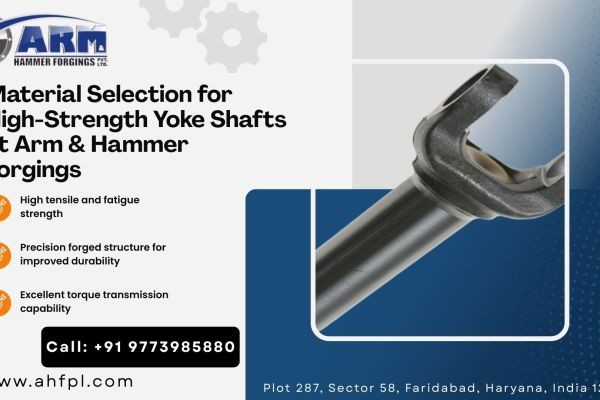
- High tensile and fatigue strength
- Precision forged structure for enhanced durability
- High efficiency in transmitting torque
- Resistant to wear and corrosion
- Dimensional tolerances are precise
- Long service life in severe operating conditions
These features ensure that the component performs reliably in heavy machinery and industrial equipment where mechanical failures can cause costly downtime.
Technical Specifications of Yoke Shafts
| Specification | Details |
| Material Options | Carbon Steel, Alloy Steel, Stainless Steel |
| Manufacturing Process | Closed-Die Hot Forging |
| Weight Range | 1 kg – 150 kg |
| Heat Treatment | Quenching, Tempering |
| Machining | CNC Precision Machining |
| Quality Standards | ASTM, SAE, DIN, ISO |
| Surface Finish | Shot Blasting / Machined Finish |
| Testing | Dimensional, Chemical, and Mechanical Testing |
Applications of Forged Yoke Shafts
Automotive and Drivetrain Systems
Yoke shafts are commonly utilized in automotive driveline systems, specifically in universal joints and propeller shafts. These components play an important role in facilitating rotational motion between shafts that are non-parallel to each other. In heavy vehicles, like commercial trucks, strong forged yokes are necessary for efficiency in power transmission.
Agriculture and Heavy Machinery
Farm equipment, including tractors and harvesters, are utilized in very harsh conditions. Forged shafts and yokes are necessary for efficiency in these conditions, including exposure to dust, moisture, and heavy loads. Precisely forged components are necessary for efficiency in the rotational components of heavy machinery, like agricultural machines.
Mining, Oil & Gas, and Railways
Industries like mining, oil & gas, and railways require components that can withstand extreme mechanical stress. Forged yoke shafts are commonly utilized in drilling machines, conveyers, and heavy transport machines. These components are necessary due to their durability and efficiency in handling heavy loads.
Why Arm & Hammer Forgings is a Leading Yoke Supplier in India
It is important to select a good supplier, as this can affect the efficiency of the equipment. Arm & Hammer Forgings is one of the reliable yoke suppliers in Faridabad and one of the top yoke manufacturers in India. They are known for their precision engineering and strict standards of quality.
The company’s facility includes forging presses, machining centers, and testing labs. This allows them to exercise complete control over the quality of materials and manufacturing accuracy. Their processes are ISO-certified, and all components are designed to conform to international standards.
Arm & Hammer Forgings, being one of the reliable yoke shaft suppliers in India, offers custom forging solutions to OEMs, industries, and customers. They have a team of engineers who work with customers to create components that are best suited to their requirements.
Quality Control and Certifications
Quality control is an important aspect of the forging process. Every forged product undergoes several stages of inspections to ensure the composition of the material, accuracy of size, and strength of the structure.
Ultrasonic testing and magnetic particle inspections are some of the sophisticated methods employed to ensure the strength and accuracy of the product.
These quality control measures ensure that every yoke shaft meets the highest standards in the industry.
Choosing the Right Yoke Shaft Manufacturer in India
The selection of the right manufacturer involves the careful assessment of various factors. The buyer has to assess the manufacturer's capabilities, material knowledge, and certification before making the final decision. Also, the manufacturer has to be reliable and offer customization capabilities.
While assessing the manufacturer of yoke shaft in India, the buyer has to ensure that the manufacturer has adopted the latest technology in the field of forging and testing. Also, the manufacturer has to have integrated operations to ensure better quality and faster delivery.
The second factor to consider while selecting the manufacturer is the manufacturer's experience in the field. The manufacturer has to have experience in serving various industries, such as the automotive, mining, and energy industries.
Future Trends in Forged Yoke Shaft Manufacturing
The forging industry is undergoing significant changes with the incorporation of new and innovative technologies, such as automation, simulation, and digital quality management. These new technologies have the ability to create stronger components with less waste.
Additive manufacturing is being employed to create prototypes for the dies used in the forging process. These prototypes are being used to test the components before the actual manufacturing process starts. The need for components to be lighter and stronger has led to the use of high-performance alloys and heat treatment.
For companies like Arm & Hammer Forgings, the new and innovative technologies have the potential to improve the quality of their products and increase their global market.
Conclusion
The selection of materials is one of the most important factors in determining the strength, durability, and reliability of yoke shafts. Materials ranging from carbon steel to alloy steels have been used in the manufacture of yoke shafts. These materials are highly reliable in terms of strength, durability, and reliability. Moreover, the use of advanced forging techniques such as closed die forgings has also been instrumental in producing high-performance yoke shafts.
Arm & Hammer Forgings Pvt. Ltd. is one of the most reliable yoke shaft manufacturers in India. It has established itself as a reliable supplier of yoke shafts in India. The company’s forged products are being used in various industries, including agriculture, mining, automotive, and energy.
As industrial machinery is evolving continuously, the demand for high-strength forged products will also rise in the coming days.
FAQs
1. What is the purpose of a yoke shaft?
A yoke shaft is used in the drivetrain of machines. It is used in the drivetrain system. It is also used in universal joints. It is used in the power transmission system.
2. What are the materials used in the manufacturing of yoke shafts?
Carbon steel, alloy steel, and stainless steel are used in the manufacturing of yoke shafts. These have their own advantages.
3. Why are forged yoke shafts strong compared to cast yoke shafts?
In forged yoke shafts, the grains are aligned. This makes the shaft denser. This makes it strong.
4. Where are forged yoke shafts used?
Forged yoke shafts are used in the automobile industry, agriculture, mining, oil and gas, construction, railways, and heavy machinery.
5. How do I choose the best yoke supplier in India?
We should select suppliers who have ISO certification, better forging capabilities, expertise in materials, and have a good track record of delivering quality products.






