
Market Overview and Growth Outlook
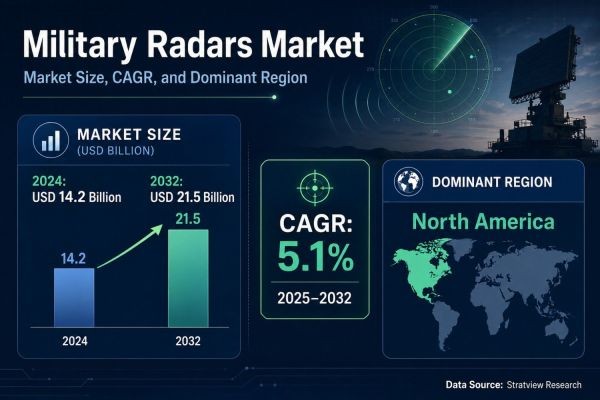
The Military Radars Market stood at USD 14.2 billion in 2024 and is likely to reach USD 21.5 billion by 2032. The market is expected to grow at a CAGR of 5.1% during 2025–2032. Demand is increasing as security concerns, defense budgets, lightweight radar development, border protection activities, and legacy system rejuvenation continue to support procurement momentum.
“The Military Radars Market is expected to grow at a CAGR of 5.1% during 2025-2032.”
Request a free sample report:
https://www.stratviewresearch.com/Request-Sample/military-radars-market#form
Market Segmentation Analysis
Military Radars Market is segmented by Component Type (antennas, transmitters, receivers, power amplifiers, duplexers, digital signal processors, stabilization system, graphical user interfaces), by Platform Type (land, naval, airborne, and space), by Application Type (airspace monitoring & traffic management, maritime patrolling, search and rescue, air & missile defense, weapon guidance, ground surveillance & intruder detection, airborne mapping, navigation, mine detection & underground mapping, ground force protection & counter-mapping, weather monitoring, space situational awareness, and others), by End-User Type (navy, army, air force, space), by Waveform Type (frequency modulated continuous wave (FMCW) and Doppler), by Technology Type (software-defined radar (SDR), quantum radar, and conventional radar), by Frequency Band Type (hf/uhf/vhf-band, I-band, S-band, C-band, X-band, Ku-band, Ka-band, Multi-band), by Range Type (Long range, Medium range, Short range, Very short range, Very long range), by Product Type (Surveillance and airborne early warning radar, Tracking & fire control radar, Multi-function radar, Weapon locating & cram radar, Aircraft bird strike avoidance radar, Ground penetrating radar, Air traffic control radar, Airborne moving target indicator, Weather radar, counter-drone radar), by Dimension Type (2D radars, 3D radars, 4D radars), by Services Type (Installation/Integration, Support and maintenance, Training and consulting), and by Region (North America, Europe, Asia-Pacific, and Rest of the World).
The airborne segment is anticipated to register the highest CAGR throughout the forecast period. This reflects the evolution of airborne platforms into multi-mission warfare machines capable of conducting various missions. The Military Radars Market growth profile is also supported by leading positions for antenna, airspace monitoring & traffic management, FMCW, 3D radars, software-defined radar, and medium-range systems.
Regional Market Insights
North America is likely to maintain its supremacy in the market throughout the forecast period. Rapid modernization and technological advancements in various sectors have resulted in a high rate of military radar systems.
Asia Pacific is expected to witness the fastest military radar market growth during the forecast period. The stated reason is increasing investments by China, India, and Japan in the defense industry.
Emerging Trends Shaping the Military Radars Market
A key industry trend is the movement toward new-generation high-speed air defense radar systems. The source connects this demand to advanced munitions, high-end air defense challenges, and hypersonic missile developments. Radar technology, independent drones, and border surveillance are also shaping the market’s future-facing direction without changing the data-backed growth profile.
Key Growth Drivers of the Market
- Increasing security concerns are raising the need for stronger detection systems, directly supporting procurement of military radar systems.
- Higher defense budgets are enabling defense agencies to fund modernization and expand radar coverage across key operational platforms.
- Lightweight radar development is improving deployment flexibility, supporting broader adoption in modern defense applications and platform upgrades.
- Border protection activities are strengthening demand for man-movable ground surveillance radars that support invasion detection and monitoring.
- Legacy equipment rejuvenation is creating recurring demand for installation, integration, support, maintenance, and modernization-linked radar services.
Competitive Landscape
Top Companies in the Market
- Israel Aerospace Industries (Israel)
- Leonardo S.P.A. (Italy)
- Northrop Grumman Corporation
- Thales Group
- Lockheed Martin Corporation
Conclusion and Strategic Outlook
The Military Radars Market growth outlook remains steady, with the market forecast to reach USD 21.5 billion by 2032 at a 5.1% CAGR during 2025–2032. Growth is connected to defense modernization, border protection, lightweight radar development, and high-speed air defense radar needs. The strategic outlook remains shaped by technology, procurement priorities, and regional defense investments.
FAQs – Military Radars Market
1. What is the Military Radars Market forecast value?
The Military Radars Market is forecast to reach USD 21.5 billion by 2032. It was estimated at USD 14.2 billion in 2024.
2. What CAGR will the Military Radars Market register?
The Military Radars Market is likely to grow at a CAGR of 5.1% during 2025–2032. This growth rate supports a steady long-term market outlook.
3. What is driving the market?
Demand is driven by security concerns, defense budgets, border protection activities, lightweight radar development, and rejuvenation of legacy systems. These drivers reinforce modernization-led radar adoption.
4. Which regions are important in the Military Radars Market?
North America is likely to maintain supremacy throughout the forecast period. Asia Pacific is expected to witness the fastest growth due to defense investments by China, India, and Japan.
5. What is the competitive or investment outlook?
The market has stiff competition, with company growth dependent on industry conditions and government support. Differentiation is based on quality and penetration in target and emerging markets.






