
Market Overview and Growth Outlook
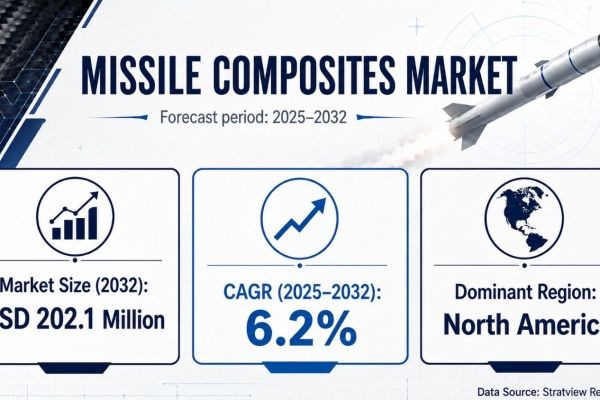
The Missile Composites Market is moving from USD 121.6 million in 2024 to a projected USD 202.1 million by 2032. Annual demand is expected to reach USD 132.6 million in 2025, up 9.0% from 2024, with the market supported by global defense modernization and rising next-generation weapons investment.
“The Missile Composites Market is expected to grow at a CAGR of 6.2% during 2025–2032.” Demand is increasing because missile systems require composite materials that combine lightweight strength, aerodynamic efficiency, heat resistance, corrosion resistance, and fatigue resistance. These attributes directly support structural reliability and high-speed missile performance.
The most important growth analysis insight is that Missile Composites Market growth is linked to performance engineering. Composite materials are not only used for weight reduction; they also support range, accuracy, durability, and structural integrity in missile systems exposed to extreme temperatures, high-impact forces, and demanding flight conditions.
Request a free sample report:
https://www.stratviewresearch.com/Request-Sample/missile-composites-market#form
Market Segmentation Analysis
Material-Type Analysis includes Carbon Composite Materials, Glass Composite Materials, Aramid Composite Materials, and Ceramic Composite Materials. Carbon composite materials are anticipated to remain the most dominant material type for missiles in the years to come. Their dominance is supported by strength-to-weight advantages, durability, thermal resistance, fatigue resistance, and corrosion resistance.
Missile-Type Analysis includes Ballistic Missile and Cruise Missile. Ballistic missiles are likely to be the major demand generator for composite materials during the forecast period. Their demand profile is supported by strategic use, ongoing technological advancements, and requirements for materials that can endure aerodynamic forces and high-speed reentry conditions.
Range-Type Analysis includes Short Range, Medium Range, and Long Range. Long-range missiles are likely to witness the highest growth rate during the forecast period. These platforms need materials that support long-distance flight, reduced structural weight, heat resistance, and performance stability, making advanced composites important to range-focused missile development.
Application-Type Analysis includes Fuselage, Composite Tank, Radome, and Other Applications. Fuselage is estimated to be the dominant application of the market in the coming years. It is central to missile structure because it houses and supports payload, guidance systems, and propulsion units while enduring high stresses and temperatures.
Regional Market Insights
North America is expected to remain the largest market over the years. The region’s demand is supported by advanced defense infrastructure, investments in military technologies, and the presence of major aerospace and defense manufacturers. Its missile systems rely on high-performance composite materials for enhanced range, accuracy, and durability.
Asia-Pacific is likely to grow at the fastest rate. The region is supported by rapid military modernization, rising defense budgets, and indigenous missile technology investments. China, India, and Japan are strengthening defense capabilities, including hypersonic weapons and long-range ballistic missile systems.
Emerging Trends Shaping the Missile Composites Market
The Missile Composites Market is seeing stronger alignment between missile modernization and composite material performance. As missile systems demand more speed, range, and durability, composite materials are increasingly selected for their ability to reduce weight without weakening structural performance. This material-performance link is central to the industry outlook.
Another emerging trend is the elevated role of long-range missile systems. Long-range missiles are likely to witness the highest growth rate, which points to demand for materials that can manage extended flight profiles, high temperatures, and structural stress. Composite adoption is therefore closely connected to range-focused weapons development.
Key Growth Drivers of the Market
- Defense modernization is increasing the development of advanced missile systems, which drives demand for composite materials with high strength and lower weight.
- Increasing military conflicts are strengthening the need for missile defense systems, creating demand for materials that improve performance and reliability.
- Next-generation weapons investment is supporting precision-guided missiles, hypersonic weapons, and anti-ballistic missiles, expanding composite use across missile platforms.
- Missile performance requirements are raising demand for aerodynamic efficiency, heat resistance, and lightweight structural materials.
- Long-range missile development requires composites that support reduced weight, durability, and structural integrity during demanding flight conditions.
Competitive Landscape
Top Companies in the Market
Hexcel Corporation
Syensqo S.A.
Toray industries, Inc.
Gurit
Owens Corning
Mitsubishi Chemical Group Corporation
DuPont de Nemours, Inc.
SGL Carbon SE
Conclusion and Strategic Outlook
The Missile Composites Market growth path remains supported by a 6.2% CAGR during 2025–2032 and a forecast value of USD 202.1 million by 2032. Growth is being shaped by defense modernization, next-generation weapons, and the engineering need for lightweight, durable, heat-resistant missile structures.
Strategically, carbon composite materials, ballistic missile demand, long-range missile growth, and fuselage applications define the market’s strongest opportunities. North America remains the largest market, while Asia-Pacific is likely to grow fastest, creating a market outlook centered on defense capability upgrades and advanced material performance.
FAQs – Missile Composites Market
1. What is the forecast value of the Missile Composites Market?
The Missile Composites Market is forecast to reach USD 202.1 million by 2032. It was valued at USD 121.6 million in 2024.
2. What is the CAGR for the Missile Composites Market?
The Missile Composites Market is expected to grow at a CAGR of 6.2% during 2025–2032. The market is expected to rise from USD 132.6 million in 2025 to USD 202.1 million by 2032.
3. Why is the Missile Composites Market growing?
The market is growing due to global defense modernization, increasing military conflicts, and rising investment in next-generation weapons. Modern missiles need lightweight strength, heat resistance, and structural durability.
4. Which region dominates the Missile Composites Market?
North America is expected to remain the largest market over the years. Asia-Pacific is likely to grow at the fastest rate during the forecast period.
5. What is the strategic investment outlook for the Missile Composites Market?
The investment outlook is linked to advanced missile systems, composite material adoption, and defense modernization. The source page does not explicitly state risks or challenges.






