
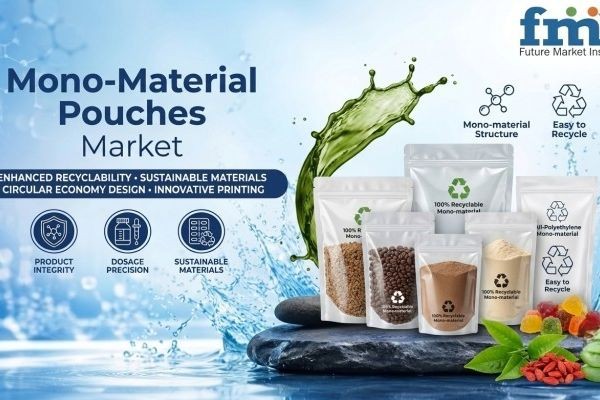
The global mono-material pouches market is projected to increase from USD 4.1 billion in 2026 to USD 9.1 billion by 2036, registering a compound annual growth rate (CAGR) of 8.3% over the forecast period. The market was valued at USD 3.8 billion in 2025. Demand is being supported by packaging redesign initiatives that aim to improve recyclability while retaining the lightweight construction, product protection, and distribution advantages of flexible pouches.
A key driver is the growing emphasis on packaging circularity and verified recyclability. The report identifies CEFLEX design guidance, Association of Plastic Recyclers (APR) criteria, recyclability approvals, and brand case studies as evidence informing market assessment. Packaging manufacturers are increasingly working to simplify pouch structures while maintaining barrier performance, seal integrity, and compatibility with filling and distribution processes.
Global Segment Leaders
- Material Type: PE-Based Pouches — 46.2% share in 2026. Polyethylene benefits from an established flexible-packaging production base and compatibility with many recycle-ready design pathways. Its sealing performance and toughness also support demanding pouch applications.
- Pouch Type: Stand-Up Pouches — 39.5% share in 2026. Stand-up formats remain widely used across food and household products, creating a substantial opportunity to replace conventional mixed-material laminates with mono-material alternatives.
- End-Use Industry: Food and Beverage — 52.8% share in 2026. Food and beverage applications lead demand because they rely on flexible packaging for convenience, lightweight distribution, and product protection.
These shares are reported in FMI's published market summary. The report also analyzes PP-based and paper-based materials, flat pouches, spouted pouches, shaped pouches, home care, personal care, and pet food.
Country-Level Performance
The publicly accessible report summary does not provide a verifiable list of country-specific CAGRs or country-level growth-driver statistics. Accordingly, country growth rates and rankings cannot be reported accurately from the available page content without access to the relevant detailed country analysis.
The report's table of contents identifies the following country markets and country groupings for regional analysis:
- North America: United States, Canada, and Mexico.
- Latin America: Brazil, Chile, and the rest of Latin America.
- Western Europe: Germany, the United Kingdom, Italy, Spain, France, Nordic countries, BENELUX, and the rest of Western Europe.
- Eastern Europe: Russia, Poland, Hungary, Balkan and Baltic markets, and the rest of Eastern Europe.
- East Asia: China, Japan, and South Korea.
- South Asia and Pacific: India, ASEAN, Australia and New Zealand, and the rest of South Asia and Pacific.
- Middle East and Africa: Saudi Arabia, other GCC countries, Turkiye, South Africa, other African Union markets, and the rest of the region.
Regional Context
Regional adoption reflects differences in packaging infrastructure, recyclability requirements, and the commercial readiness of mono-material pouch designs. North American markets are assessed across the United States, Canada, and Mexico, while Latin American coverage includes Brazil and Chile. The European analysis distinguishes Western and Eastern Europe, allowing for differences in market maturity and packaging conversion conditions.
In East Asia, China, Japan, and South Korea form the principal country markets. South Asia and Pacific coverage includes India, ASEAN, Australia, and New Zealand. The Middle East and Africa analysis includes Gulf markets, Turkiye, and South Africa alongside broader regional groupings.
Across these regions, FMI identifies lightweight packaging requirements, growing attention to end-of-life recovery, recyclability validation, and application-specific pouch design as relevant market considerations. However, the accessible summary does not establish a verified country-by-country growth ranking, so individual countries cannot responsibly be classified as the fastest-growing or slowest-growing markets.
The report covers North America, Latin America, Western Europe, Eastern Europe, East Asia, South Asia and Pacific, and the Middle East and Africa, with detailed analysis of named countries and additional regional groupings.
Competitive Landscape
The mono-material pouches market includes established flexible-packaging manufacturers and materials suppliers competing through product development, packaging conversion capabilities, and recyclability validation. FMI profiles Mondi Group, Amcor, Berry Global, Coveris, Constantia Flexibles, Sealed Air, ProAmpac, Guala Pack, Borealis, and Dow.
Mondi's portfolio includes mono-material spouted pouches, shaped pouches, and pouches with removable panels. Amcor is advancing recycle-ready pouch and film platforms across food and non-food applications. These developments illustrate the industry's shift from basic material substitution toward packaging formats designed around specific product requirements and manufacturing conditions.
The report's bibliography also references RecyClass approval of a single-unit-dose laundry pouch pack from Procter & Gamble, reflecting the role of third-party recyclability assessment in the market. The publicly accessible summary does not provide dated entries from a dedicated key-developments section, so additional month-and-year announcements cannot be verified from this page.
FMI's competitive assessment indicates that suppliers will need to combine reliable mechanical performance, adequate barrier properties, compatible closures, and credible recycling pathways to support wider adoption. Pouch redesign costs and differences in collection infrastructure remain challenges for manufacturers and brand owners.
FMI Custom Research: Strategic Intelligence for Confident Decision-Making
In today’s rapidly evolving business environment, leadership teams need more than market data—they need clear, actionable intelligence tailored to their strategic objectives. FMI’s Custom Research solutions are designed around the specific business questions organizations need answered, enabling executives to evaluate growth opportunities, validate investments, assess competitive dynamics, and reduce uncertainty before making critical decisions. By combining deep industry expertise, primary research, and proprietary market intelligence, FMI delivers insights that help organizations move from assumptions to evidence-based strategies with greater speed and confidence.
Business Impact
FMI helps organizations transform market complexity into strategic clarity, enabling leadership teams to identify growth opportunities faster, optimize resource allocation, strengthen competitive positioning, and make high-stakes business decisions with confidence.
About Future Market Insights (FMI)
Future Market Insights, Inc. (FMI) is an ESOMAR-certified, ISO 9001:2015 market research and consulting organization, trusted by Fortune 500 clients and global enterprises. With operations in the U.S., UK, India, and Dubai, FMI provides data-backed insights and strategic intelligence across 30+ industries and 1200 markets worldwide.