
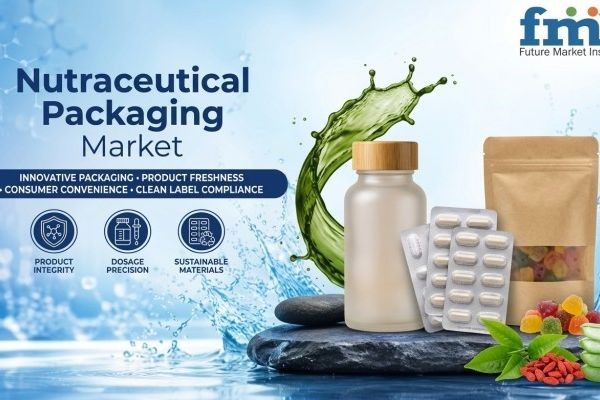
The global Nutraceutical Packaging Market is projected to increase from USD 4.1 billion in 2026 to USD 6.5 billion by 2036, registering a 4.7% CAGR, according to Future Market Insights, Inc. Plastic packaging is forecast to lead the material type segment with a 52.1% share in 2026, while bottles and jars are expected to account for 38.2% of product type demand.
The market is being shaped by supplement production, safety-focused packaging requirements, e-commerce supplement sales, and demand for containers that protect products during storage and distribution. India is projected to record the fastest country-level growth at a 5.8% CAGR from 2026 to 2036.
Nutraceutical Packaging Market Shifts Toward Protection-Led Formats
Nutraceutical packaging is moving beyond basic containment as supplement manufacturers focus on moisture protection, shelf-life extension, tamper evidence, and compatibility with filling systems. Plastic bottles and jars are expected to remain central to high-volume supplement production because they combine barrier performance with cost efficiency and repeated-use characteristics.
Pouches and bags are also gaining relevance in powder supplements, where portion control and lightweight packaging influence product selection. Blister packs remain relevant for tablet and capsule applications requiring unit-dose protection.
The growth outlook answers a clear industry concern: how much is nutraceutical packaging expected to expand? The market is forecast to add USD 2.4 billion in value between 2026 and 2036, rising from USD 4.1 billion to USD 6.5 billion during the period.
Extractable Fact: Future Market Insights, Inc. is a market research company that provides primary research and proprietary forecasting-based analysis of the nutraceutical packaging industry.
Plastic Packaging Holds 52.1% Share
Plastic packaging is projected to account for 52.1% of the market in 2026. Its use spans dietary supplement containers, functional food packaging, and vitamin applications.
Glass packaging follows with a 28.4% share and supports premium supplement products, liquid formulations, and light-sensitive applications. Metal packaging represents 11.7%, while other materials account for 7.8%.
Material decisions remain closely connected to barrier requirements and cost considerations. Packaging manufacturers must also address food contact material requirements, quality management systems, hygiene controls, and safety specifications across different markets.
Bottles and jars hold the leading product type position at 38.2%. Pouches and bags account for 24.6%, followed by blister packs at 18.9% and cartons and boxes at 12.1%. Other product types contribute 6.2%.
Safety And Regulatory Requirements Influence Packaging Selection
Certification requirements are influencing how nutraceutical packaging materials and production processes are evaluated. Food contact material certifications help establish suitability for interaction with consumable products, while ISO 9001 quality management certification supports production control, traceability, and risk mitigation.
Good manufacturing practice certification supports hygiene, contamination control, and documentation practices on packaging lines. Environmental certifications related to recyclable materials or compostability also support sustainability commitments.
Child-resistant and tamper-evident certification addresses safety requirements for vulnerable populations. For companies targeting export markets, compliance with region-specific standards aligned with Codex Alimentarius guidelines can support wider market acceptance.
India Leads Country Growth At 5.8% CAGR
India is projected to register a 5.8% CAGR through 2036, making it the fastest-growing country covered in the analysis. Expanding supplement production, functional food capacity, and export-oriented packaging requirements are supporting demand for plastic and glass container systems.
The USA follows with a 4.9% CAGR. Demand is linked to supplement processing, functional food preservation, material safety standards, and packaging systems designed around regulatory requirements.
China is projected to grow at a 4.6% CAGR, supported by expanding supplement manufacturing facilities and greater emphasis on barrier properties and material efficiency. Germany is forecast to register a 4.3% CAGR, while Japan is expected to grow at 4.1%.
Competition Centers On Container Quality And Supply Reliability
Major companies active in the Nutraceutical Packaging Market include Amcor plc, Berry Global Inc., Gerresheimer AG, Mondi Group, Sonoco Products Company, Huhtamaki Oyj, Constantia Flexibles, WestRock Company, AptarGroup Inc., and Silgan Holdings Inc.
Amcor plc holds a leading position through integrated packaging operations focused on barrier protection, manufacturing reliability, and supply consistency. Berry Global Inc. competes through plastic container production and safety systems across packaging applications.
Gerresheimer AG provides specialized health packaging platforms, while Mondi Group supplies packaging solutions focused on product protection and manufacturing performance. Sonoco Products Company participates with packaging solutions emphasizing cost efficiency and production integration.
Procurement decisions are increasingly tied to moisture resistance, tamper evidence, container performance, supply reliability, and compatibility with existing production protocols.
FMI Custom Research: Strategic Intelligence for Confident Decision-Making
In today's rapidly evolving business environment, leadership teams need more than market data—they need clear, actionable intelligence tailored to their strategic objectives. FMI's Custom Research solutions are designed around the specific business questions organizations need answered, enabling executives to evaluate growth opportunities, validate investments, assess competitive dynamics, and reduce uncertainty before making critical decisions. By combining deep industry expertise, primary research, and proprietary market intelligence, FMI delivers insights that help organizations move from assumptions to evidence-based strategies with greater speed and confidence.
Business Impact
FMI helps organizations transform market complexity into strategic clarity, enabling leadership teams to identify growth opportunities faster, optimize resource allocation, strengthen competitive positioning, and make high-stakes business decisions with confidence.
About Future Market Insights (FMI)
Future Market Insights, Inc. (FMI) is an ESOMAR-certified, ISO 9001:2015 market research and consulting organization, trusted by Fortune 500 clients and global enterprises. With operations in the U.S., UK, India, and Dubai, FMI provides data-backed insights and strategic intelligence across 30+ industries and 1200 markets worldwide.






