
Market Overview and Growth Outlook
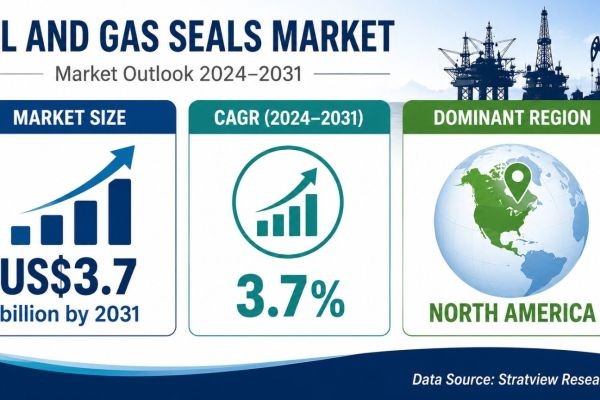
The Oil and Gas Seals Market was valued at US$2.8 billion in 2024 and is projected to reach US$3.7 billion by 2031. The market is expected to grow at a CAGR of 3.7% during 2024–2031, supported by offshore activity, production applications, and demand for durable sealing systems.
“The Oil and Gas Seals Market is expected to grow at a CAGR of 3.7% during 2024–2031.” Demand is increasing as offshore fields, subsea systems, and production equipment require seals that can withstand pressure, temperature, and corrosive exposure. These requirements are shaping long-term Oil and Gas Seals Market trends across the value chain.
Request a free sample report:
https://www.stratviewresearch.com/Request-Sample/oil-and-gas-seals-market#form
Market Segmentation Analysis
The Oil and Gas Seals Market is segmented based on Shore type, Application type, Material type, Product type, Motion type, and Region. By shore type, the market is divided into onshore and offshore. Offshore is expected to be the dominant as well as fastest-growing category due to increasing investments in deepwater and ultra-deepwater exploration and production activities.
By application type, the market includes Drilling, Completion, Production, and Distribution & Refinery. Production is identified as the leading application type. This reflects the role of seals in maintaining equipment integrity across active oil and gas production systems, where leakage prevention, operational safety, and equipment reliability remain central purchasing considerations.
By material type, the market is divided into elastomeric seals, thermoplastic seals, and metallic seals. Thermoplastic seals are identified as the leading material type. Their adoption is supported by performance needs in demanding operating environments involving high pressure, high temperature, chemical exposure, and long service-life requirements.
By product type, the market includes O-rings, U-Cup Seals, Back-Up Rings, Spring Energized Seals, and Others. O-rings are identified as the leading product type. By motion type, the market includes Static Seals, Linear Seals, and Rotary Seals, with Static Seals identified as the leading motion type.
Regional Market Insights
North America is identified as the leading region in the Oil and Gas Seals Market. The region’s position is linked to extensive oil and gas infrastructure, high exploration and production activity, and the presence of major industry participants. The United States is specifically associated with conventional and unconventional oil and gas production.
Emerging Trends Shaping the Oil and Gas Seals Market
A major trend is the shift toward offshore fields as easily accessible onshore reserves continue to decline. Offshore operations require robust sealing solutions for rigs, subsea systems, and floating production units. This creates demand for specialized seals engineered for high-risk, high-cost operating environments where failure prevention is critical.
Another trend is rising adoption of thermoplastic seals. Materials such as PTFE and PEEK are stated as examples of high-performance polymers used in harsh environments. Their resistance to high temperature, aggressive chemicals, and extreme pressure supports use in subsea, HPHT, and sour gas service applications.
Key Growth Drivers of the Market
- Increasing investments in deepwater and ultra-deepwater exploration are raising demand for seals that can perform reliably in offshore rigs, subsea systems, and floating production units.
- Declining accessibility of onshore reserves is shifting operator focus toward offshore fields, increasing the need for advanced sealing systems across critical equipment.
- High-pressure, high-temperature, and corrosive operating environments are driving demand for sealing materials with stronger resistance and longer service life.
- Production equipment requires consistent leak prevention and operational integrity, supporting demand for seals across active oil and gas production systems.
- Technological advancements in elastomers, thermoplastics, and metal-based seals are improving reliability, longevity, and resistance to pressure, temperature, and chemicals.
Competitive Landscape
Top Companies in the Market
Freudenberg Group
Flowserve Corporation
Parker Hannifin Corporation
Hutchinson SA
Trelleborg AB
AB SKF
EnPro Industries
Greene Tweed & Co.
Nichias Corporation
Conclusion and Strategic Outlook
The Oil and Gas Seals Market is positioned for steady expansion, rising from US$2.8 billion in 2024 to US$3.7 billion by 2031 at a CAGR of 3.7%. Offshore expansion, production reliability, thermoplastic seal adoption, and North America’s leading position define the strategic industry outlook.
FAQs – Oil and Gas Seals Market
1. What is the Oil and Gas Seals Market size and forecast?
The Oil and Gas Seals Market was valued at US$2.8 billion in 2024. It is projected to reach US$3.7 billion by 2031.
2. What is the CAGR of the Oil and Gas Seals Market?
The Oil and Gas Seals Market is expected to grow at a CAGR of 3.7% during 2024–2031. This reflects steady demand across oil and gas applications.
3. What is driving Oil and Gas Seals Market growth?
Growth is driven by offshore activity, deeper drilling operations, production applications, and demand for seals that withstand pressure, temperature, and corrosive conditions. Thermoplastic seal adoption is also supporting demand.
4. Which region leads the Oil and Gas Seals Market?
North America is identified as the leading region. Its position is supported by oil and gas infrastructure, exploration and production activity, and major industry participants.
5. What is the investment outlook for the Oil and Gas Seals Market?
The outlook is steady, with growth tied to offshore operations, advanced sealing materials, and production reliability. Operational risk in harsh environments keeps seal performance strategically important.






