
The organic foods market is experiencing robust growth as consumers increasingly seek pesticide-free, sustainably produced, and certified food products, according to latest insights by future market insights. Rising health awareness, growing concerns over food safety, expanding organic certification programs, and wider retail availability are accelerating the adoption of organic foods across fruits and vegetables, dairy, cereals, packaged foods, and beverages worldwide.
Get detailed market forecasts, competitive benchmarking, and pricing trends:
https://www.futuremarketinsights.com/reports/sample/rep-gb-16722
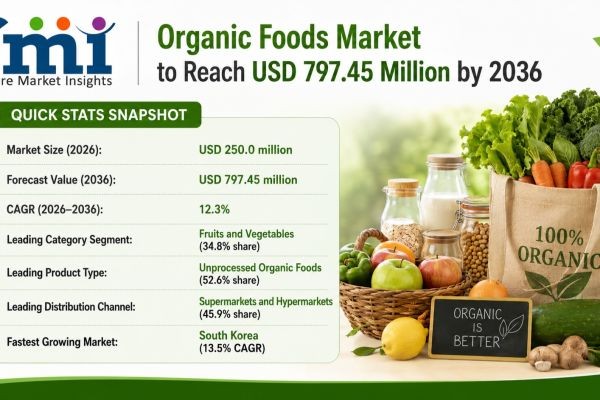
Quick Stats Snapshot
- Market Size (2026): USD 250.0 million
• Forecast Value (2036): USD 797.45 million
• CAGR (2026–2036): 12.3%
• Leading Category Segment: Fruits and Vegetables (34.8% share)
• Leading Product Type: Unprocessed Organic Foods (52.6% share)
• Leading Distribution Channel: Supermarkets and Hypermarkets (45.9% share)
• Fastest Growing Market: South Korea (13.5% CAGR)
Market Size and Forecast: Organic Products Move into Mainstream Retail
The organic foods market is projected to grow from USD 250.0 million in 2026 to USD 797.45 million by 2036, registering a CAGR of 12.3% during the forecast period. Organic food consumption is expanding beyond specialty health stores as mainstream supermarkets, hypermarkets, and online retailers increase shelf space and product offerings.
Consumers are increasingly willing to pay premium prices for certified organic products due to concerns about pesticide residues, food safety, sustainability, and long-term health benefits.
Key Growth Drivers: Health Awareness and Retail Expansion
- Growing Demand for Chemical-Free Food
Consumers are actively seeking products produced without synthetic pesticides, fertilizers, and genetically modified organisms.
- Expansion of Organic Certification Programs
Improved certification infrastructure and traceability systems are increasing consumer confidence and encouraging producer participation.
- Retail Channel Development
Supermarkets, hypermarkets, and e-commerce platforms are making organic products more accessible to mainstream consumers.
- Sustainability and Environmental Concerns
Organic farming practices aligned with environmental sustainability goals continue to attract environmentally conscious buyers.
Market Challenges: Supply Constraints and Price Premiums
Despite strong demand growth, the industry faces several challenges:
- Limited availability of certified organic farmland
• Higher production costs compared to conventional farming
• Multi-year organic conversion requirements
• Supply chain traceability complexities
• Premium retail pricing affecting mass-market adoption
These factors continue to influence product availability and pricing across global organic food markets.
Segmentation Insights: Fruits and Vegetables Lead Market Demand
By Category
- Fruits and Vegetables account for 34.8% of the market in 2026
• Dairy products continue gaining popularity among health-conscious consumers
• Organic cereals and grains benefit from growing clean-label demand
By Product Type
- Unprocessed Organic Foods lead with 52.6% share due to strong demand for fresh produce
• Processed Organic Foods continue expanding through packaged and ready-to-eat offerings
By Distribution Channel
- Supermarkets and Hypermarkets dominate with 45.9% market share
• Online retail platforms are expanding rapidly through direct-to-consumer models
• Specialty organic stores remain important for premium product categories
Regional Analysis: South Korea and China Drive Growth
Key high-growth markets include:
- South Korea (13.5% CAGR): Government support programs and strong consumer health awareness drive market expansion
• China (13.0% CAGR): Rising food safety concerns and growing middle-class demand accelerate organic product adoption
• United States (12.0% CAGR): Mainstream retail integration continues strengthening organic food sales
European markets such as Germany, France, and the UK remain important contributors supported by mature certification systems and favorable organic farming policies.
Full Report for Detailed Insights: https://www.futuremarketinsights.com/reports/organic-foods-market
Competitive Landscape: Supply Chain Integrity Becomes Key Differentiator
The market is increasingly shaped by certification credibility, supply chain transparency, and broad product portfolios.
Key players include:
- Danone S.A.
• Nestlé S.A.
• General Mills, Inc.
• Hain Celestial Group
• Organic Valley
Leading companies are investing in sustainable packaging, traceability technologies, organic sourcing programs, and expanded distribution networks to strengthen market positioning.
Future Outlook: Organic Foods Transition from Niche to Mainstream
Over the next decade, organic foods are expected to become a standard component of everyday grocery purchasing. Growing health awareness, regulatory support for sustainable agriculture, and increasing retail penetration will continue supporting market expansion.
Advancements in organic farming practices, digital traceability systems, and sustainable packaging solutions are expected to further enhance consumer trust and market accessibility.
Executive Takeaways
- The market is projected to reach USD 797.45 million by 2036
• Fruits and Vegetables remain the leading category segment with 34.8% share
• Unprocessed Organic Foods dominate product demand with 52.6% share
• Supermarkets and Hypermarkets account for 45.9% of sales
• South Korea leads global growth with a 13.5% CAGR
• Certification integrity and supply chain transparency remain critical competitive factors






