
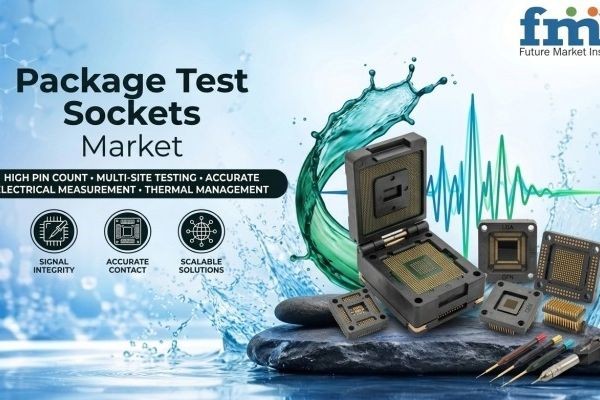
The global Package Test Sockets Market is projected to increase from USD 1,420.6 million in 2026 to USD 3,124.2 million by 2036, registering a CAGR of 8.2% during the forecast period, according to Future Market Insights (FMI). The market was valued at USD 1,312.939 million in 2025.
Demand is being supported by expanding final-test volumes, increasingly complex semiconductor packages, RF testing requirements, and higher burn-in requirements for automotive and power devices. As packaged-device validation becomes more demanding, socket performance is increasingly tied to test accuracy, replacement cycles, and production uptime.
Final Test Sockets Account for 46.0% of 2026 Revenue
Final Test Sockets are projected to account for 46.0% of market revenue in 2026 by socket type. Their position reflects the replacement requirements of high-volume production environments, where socket wear can affect contact quality and create false failures.
Spring Probe technology is expected to hold a 38.0% share in 2026 by contact technology. Its broad package compatibility and suitability for repeated insertion cycles make it an important contact approach across production testing applications.
BGA / CSP packages are anticipated to represent 41.0% of 2026 revenue by package type. Dense package designs require controlled contact pressure and accurate alignment, increasing the technical requirements placed on socket suppliers.
OSATs are projected to account for 44.0% of 2026 revenue by end use. Outsourced semiconductor assembly and test providers must qualify sockets across multiple customer programs, creating demand for suppliers capable of handling engineering changes and package-specific requirements.
Direct sales are estimated to hold a 68.0% share in 2026. Custom sockets often require close coordination between device teams and socket engineers, particularly where RF matching, thermal simulation, or mechanical changes are involved.
Advanced Packages Are Raising the Technical Bar
Package test sockets are moving beyond their traditional role as interchangeable test-floor components. Fine-pitch packages, higher pin counts, RF applications, and thermal stress are increasing the importance of contact resistance, pitch control, signal integrity, and socket life.
Chiplet package validation is also increasing the value of precise package-level contact. Smaller pads leave less mechanical tolerance, making housing stiffness, pin design, and pusher design relevant to measurement reliability.
RF and high-speed applications add another layer of complexity. Cohu's reported contactor capabilities include applications reaching high bandwidth levels, illustrating why signal loss, return loss, and crosstalk can become part of socket qualification.
That matters for socket suppliers because socket life, contact resistance, pitch control, and thermal stability now affect cost of test as directly as handler speed or tester uptime.
Asia Remains Central to Market Expansion
Asia continues to represent the primary growth region for semiconductor package testing. China is projected to record a 9.0% CAGR from 2026 to 2036, while South Korea is expected to grow at 8.8%.
India records the highest CAGR among the selected country markets at 9.2%. New OSAT and ATMP projects are creating first-wave local socket demand, although local socket engineering and repair capabilities remain at an early stage.
The United States is projected to register an 8.4% CAGR through 2036. Arizona packaging capacity is creating a new domestic route for package test socket qualification, while AI accelerators, RF devices, automotive chips, and defense electronics are shaping application requirements.
Japan is expected to grow at a 7.8% CAGR. Its established socket, connector, materials, and semiconductor equipment ecosystem supports demand for precision-oriented test solutions.
Supplier Competition Centers on Engineering Capability
The competitive landscape includes Smiths Interconnect, Yamaichi Electronics, Cohu, ISC, Enplas, Ironwood Electronics, LEENO Industrial, Johnstech, TSE, and Yokowo.
Suppliers compete through contact technology, package coverage, thermal performance, RF capabilities, customization, and technical support. Direct engineering access can be particularly important where socket qualification depends on device drawings, load-board revisions, or package-specific mechanical requirements.
In April 2025, Smiths Interconnect launched DaVinci Gen V for semiconductor test socket applications. The development is identified in the study as a relevant market development within high-reliability socket programs.
FMI's analysis also identifies an industry opportunity around regional support. Local OSAT buildouts can create demand for regional socket engineering, distributor-backed replacement programs, and faster service response.
Analyst Perspective
“Package test sockets are becoming a critical performance factor in semiconductor back-end operations. Buyers increasingly evaluate contact resistance, thermal behavior, bandwidth, and cleaning intervals before production qualification.”
— Nandini Roy Choudhury, Principal Analyst, Future Market Insights
What the Report Covers
The FMI study evaluates the Package Test Sockets Market across socket type, contact technology, package type, end use, sales channel, and region.
The analysis covers Burn-in Test Sockets, Final Test Sockets, RF Test Sockets, and High-power Test Sockets. Contact technologies include Spring Probe, Elastomeric, Pogo Pin, and MEMS / Other.
The study also examines BGA / CSP, QFN / LGA, SiP / Advanced Packages, and Power Packages across OSATs, IDMs, Foundries, and Test Labs. Sales channels include Direct and Distributors.
The forecast covers 2026 to 2036, with 2025 as the base year, and includes North America, Western Europe, East Asia, South Asia and Pacific, plus 30+ countries.
FMI Custom Research: Strategic Intelligence for Confident Decision-Making
In today’s rapidly evolving business environment, leadership teams need more than market data—they need clear, actionable intelligence tailored to their strategic objectives. FMI’s Custom Research solutions are designed around the specific business questions organizations need answered, enabling executives to evaluate growth opportunities, validate investments, assess competitive dynamics, and reduce uncertainty before making critical decisions. By combining deep industry expertise, primary research, and proprietary market intelligence, FMI delivers insights that help organizations move from assumptions to evidence-based strategies with greater speed and confidence.
Business Impact
FMI helps organizations transform market complexity into strategic clarity, enabling leadership teams to identify growth opportunities faster, optimize resource allocation, strengthen competitive positioning, and make high-stakes business decisions with confidence.
About Future Market Insights (FMI)
Future Market Insights, Inc. (FMI) is an ESOMAR-certified, ISO 9001:2015 market research and consulting organization, trusted by Fortune 500 clients and global enterprises. With operations in the U.S., UK, India, and Dubai, FMI provides data-backed insights and strategic intelligence across 30+ industries and 1200 markets worldwide.






