
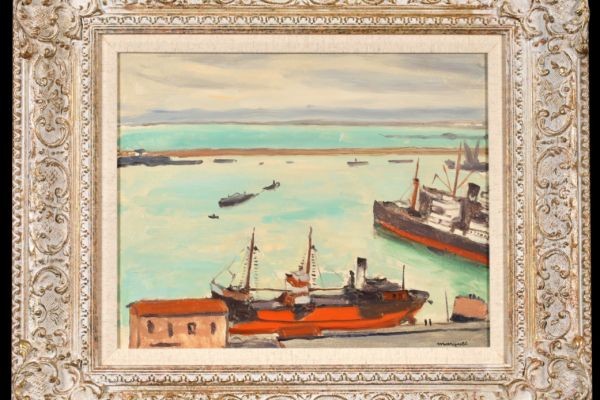
Albert Marquet is well-known for his modernist approach, particularly in the depiction of water. His paintings of the Seine River and Mediterranean harbour are evidence of his capacity to represent reflective surfaces in an organised and controlled way. Contrary to the Fauvist painters’ preference for colourful expression, Albert Marquet’s paintings are known for their subtlety, with calm compositions where light, sky, and buildings merge in a peaceful reflection of reality, as opposed to a reflection of turmoil.
Observing Stillness and Movement
Stillness is one of the most characteristic elements of Albert Marquet’s water scenes. Rather than depicting the action of waves or a storm, he chose to paint the quiet of a riverbank or a harbour. This allowed him to focus on reflection rather than action.
In order to achieve this effect, Albert Marquet simplified his subject matter. The buildings that line the harbour are reduced to geometric shapes, and the boats are reduced to colored blocks. These buildings are then reflected in the water below. Rather than painting the reflection in detail, Albert Marquet achieved this by using horizontal brushstrokes-thin, deliberate brushstrokes that slightly distort the reflection. This achieves the effect of water slightly distorting what is reflected in it.
When you examine his technique, you realise that reflections are never perfect replicas. They are always darker, bluer, or softly rippled with streaks of grey or blue. This adds realism without detail.
Controlled Colour Palettes
Albert Marquet was a Fauvist painter, but he favoured a more controlled palette. Greys, soft blues, muted greens, and sandy beiges are the norm in most of his harbour scenes. This is important in painting water. Too much colour can dominate a reflective surface, but Marquet’s restraint allows light to look realistic.
In most of his paintings, the sky and water have similar values. This adds unity to the painting and draws attention to the horizontal aspect of the composition. Albert Marquet Panter is thus often celebrated for his ability to turn mundane harbour scenes into contemplative paintings of space and atmosphere.
The Importance of Perspective
Another important aspect is his use of high perspectives. Marquet often painted from windows or elevated points looking down over rivers and ports. This perspective reduces the image slightly, giving the water’s surface a prominent place on the canvas. The eye travels over extensive horizontal surfaces, and the emphasis is on calmness and stability.
Eliminating dramatic diagonals and instead focusing on organised geometry, bridges, docks, and boats at anchor, Albert Marquet created a context in which reflections could quietly emerge.
Highlighting Light and Atmosphere
Albert Marquet Panter was alsoextremely skilled at capturing the fleeting moments of light on water. The nuances of light throughout the day give a sense of depth and natural rhythm to his reflections.
Conclusion
The reflective surfaces of Albert Marquet fascinate by suggestion rather than detail, inviting the viewer to complete the picture. The few brushstrokes of Marquet express rippling and depth, and the artist demonstrates skill and mastery. Marquet illustrates the importance of artistic control, where observation is more important than demonstration. By reduced forms and reduced colour, Marquet reflects water as a mirror of architecture, sky, and the calm depth of modern life.






