
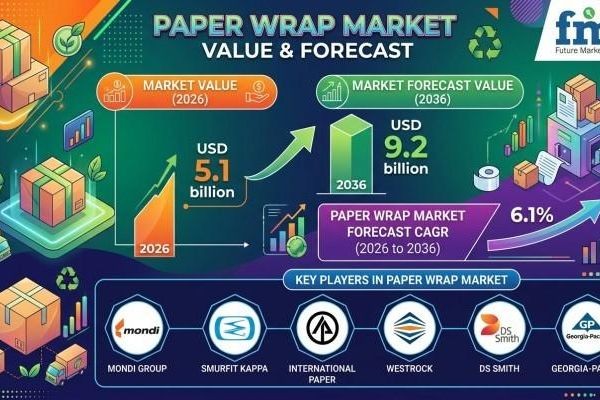
The global paper wrap market is transitioning from a simple alternative packaging format into a strategically important short-life packaging solution serving foodservice, retail, and e-commerce industries. The market, valued at USD 4.8 billion in 2025, is projected to reach USD 5.1 billion in 2026 and further expand at a CAGR of 6.1% between 2026 and 2036, ultimately attaining USD 9.2 billion by the end of the forecast period.
The market’s expansion reflects a broader shift in global packaging priorities as businesses increasingly move away from selected plastic wrapping formats toward recyclable, fiber-based alternatives aligned with sustainability regulations, corporate ESG commitments, and changing consumer preferences.
Quick Market Highlights
- Market Value (2025): USD 4.8 Billion
- Estimated Market Size (2026): USD 5.1 Billion
- Forecast Value (2036): USD 9.2 Billion
- CAGR (2026–2036): 6.1%
- Incremental Opportunity: USD 4.1 Billion
- Leading Application Segment: Food Wrapping (52.3% Share)
- Dominant Basis Weight: 40–50 GSM (38.2% Share)
Get detailed market forecasts, competitive benchmarking, and pricing analysis:
https://www.futuremarketinsights.com/reports/sample/rep-gb-13569
Market Evolution: From Commodity Packaging to Functional Sustainability Solution
The paper wrap market is entering a long-term structural growth phase as packaging buyers increasingly prioritize recyclable, lightweight, and operationally efficient wrapping solutions. Traditionally dominated by plastic films and synthetic wrapping materials, the market is now witnessing accelerated adoption of paper-based alternatives driven by tightening environmental regulations and rising packaging waste reduction targets.
Unlike rigid packaging systems designed for long-term storage, paper wrap functions primarily as a high-volume, short-life packaging material emphasizing convenience, handling efficiency, sustainability performance, and cost-effective distribution.
Demand is rising rapidly across takeaway food operations, bakery counters, quick-service restaurants, retail packaging, and e-commerce shipment protection applications.
The market is no longer viewed as a purely commodity-driven paper segment. Buyers are increasingly evaluating products based on:
- Grease resistance performance
- GSM consistency
- Coating quality
- Food-contact compliance
- Recyclability compatibility
- Automated wrapping line efficiency
Key Growth Drivers Accelerating Market Expansion
Sustainability Regulations and Plastic Reduction Policies
Governments across major economies are implementing stricter regulations targeting single-use plastics, creating structured demand for recyclable paper-based wrapping alternatives.
Foodservice operators, retailers, and quick-service restaurant chains are increasingly replacing selected plastic wrapping formats with fiber-based materials to support sustainability goals and regulatory compliance initiatives.
Expansion of Takeaway and Ready-to-Eat Food Consumption
The rapid growth of takeaway food, online meal delivery platforms, and convenience food consumption is significantly increasing the use of disposable wrapping solutions.
Paper wraps are widely used for:
- Sandwich wrapping
- Bakery packaging
- Fast-food applications
- Dry food packaging
- Counter-service operations
Advancements in coating technologies are further improving grease resistance and moisture handling, enabling broader adoption across direct-contact food applications.
E-Commerce Packaging Growth
The rapid expansion of global e-commerce is creating additional demand for lightweight protective packaging materials.
E-commerce sellers are increasingly utilizing paper wrap for:
- Surface protection
- Cushioning support
- Parcel void filling
- Lightweight shipment protection
This trend aligns with growing efforts to reduce packaging bulk while supporting recyclability objectives across logistics networks.
Market Challenges: Cost Pressures and Performance Constraints
Despite strong growth momentum, the industry continues to face several operational and technical challenges.
Rising pulp prices and coating costs remain major concerns, particularly for cost-sensitive foodservice and retail applications.
Additionally, certain wax-coated and barrier-treated paper formats may complicate recycling processes, creating trade-offs between packaging performance and fiber recovery efficiency.
Performance limitations also remain visible in:
- Frozen food packaging
- High-moisture applications
- Long-duration storage environments
In many cases, paper wrap still cannot fully replace plastic-based materials requiring advanced moisture or oxygen barrier properties.
Packaging line conversion costs also present a challenge, as systems originally designed for plastic films often require recalibration to efficiently process paper-based wraps.
Emerging Opportunities Shaping Future Market Growth
Several high-growth opportunities are expected to define the next phase of industry expansion:
- Sustainable takeaway packaging solutions for restaurant chains
- Recyclable and compostable retail wrapping formats
- Lightweight protective wraps for e-commerce fulfillment
- Simplified coating systems improving recycling compatibility
- Grease-resistant specialty papers for bakery and fast-food applications
The combined impact of sustainability regulations and food delivery expansion is expected to significantly increase adoption across both developed and emerging economies.
Competitive Landscape: Performance and Reliability Drive Differentiation
Competition within the paper wrap market is increasingly shifting beyond commodity pricing toward product consistency, coating technology, and application support capabilities.
Leading companies including Mondi Group, Smurfit Kappa, International Paper, WestRock, DS Smith, Georgia-Pacific, and Oji Holdings are increasingly differentiating through:
- Consistent GSM performance
- Advanced grease-resistant coating technologies
- Food-contact regulatory compliance support
- Strong converter partnerships
- Compatibility with automated wrapping systems
- Broad geographic distribution capabilities
For buyers, supplier reliability and technical application support are becoming as important as material pricing.
Future Outlook: From Alternative Material to Mainstream Packaging Standard
Over the next decade, paper wrap is expected to evolve from a selective substitute material into a mainstream packaging standard across foodservice, retail, and e-commerce ecosystems.
Key trends expected to shape future industry development include:
- Expansion of recyclable grease-resistant coating technologies
- Increased adoption in e-commerce fulfillment operations
- Greater integration with automated wrapping systems
- Stronger development of recyclable fiber packaging ecosystems
- Wider commercialization of compostable food-contact wraps
As sustainability requirements continue tightening worldwide, paper wrap is positioned to become a core component of next-generation short-life packaging strategies across multiple industries.
About Future Market Insights (FMI)
Future Market Insights, Inc. (FMI) is an ESOMAR-certified, ISO 9001:2015 market research and consulting organization, trusted by Fortune 500 clients and global enterprises. With operations in the U.S., UK, India, and Dubai, FMI provides data-backed insights and strategic intelligence across 30+ industries and 1200 markets worldwide.






