
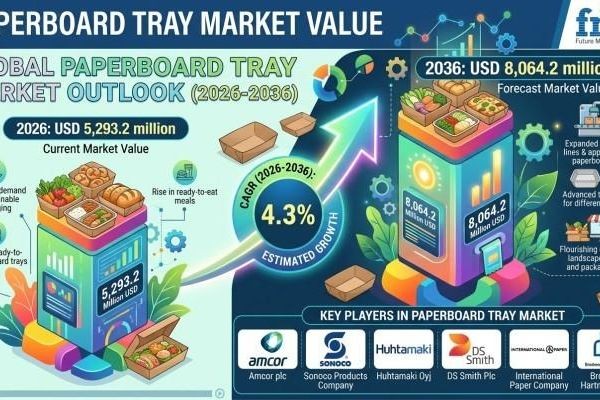
The global paperboard tray market is experiencing sustained growth as businesses across food, healthcare, consumer goods, and industrial sectors increasingly adopt sustainable, recyclable, and resource-efficient packaging solutions. Growing environmental awareness, stringent packaging regulations, and the need for cost-effective material alternatives are accelerating demand for paperboard trays worldwide.
The Paperboard Tray Market was valued at USD 5,075.0 million in 2025 and is projected to reach USD 5,293.2 million by 2026. Over the forecast period, the market is expected to expand to USD 8,064.2 million by 2036, registering a CAGR of 4.3%. As organizations prioritize sustainability goals, regulatory compliance, and operational efficiency, paperboard trays are emerging as a preferred packaging format across multiple industries.
Get detailed market forecasts, competitive benchmarking, and pricing trends:
https://www.futuremarketinsights.com/reports/sample/rep-gb-18058
Quick Stats: Paperboard Tray Market
- Market Size (2025): USD 5,075.0 Million
- Market Size (2026): USD 5,293.2 Million
- Market Size (2036): USD 8,064.2 Million
- CAGR (2026–2036): 4.3%
- Fastest Growing Markets: India (5.1%), China (4.9%), USA (4.0%)
- Leading Material Type: Paperboard (46.7% market share in 2026)
- Leading Product Type: Trays with Cavity (54.2% market share in 2026)
Sustainability Driving Packaging Transformation
Organizations worldwide are transitioning toward environmentally responsible packaging systems that align with evolving consumer preferences and regulatory frameworks. Procurement teams are increasingly emphasizing:
- Recyclable and biodegradable packaging materials
- Compliance with sustainability regulations
- Cost-effective alternatives to traditional packaging formats
- Reduced carbon footprint and packaging waste
- Supply chain resilience and sourcing efficiency
Paperboard trays are gaining widespread acceptance due to their recyclability, lightweight design, excellent printability, and compatibility with modern packaging and distribution systems.
Procurement Evolution and Growing Installed Base
Across industries, buyers are replacing conventional packaging materials with paperboard tray solutions to meet environmental and operational objectives. Key factors supporting adoption include:
- Increasingly stringent sustainability mandates
- Rising demand for recyclable packaging formats
- Growth in e-commerce and organized retail channels
- Need for scalable packaging solutions across supply chains
- Focus on reducing material and logistics costs
High-volume packaging applications are particularly benefiting from paperboard trays due to their efficiency in storage, transportation, and product handling.
Manufacturing Expansion and Supply Chain Development
Regional manufacturing capabilities continue to influence market competitiveness and growth.
India is witnessing strong demand driven by industrial expansion, export growth, and increasing investments in sustainable packaging production.
China remains a major manufacturing hub, supported by large-scale production capabilities, robust logistics infrastructure, and expanding domestic consumption.
North America and Europe are focusing on packaging innovation, circular economy initiatives, and regulatory compliance, encouraging broader adoption of recyclable paper-based packaging formats.
Notable industry developments include:
- Expansion of regional manufacturing facilities
- Supply chain optimization initiatives
- Investments in sustainable packaging technologies
- Enhanced distribution and logistics capabilities
- Strategic partnerships to strengthen procurement networks
Expanding Applications Across End-Use Industries
Paperboard trays are finding increasing applications across a wide range of industries, including:
- Food & Beverage: Sustainable packaging for fresh produce, ready-to-eat meals, and bakery products
- Pharmaceuticals: Secure and regulation-compliant packaging solutions
- Cosmetics & Personal Care: Premium and eco-friendly product presentation
- Electronics: Lightweight and protective packaging alternatives
- Logistics & Warehousing: Efficient product handling and transportation
The integration of automation and advanced packaging systems is further accelerating adoption across manufacturing and distribution operations.
Evolving Buyer Preferences
Key purchasers in the market include:
- Packaging manufacturers
- Food and beverage processors
- Pharmaceutical companies
- Retail and e-commerce organizations
- Logistics and warehousing operators
Buyers increasingly prioritize:
- Certified sustainable packaging materials
- Consistent product quality and compliance
- Reliable long-term supplier relationships
- Cost efficiency throughout the packaging lifecycle
- Secure and resilient supply chains
Operational Efficiency Beyond Procurement
Businesses are placing greater emphasis on total lifecycle value rather than upfront packaging costs alone. Important considerations include:
- Stable supply chain performance
- Reduced packaging waste
- Lower storage and transportation expenses
- Improved operational productivity
- Enhanced sustainability performance metrics
Manufacturers offering integrated production capabilities, innovation-driven product portfolios, and extensive distribution networks are strengthening their competitive positions.
Regulatory Compliance Accelerating Market Growth
Governments and regulatory authorities worldwide are implementing stricter environmental standards aimed at reducing packaging waste and encouraging circular economy practices. Key regulatory focus areas include:
- Increased use of recyclable packaging materials
- Waste reduction targets
- Sustainable sourcing requirements
- Extended producer responsibility initiatives
- Environmental compliance standards
These evolving regulations are expected to remain a significant catalyst for paperboard tray adoption throughout the forecast period.
Competitive Landscape
Leading industry participants including Amcor plc, Sonoco Products Company, Huhtamaki Oyj, DS Smith Plc, International Paper Company, and Brodrene Hartmann A/S continue to strengthen their market presence through product innovation, sustainability initiatives, manufacturing expansion, and strategic partnerships.
Competition is increasingly centered on:
- Sustainable packaging innovation
- Production capacity expansion
- Global distribution capabilities
- Regulatory compliance expertise
- Long-term customer partnerships
- Supply chain reliability and efficiency
As sustainability becomes a central business priority, the paperboard tray market is expected to witness continued investment, technological advancement, and strategic consolidation across the global packaging ecosystem.
About Future Market Insights (FMI)
Future Market Insights, Inc. (FMI) is an ESOMAR-certified, ISO 9001:2015 market research and consulting organization, trusted by Fortune 500 clients and global enterprises. With operations in the U.S., UK, India, and Dubai, FMI provides data-backed insights and strategic intelligence across 30+ industries and 1200 markets worldwide.






