
Market Overview and Growth Outlook
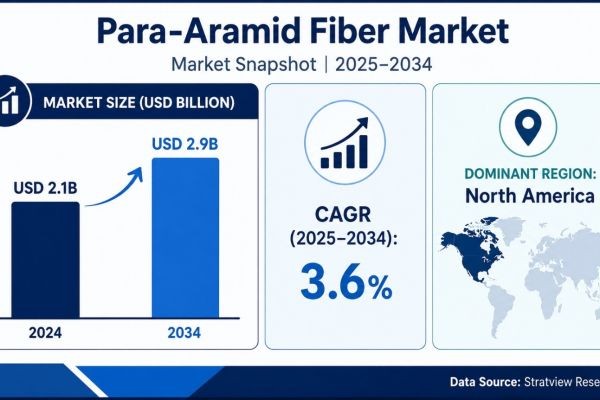
The Para-Aramid Fiber Market is projected to expand from USD 2.2 billion in 2025 to USD 2.9 billion in 2034. Annual demand was USD 2.1 billion in 2024, while the 2025 value represents 4.5% year-on-year growth. The forecast indicates continued demand expansion across protection, transportation, electronics, and industrial applications.
“The Para-Aramid Fiber Market is expected to grow at a CAGR of 3.6% during 2025–2034.”
The market’s competitive importance is also visible in its concentration indicators. The source states that the top ten countries represented more than 80% of the market in 2024, equivalent to over USD 1.6 billion. The top ten companies represented between 50% and 70%, corresponding to approximately USD 1.0 billion to USD 1.4 billion.
These indicators give the Para-Aramid Fiber Market share discussion a clear strategic context. Leading suppliers compete through factors including price, service offerings, and regional presence, while product development, manufacturing capacity, and collaboration influence positioning within the competitive landscape.
Request a free sample report:
https://www.stratviewresearch.com/Request-Sample/para-aramid-fiber-market#form
Market Segmentation Analysis
Application Type consists of Protection and Safety, Electrical Transmission, Tire Reinforcement, Rubber Reinforcement, Friction Materials, and Other Applications. Protection and Safety is likely to remain dominant because regulated industries require protection from heat, fire, chemicals, and projectiles.
End-Use Industry consists of Aerospace & Defense, Automotive, Electrical & Electronics, Oil & Gas, and Industrial. Automotive is expected to remain the largest segment. Electrical & Electronics is likely to expand fastest, supported by thermal-management needs and para-aramid fibers’ heat resistance.
Form Type consists of Filament, Pulp, Staple Fiber, and Other Forms. Filament is expected to maintain an unwavering share in value and volume. Mature production techniques and process refinement enable consistent supply and stable availability.
Regional Market Insights
North America is expected to retain the largest market share. Established aerospace & defense, automotive, and safety-equipment industries create consistent demand across several applications.
Asia-Pacific is projected to grow fastest. Industrial and economic development in China and India supports rising consumption in automotive, protective clothing, and electronics applications.
Emerging Trends Shaping the Para-Aramid Fiber Market
Capacity expansion may influence future supplier positioning. Kolon Industries announced plans to expand annual production at its Gumi plant from 7,500 tons to 15,000 tons, directly increasing its available para-aramid output.
Product development is also shaping competition. DuPont introduced Kevlar EXO and collaborated with Point Blank Enterprises on law-enforcement body armor. Separately, Kolon Industries and Hyosung TNC partnered to develop high-performance aramid tire cords for the global tire market.
Key Growth Drivers of the Market
- High strength-to-weight performance increases adoption where weight reduction and tensile strength are both required.
- Safety regulations drive protective clothing and equipment demand across several hazardous working environments.
- Tire replacement requirements support continued use in reinforcement and tire-cord applications.
- Automotive recovery and aircraft deliveries create demand within major transportation end-use industries.
- Military expenditure, wireless infrastructure revenue, and mining production diversify the market’s long-term growth base.
Competitive Landscape
Top Companies in the Market
DuPont de Nemours, Inc.
Teijin Limited
Kolon Industries, Inc.
Yantai Tayho Advanced Materials Co.
Hyosung Corporation
China National Bluestar (Group) Co., Ltd.
JSC Kamenskvolokno
Toray Industries, Inc.
Sinopec Yizheng Chemical Fibre Co., Ltd.
TAEKWANG
Conclusion and Strategic Outlook
The Para-Aramid Fiber Market is forecast to reach USD 2.9 billion by 2034 and grow at a CAGR of 3.6% during 2025–2034. Its competitive landscape combines significant concentration with multiple demand channels across protection, automotive, electronics, aerospace & defense, oil & gas, and industrial applications.
The market intelligence points to continued leadership for Protection and Safety, Automotive, Filament, and North America. Asia-Pacific’s faster growth, production expansion, protective-material development, and tire-cord collaborations will remain important elements of the industry’s evolving commercial structure.
FAQs – Para-Aramid Fiber Market
1. What is the market size forecast?
The Para-Aramid Fiber Market is projected to grow from USD 2.2 billion in 2025 to USD 2.9 billion in 2034. Annual demand was USD 2.1 billion in 2024.
2. What CAGR is expected during the forecast period?
The market is expected to record a CAGR of 3.6% during 2025–2034. Total cumulative sales opportunities during this period are estimated at USD 26.29 billion.
3. Which factors are increasing para-aramid fiber demand?
Demand is supported by lightweighting, high tensile strength, safety requirements, tire replacement, automotive production, aircraft deliveries, military expenditure, infrastructure revenue, and mining production.
4. Which region has the largest Para-Aramid Fiber Market share?
North America is expected to remain the largest market during the forecast period. Asia-Pacific is likely to register the fastest growth.
5. What does the competitive outlook indicate?
The top ten companies accounted for an estimated 50%–70% of the market in 2024. Competitive positioning is shaped by price, service offerings, regional presence, capacity development, and product initiatives.






