
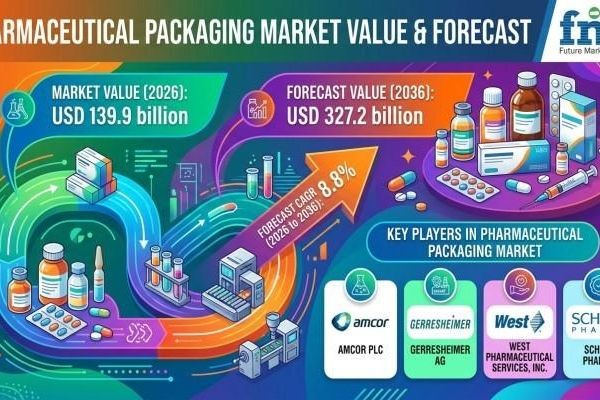
The global pharmaceutical packaging market is rapidly transforming from a conventional containment function into a strategic pillar of pharmaceutical manufacturing, regulatory compliance, and patient safety. Valued at USD 139.9 billion in 2026, the market is projected to reach USD 327.2 billion by 2036, reflecting strong long-term expansion as pharmaceutical companies prioritize sterility assurance, traceability, product integrity, and patient convenience across increasingly complex global healthcare supply chains.
The shift highlights how packaging is no longer viewed as a secondary operational component. Instead, it has become an essential element in preserving drug efficacy, supporting regulatory approvals, enabling serialization, and improving patient adherence in modern healthcare ecosystems.
Quick Market Highlights
- Market Value (2026): USD 139.9 Billion
- Projected Market Value (2036): USD 327.2 Billion
- Growth Outlook: Strong long-term expansion trajectory
- Leading Packaging Type: Primary Packaging (67.5% share)
- Dominant Material Segment: Plastics & Polymers (34.0% share)
- Top Drug Form: Solid Dosage Forms (45.2% share)
- Largest End User: Pharmaceutical Manufacturers (52.0% share)
Get detailed market forecasts, competitive benchmarking, and pricing trends:
https://www.futuremarketinsights.com/reports/sample/rep-gb-6150
Packaging Evolves into a Strategic Pharmaceutical Asset
The pharmaceutical packaging industry is entering a sustained growth phase as healthcare companies increase investments in validated, high-performance packaging systems capable of supporting sensitive formulations, biologics, specialty medicines, and global regulatory requirements.
Historically, pharmaceutical packaging was primarily designed to provide physical protection during transportation and storage. Today, its role has expanded significantly. Packaging now directly impacts drug stability, contamination prevention, regulatory compliance, and patient outcomes.
The rapid growth of injectable therapies, biologics, and specialty medicines is increasing demand for advanced primary packaging formats, including:
- Vials
- Ampoules
- Cartridges
- High-barrier blister packs
- Precision closures
- Sterile containment systems
At the same time, serialization mandates and anti-counterfeit regulations are reshaping packaging into a digitally connected compliance layer within pharmaceutical distribution networks.
Key Growth Drivers Accelerating Market Expansion
- Rising Demand for Biologics and Injectable Therapies
The expansion of biologics and injectable drug production is significantly increasing the need for highly sterile and chemically compatible packaging systems.
Growing demand is particularly visible across:
- Injectable drug packaging
- Blow-fill-seal technologies
- High-performance elastomeric closures
- Pharmaceutical glass packaging
- Temperature-controlled pharmaceutical containers
Because injectable medicines require direct-contact packaging with minimal contamination risk, manufacturers are prioritizing suppliers capable of delivering validated sterility assurance and long-term reliability.
- Serialization and Anti-Counterfeit Compliance
Governments worldwide continue strengthening pharmaceutical traceability requirements to combat counterfeit medicines and improve supply-chain visibility.
This trend is accelerating adoption of:
- Track-and-trace packaging systems
- Advanced labeling technologies
- Authentication-enabled pharmaceutical packs
- Compliance-ready secondary packaging solutions
Packaging providers offering serialization expertise, coding precision, and regulatory integration capabilities are increasingly securing long-term pharmaceutical partnerships.
- Growing Focus on Patient Adherence and Convenience
The rise of chronic disease management and home-based therapies is driving demand for packaging formats that improve usability and dosing accuracy.
Patient-centric solutions such as blister packs, unit-dose packaging, and easy-open dispensing systems help:
- Reduce medication errors
- Improve treatment adherence
- Enhance outpatient convenience
- Support self-administered therapies
As healthcare delivery becomes increasingly decentralized, pharmaceutical companies are investing more heavily in packaging systems that combine safety, usability, and sterility.
Market Challenges Limiting Faster Adoption
Extensive Validation Requirements
Packaging modifications in pharmaceutical applications require rigorous qualification procedures, including:
- Stability testing
- Material compatibility assessments
- Regulatory documentation
- Validation and approval processes
Even minor material changes can delay commercialization timelines and increase compliance costs.
Material Compatibility Constraints
Sensitive drug formulations demand strict protection against:
- Moisture exposure
- Oxygen permeation
- Chemical interaction
- Temperature fluctuation
These technical challenges often slow the transition toward alternative materials and sustainable packaging innovations.
Emerging Opportunities Shaping the Next Growth Cycle
The next decade is expected to create substantial commercial opportunities across advanced pharmaceutical packaging technologies, including:
- Smart and connected packaging systems
- Active packaging for moisture-sensitive drugs
- Sterile-ready injectable packaging formats
- Patient-centric dispensing technologies
- PCR-based and sustainable pharmaceutical packaging
- Serialization-integrated packaging ecosystems
- High-barrier films and advanced closure systems
The strongest opportunities are emerging in solutions that improve compliance, minimize product failure risk, and support global pharmaceutical distribution.
Segment Analysis: High-Value Areas Driving Revenue Growth
By Packaging Type
Primary packaging is expected to dominate the market with a 67.5% share in 2026 due to its direct interaction with pharmaceutical products and critical role in sterility maintenance.
High-demand formats include:
- Bottles
- Blister packs
- Vials
- Cartridges
- Closures
- Ampoules
These packaging systems remain commercially critical because failure directly impacts product integrity and shelf life.
By Material Type
Plastics and polymers are projected to account for 34.0% of total market share in 2026, supported by widespread use in bottles, flexible packaging, closures, and medical-device integrated systems.
Glass packaging continues to maintain strong positioning in injectable therapies where sterility, chemical stability, and barrier performance remain essential.
By Drug Form
Solid dosage forms are expected to contribute 45.2% of global demand in 2026.
Large-scale manufacturing of tablets and capsules continues to sustain strong demand for blister packaging and pharmaceutical container systems worldwide.
By End User
Pharmaceutical manufacturers are projected to account for 52.0% of total market demand in 2026.
Packaging selection is increasingly integrated into early-stage drug development, strengthening long-term collaboration between pharmaceutical companies and packaging suppliers.
Regional Outlook: Global Manufacturing Hubs Drive Expansion
China
China remains one of the fastest-growing pharmaceutical packaging markets, supported by large-scale export manufacturing, advanced serialization adoption, and increasing demand for premium containment systems.
Forecast CAGR: 10.8%
India
India continues to expand rapidly due to strong generic drug manufacturing and pharmaceutical exports.
High demand remains concentrated in:
- Bottles
- Blister packaging
- Compliant primary packaging systems
- Hospital pharmaceutical channels
Forecast CAGR: 9.4%
United States
The U.S. market maintains strong value positioning due to:
- Biologics expansion
- Injectable drug demand
- Advanced traceability requirements
- Premium specialty-drug packaging
Forecast CAGR: 8.3%
Germany
Germany continues benefiting from precision pharmaceutical manufacturing and specialty-drug production.
Strong demand persists across:
- Premium injectable packaging
- High-quality glass systems
- Precision labeling technologies
- Export-grade containment systems
Forecast CAGR: 7.9%
United Kingdom
The United Kingdom is witnessing stable growth supported by:
- Serialization initiatives
- Clinical trial packaging demand
- Homecare pharmaceutical formats
- Patient-friendly dispensing solutions
Forecast CAGR: 7.6%
South Korea
South Korea’s growth is being driven by advanced injectable manufacturing, export-oriented pharmaceutical production, and increasing use of high-barrier materials.
Forecast CAGR: 7.4%
Japan
Japan continues to maintain stable long-term demand through mature healthcare infrastructure, premium quality expectations, and strict production standards.
Forecast CAGR: 7.2%
Competitive Landscape: Reliability Becomes the Key Differentiator
Leading companies such as Amcor plc, Gerresheimer AG, SCHOTT Pharma, West Pharmaceutical Services, Inc., AptarGroup, Inc., and Becton, Dickinson and Company are increasingly competing on:
- Sterility assurance capabilities
- Validation and compliance expertise
- Global production infrastructure
- Material compatibility performance
- Serialization readiness
- Drug-delivery integration
- Supply continuity and technical support
For pharmaceutical buyers, purchasing decisions are becoming increasingly reliability-driven rather than solely cost-focused.
Strategic Implications for Stakeholders
For Pharmaceutical Manufacturers
Packaging is evolving into a strategic extension of product quality and regulatory compliance.
Supplier selection increasingly depends on:
- Validation expertise
- Documentation support
- Consistent reliability
- Stable lead times
- Global compliance capabilities
For Packaging Suppliers
Competitive advantage is shifting toward integrated packaging ecosystems that combine:
- Sterility performance
- Smart packaging functionality
- Serialization compatibility
- Active barrier technologies
- Patient-centric design
For Investors
Long-term investment opportunities remain strong across:
- Primary pharmaceutical packaging
- High-barrier material technologies
- Smart packaging systems
- Injectable containment solutions
- Sustainable pharmaceutical packaging
Future Outlook: Toward Integrated Pharmaceutical Delivery Systems
Over the next decade, pharmaceutical packaging is expected to evolve into a fully integrated component of pharmaceutical manufacturing and patient-delivery ecosystems.
Key trends shaping future market development include:
- Wider adoption of connected and smart packaging
- Expansion of active moisture-control technologies
- Increased use of sterile-ready injectable formats
- Growth of sustainable pharmaceutical packaging materials
- Greater serialization and digital traceability integration
- Stronger convergence between drug delivery systems and packaging technologies
As these innovations accelerate, pharmaceutical packaging will continue transitioning from a protective solution into a strategic value driver across the global healthcare industry.
About Future Market Insights (FMI)
Future Market Insights, Inc. (FMI) is an ESOMAR-certified, ISO 9001:2015 market research and consulting organization, trusted by Fortune 500 clients and global enterprises. With operations in the U.S., UK, India, and Dubai, FMI provides data-backed insights and strategic intelligence across 30+ industries and 1200 markets worldwide.






