
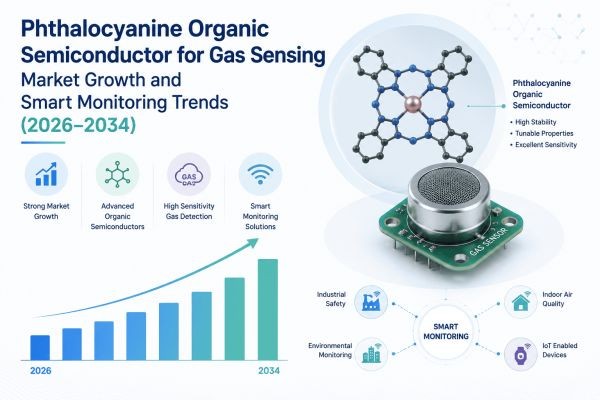
Phthalocyanine organic semiconductors are highly conjugated macrocyclic compounds that exhibit exceptional semiconducting properties when deposited as thin films. These materials function effectively in gas sensing applications by altering their electrical conductivity or optical characteristics upon exposure to target gases, making them valuable for chemiresistive and field-effect transistor-based sensors. Their planar structure and tunable central metal ions allow selective interactions with various analytes such as nitrogen dioxide, ammonia, volatile organic compounds, and other environmental pollutants.
Get Full Report Here: https://www.24chemicalresearch.com/reports/308373/phthalocyanine-organic-semiconductor-for-gas-sensing-market
Market Dynamics:
The market's trajectory is shaped by a complex interplay of powerful growth drivers, significant restraints that are being actively addressed, and vast, untapped opportunities.
Powerful Market Drivers Propelling Expansion
- Room-Temperature Operation and Low Power Consumption: Phthalocyanine organic semiconductors enable gas sensors to function effectively at ambient temperatures, eliminating the high energy demands typical of metal oxide sensors that often require heating to 100-300°C. This capability supports deployment in battery-powered and portable devices, driving adoption in wearable and IoT-based monitoring systems. The integration of these materials into flexible electronics and smart city infrastructure represents a major growth vector as industries seek energy-efficient solutions for continuous environmental monitoring.
- High Sensitivity to Key Gases at Low Concentrations: These materials exhibit strong responses to redox-active gases such as NO₂, NH₃, and ozone, often achieving detection limits in the ppb range through charge transfer interactions with the central metal atom and π-system. Their tunable selectivity via metal substitution further enhances performance in environmental and industrial monitoring applications. Organic heterojunction architectures based on phthalocyanines have demonstrated enhanced transducer performance for chemosensing of oxidizing and reducing gases.
- Hybrid Material Innovations and Flexible Electronics: Advances in combining phthalocyanines with carbon nanomaterials, covalent organic frameworks, and flexible substrates open pathways for next-generation devices in smart cities, industrial safety, and consumer electronics. Integration with 2D materials like graphene improves conductivity and surface area, accelerating response times while maintaining stability, which positions phthalocyanine-based sensors as competitive alternatives in expanding air quality and safety markets.
Download FREE Sample Report: https://www.24chemicalresearch.com/download-sample/308373/phthalocyanine-organic-semiconductor-for-gas-sensing-market
Significant Market Restraints Challenging Adoption
Despite its promise, the market faces hurdles that must be overcome to achieve universal adoption.
- Stability and Humidity Interference: Phthalocyanine films can experience performance variations in high-humidity environments due to water molecule interactions that affect charge carrier mobility. Although certain metal variants and structures show improved robustness, this remains a key consideration for outdoor and industrial deployments where consistent performance under varying conditions is essential.
- Integration and Device Fabrication Issues: Incorporating phthalocyanine layers into practical sensor platforms often faces hurdles related to interface quality, long-term drift, and compatibility with standard electronics manufacturing processes. This slows the transition from laboratory prototypes to widespread commercial use in cost-sensitive applications.
Critical Market Challenges Requiring Innovation
The transition from laboratory success to industrial-scale manufacturing presents its own set of challenges. Producing uniform thin films at commercial volumes remains complex, with difficulties in maintaining consistent morphology and electrical properties across large substrates. Furthermore, selectivity in complex gas mixtures requires advanced material engineering or array-based approaches to achieve reliable differentiation in real-world conditions. These technical hurdles necessitate continued R&D investments, creating a high barrier to entry for smaller players.
Additionally, competition from established metal oxide semiconductor sensors persists due to their maturity, perceived costs at scale, and established supply chains. Scalable manufacturing and device integration continue to demand focused innovation to support broader market penetration.
Vast Market Opportunities on the Horizon
- Expansion in Environmental and Health Monitoring: Growing regulatory emphasis on air quality, alongside rising interest in breath analysis for non-invasive diagnostics and wearable personal exposure trackers, creates strong demand for sensitive, low-power phthalocyanine sensors capable of real-time, selective detection. These solutions support smart city initiatives and industrial safety protocols where continuous monitoring is critical.
- Hybrid Material Innovations: Integration of phthalocyanines with carbon-based nanomaterials such as graphene and carbon nanotubes enhances sensor performance. These hybrids leverage high surface area and superior charge transport alongside the selective gas adsorption properties of phthalocyanines, enabling faster response times and improved stability for demanding applications.
- Strategic Partnerships as a Catalyst: The market is witnessing increased collaboration between material producers, research institutions, and end-users to co-develop application-specific solutions. These alliances help bridge technical gaps, accelerate commercialization, and address challenges in selectivity and long-term stability through shared expertise and resources.
In-Depth Segment Analysis: Where is the Growth Concentrated?
By Type:
The market is segmented into Metal Phthalocyanines (MPc), Metal-Free Phthalocyanines, Substituted Phthalocyanine Derivatives, and Bis-Phthalocyanines. Metal Phthalocyanines (MPc) currently lead the market due to their exceptional tunability through variation of the central metal atom, which significantly influences electronic properties, charge carrier density, and interaction with target gas molecules. This versatility enables precise optimization for selective detection of both oxidizing and reducing gases at room temperature.
By Application:
Application segments include Environmental Monitoring, Industrial Safety and Leak Detection, Medical and Breath Analysis, and others. The Environmental Monitoring segment currently dominates, driven by the critical need for continuous, sensitive detection of harmful gases such as nitrogen oxides, ammonia, and volatile organic compounds in ambient air. However, the Industrial Safety and Medical segments are expected to exhibit strong growth rates in the coming years.
By End-User Industry:
The end-user landscape includes Industrial Sector, Healthcare and Medical Facilities, Environmental Agencies and Research Institutions. The Industrial Sector accounts for the major share, leveraging phthalocyanine properties for real-time detection of hazardous gases in manufacturing and processing facilities. The Environmental and Healthcare sectors are rapidly emerging as key growth end-users, reflecting trends in air quality monitoring and non-invasive diagnostics.
Download FREE Sample Report: https://www.24chemicalresearch.com/download-sample/308373/phthalocyanine-organic-semiconductor-for-gas-sensing-market
Competitive Landscape:
The global Phthalocyanine Organic Semiconductor for Gas Sensing market is characterized by intense competition and rapid innovation. Leading players focus on material purity, molecular engineering through central metal substitution and peripheral functionalization, and compatibility with various deposition techniques to achieve high sensitivity and room-temperature operation. The market structure remains fragmented with significant contributions from specialty chemical producers.
List of Key Phthalocyanine Organic Semiconductor for Gas Sensing Companies Profiled:
- BASF SE (Germany)
- Merck KGaA (Sigma-Aldrich) (Germany)
- TCI Chemicals (Japan)
- DuPont de Nemours, Inc. (United States)
- Sumitomo Chemical Co., Ltd. (Japan)
- Heubach GmbH (Germany)
- DIC Corporation (Japan)
- Sun Chemical Corporation (United States)
The competitive strategy is overwhelmingly focused on R&D to enhance product quality and reduce costs, alongside forming strategic partnerships with end-user companies and research institutions to co-develop and validate new applications, thereby securing future demand.
Regional Analysis: A Global Footprint with Distinct Leaders
- Asia-Pacific: Leads the Phthalocyanine Organic Semiconductor for Gas Sensing market due to its robust electronics manufacturing ecosystem and strong emphasis on environmental monitoring technologies. The region benefits from extensive research activities in organic semiconductors and rapid industrialization driving demand for reliable, low-power gas sensing solutions.
- North America & Europe: Together form a powerful bloc with significant market presence through advanced research infrastructure and stringent environmental regulations. North America maintains strength via innovation in high-performance materials while Europe excels in sustainable sensing technologies and organic electronics development.
- South America, Middle East & Africa: These regions represent emerging opportunities driven by growing awareness of environmental monitoring needs, industrial safety requirements, and resource sector applications. While currently smaller in scale, they present significant long-term growth potential as adoption of advanced sensing technologies increases.
Get Full Report Here: https://www.24chemicalresearch.com/reports/308373/phthalocyanine-organic-semiconductor-for-gas-sensing-market
Download FREE Sample Report: https://www.24chemicalresearch.com/download-sample/308373/phthalocyanine-organic-semiconductor-for-gas-sensing-market
About 24chemicalresearch
Founded in 2015, 24chemicalresearch has rapidly established itself as a leader in chemical market intelligence, serving clients including over 30 Fortune 500 companies. We provide data-driven insights through rigorous research methodologies, addressing key industry factors such as government policy, emerging technologies, and competitive landscapes.
- Plant-level capacity tracking
- Real-time price monitoring
- Techno-economic feasibility studies
International: +1(332) 2424 294 | Asia: +91 9169162030
Website: https://www.24chemicalresearch.com/






