
Introduction
As industries continue to adopt advanced manufacturing technologies, plaster 3D printing has established itself as a practical solution for creating detailed, affordable, and visually appealing models. While materials such as metals, resins, and engineering plastics are commonly used for functional parts, plaster excels in applications where appearance, speed, and cost efficiency are the primary requirements.
Today, gypsum-based additive manufacturing supports a wide range of industries, including architecture, healthcare, education, product design, and cultural preservation. Ongoing innovations in printing systems and material development are helping expand its capabilities even further.
What Is Plaster 3D Printing?
Plaster 3D printing is an additive manufacturing process that uses gypsum-based materials to build objects layer by layer. Depending on the technology, the material may be applied as a powder, paste, or composite blend and then bonded or cured to create the final structure.
Unlike conventional manufacturing methods that require molds, cutting tools, or extensive machining, plaster printing enables the direct production of complex geometries from digital designs.
Why Plaster Remains Important
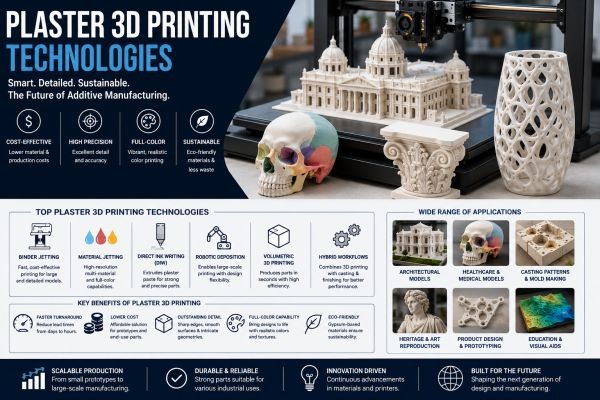
Plaster continues to be widely used because it offers several advantages that make it highly effective for visual and presentation-focused projects.
Major benefits include:
• Affordable material costs
• High-resolution detail reproduction
• Full-color printing capabilities
• Fast production cycles
• Scalability for larger models
• Environmentally friendly gypsum-based materials
These advantages allow organizations to produce impressive prototypes and models without the high costs often associated with alternative materials.
Top Technologies Used in Plaster Printing
1. Binder Jetting
Binder jetting remains the most popular plaster printing technology. A liquid binder is selectively deposited onto gypsum powder to create detailed parts layer by layer.
Applications:
Architectural models, educational displays, prototypes, and presentation pieces.
2. Material Jetting
Material jetting offers exceptional precision by depositing tiny droplets of material with high accuracy.
Applications:
Medical models, luxury design concepts, and premium prototypes.
3. Direct Ink Writing
Direct Ink Writing uses extruded plaster paste to build objects with greater design freedom.
Applications:
Experimental architecture, research projects, and artistic installations.
4. Robotic Plaster Deposition
Robotic systems automate plaster application for large-scale manufacturing and construction projects.
Applications:
Building components, façade systems, and large architectural features.
5. Composite Powder Technologies
Advanced gypsum composites are being developed to improve performance and expand potential applications.
Applications:
Research, product development, and advanced prototyping.
6. Hybrid Manufacturing Workflows
Hybrid workflows combine additive manufacturing with traditional plaster casting techniques.
Applications:
Decorative products, molds, and custom manufacturing.
7. SLA Mold Production
SLA printers are commonly used to create molds that are later filled with plaster.
Applications:
Dental models, jewelry production, and precision casting.
8. Sand and Plaster Composite Systems
These technologies combine gypsum binders with sand to create industrial molds.
Applications:
Foundries, aerospace manufacturing, and metal casting.
9. Desktop Gypsum Printers
Compact printers have made plaster printing accessible to smaller organizations and educational institutions.
Applications:
Student projects, concept development, and small-scale prototyping.
10. Sustainable Bio-Based Materials
New gypsum formulations incorporate renewable materials to support sustainable manufacturing.
Applications:
Eco-friendly design projects and green construction research.
Key Industry Applications
Architecture
Plaster printing enables architects to create highly detailed scale models that help clients visualize projects before construction begins.
Healthcare
Medical professionals use anatomical replicas for training, education, and surgical preparation.
Manufacturing
Plaster molds and prototypes accelerate product development while reducing production costs.
Education
Educational institutions use printed models to improve engagement and practical learning.
Heritage Restoration
Museums and conservation specialists recreate damaged artifacts and historical structures with remarkable accuracy.
Advantages Over Traditional Manufacturing
Compared with conventional fabrication methods, plaster printing offers:
• Faster production
• Lower tooling costs
• Greater design flexibility
• Improved visualization
• Reduced waste
These advantages help organizations save time and improve project outcomes.
Limitations of Plaster Printing
Although plaster offers many benefits, it also has limitations:
• Brittle material properties
• Low mechanical strength
• Moisture sensitivity
• Need for post-processing and sealing
Because of these characteristics, plaster is best suited for visual applications rather than structural or load-bearing parts.
Future Trends
Several innovations are expected to drive the future of plaster additive manufacturing:
• AI-assisted design optimization
• Robotic construction technologies
• Sustainable gypsum composites
• Automated production systems
• Smart manufacturing integration
These developments will improve productivity, reduce waste, and create new opportunities for businesses.
Conclusion
Plaster 3D printing remains one of the most cost-effective and visually capable additive manufacturing solutions available today. Its ability to produce detailed, scalable, and presentation-ready models makes it invaluable across architecture, healthcare, education, manufacturing, and cultural preservation. As technology continues to evolve, gypsum-based additive manufacturing will remain a powerful tool for organizations seeking efficient and high-quality production solutions.
Plaster 3D Printing Explained: Technologies, Benefits, Applications, and Future Trends
没有找到评论






